Week 11 - Final project
Automotive Door Trim Panel Development
Introduction:
The aim of this project is to develop a sub-assembly of plastic automotive trim components with all possible attachment strategies and manufacturing considerations. This process is made easy by adopting the surface modeling technique and implementing the design requirements. Moreover, this work also consists of the feasibility study, practical way of communication, and drawing reading skills to set the product at a higher quality of benchmark.
Input:
The Class A surfaces and the master sections are the inputs over here. The Class A Surface helps us to get an idea of the profile in a three-dimensional workspace. The master sections are the sketches of attachment features and thickness. Apart from this the purchased part models and the material templets are the additional sources that are to be used as input over this project to satisfy the attachment requirements.
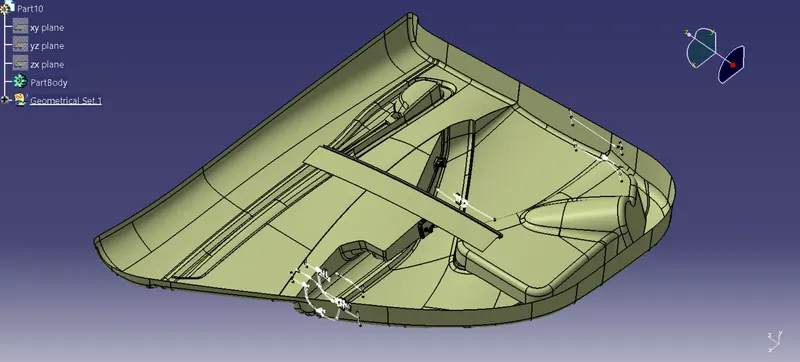
Class A Surface and Master Sections
Understanding Class A and Master Section:
The Master sections are done at the sectional references of Class A, where the feature attachment drawings at the intersections help us to differentiate different parts in Class A along with its thickness and attachment strategies. Further, Class A features intersection with sharp corners without any smooth profile is understood to be a separate part, since the basic rule of Class A is to follow the continuity as a smooth profile without any sharp corners.
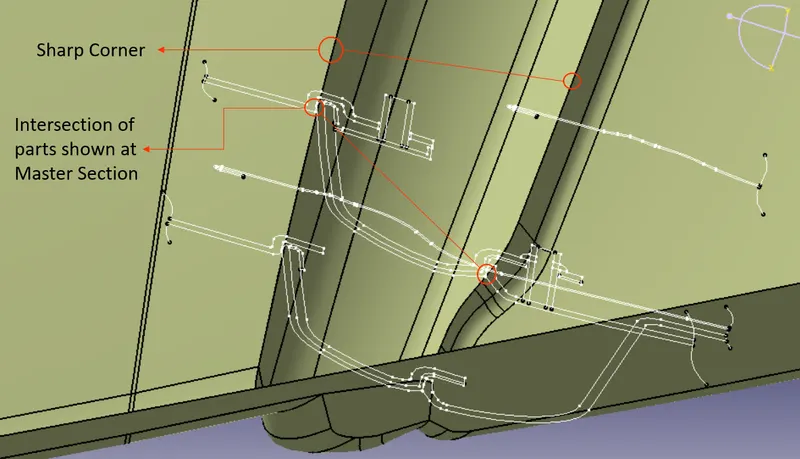
Intersection Zones and Sharp Corners of Class A
Pre Processing Draft Analysis:
The Surface draft analysis and the curvature continuity are considered to be the pre-processing draft analysis. It's the design inspection before proceeding into the actual work. It is necessary to have a closed surface without any gaps in between them, for achieving this the surfaces are checked for their closed boundary profile. If there are any gaps on the profile which is leading to surface imperfection, the A surface is imposed for surface improvement. Similarly, when considering the surface draft analysis the profile of the A surfaces are checked for the draft requirements and if the A surface requirements are not satisfied, further discussion is done to transform the work which is functionally achievable. The uneven surface extensions are eliminated at this stage.
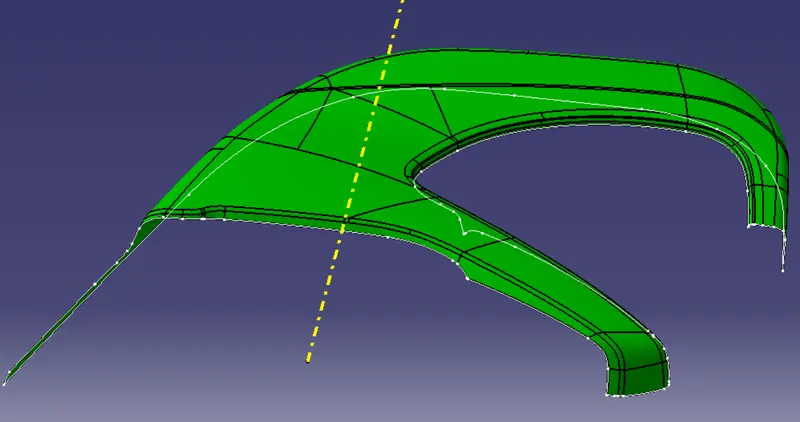
Pre Processing Surface Continuity and Draft Analysis of Lower Substrate
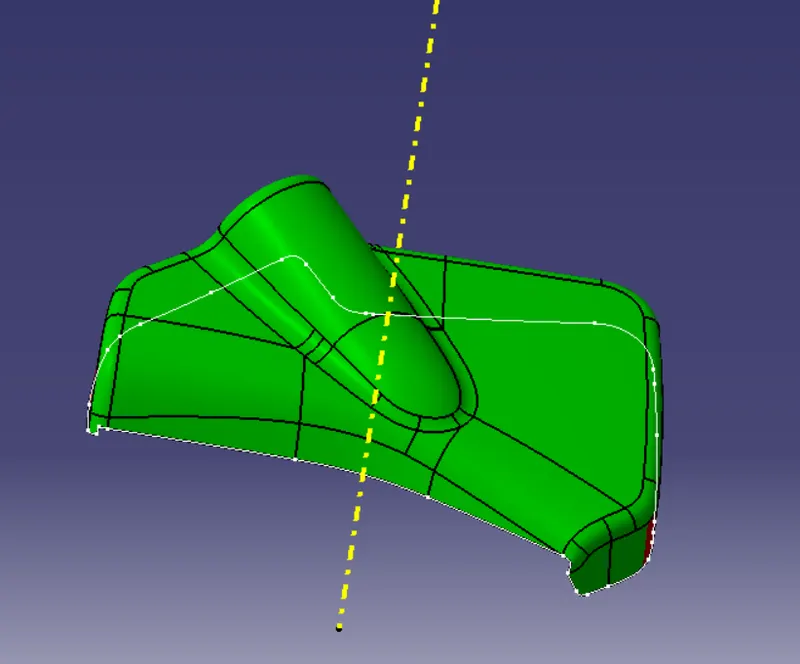
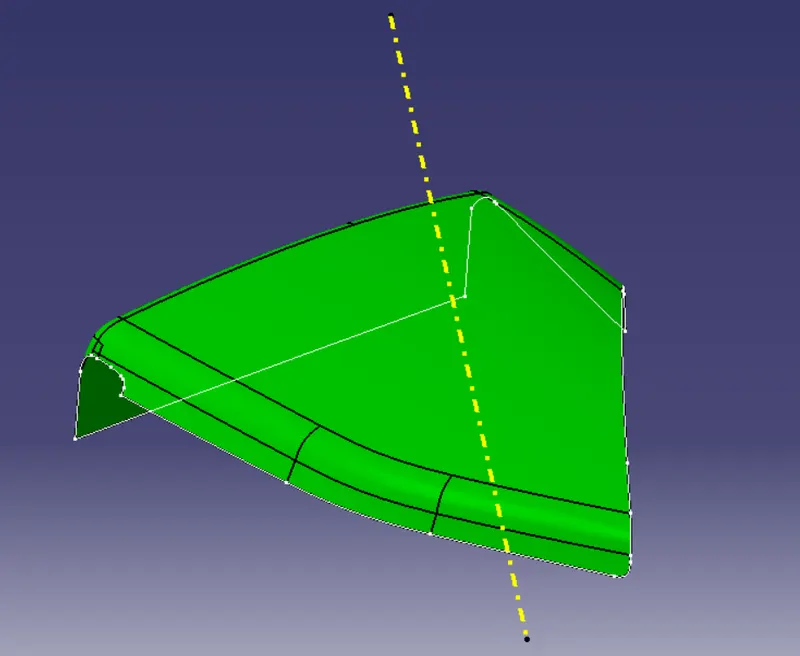
Pre Processing Surface Continuity and Draft Analysis of Lower and Upper Map Pocket
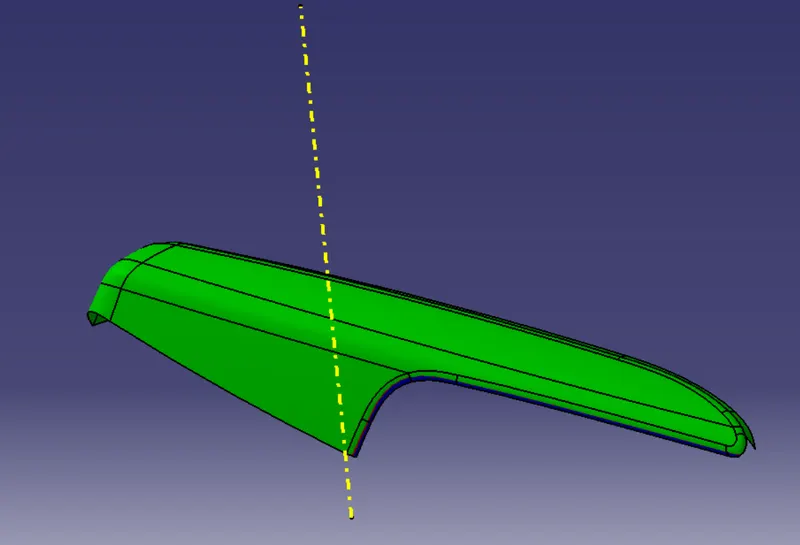
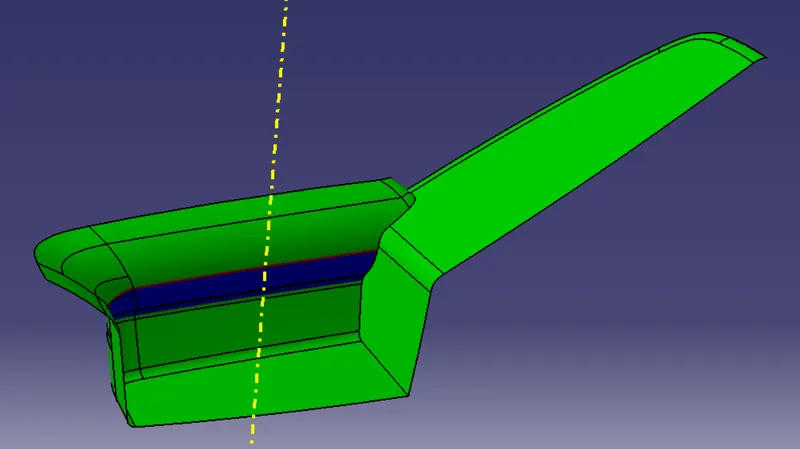
Pre Processing Draft Analysis of Door Arm Rest Segments Along Main Tooling Axises
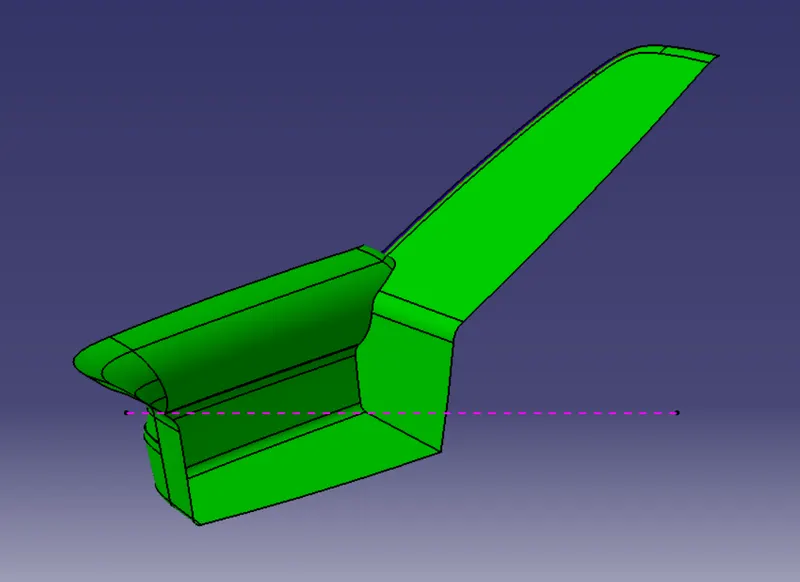
Pre Processing Draft Analysis of Door Arm Rest Segment Along Slider Tooling Axises
Formation of Surfaces:
The basic need for approaching the automotive trim works through surface modeling is its profile and geometry. It is always hard or not easy to create and change the part modeling features as per our requirements. But when it comes to surface modeling it is designed in the bottom to top approaches, like starting from one dimensional to three-dimensional features. The parts to be modeled are created by two different surface modeling techniques, they are closed volume surface and thickness features. In each and every surface modeling technique, three different surfaces are taken into consideration, they are Class A, B, and C surfaces with the necessary draft requirements. Here the Class A surface is considered to be the input, B and C surfaces are the output or work in progress features. All the surfaces are worked in individual segments with proper geometrical sets so that the need for changes in design and feasible design readability could be achieved easily. The individual surface segments are joined together leading to the formation of part bodies.
Boolean Network:
All the individual surfaces which are converted into new part bodies are combined together under boolean operation, where the features in the boolean operation help to obtain a boolean network that is flexible for changes as per the requirements. It is important to know that these boolean operations can be worked individually without disturbing the entire system which is hard to achieve by traditional part modeling technique.
Engineering Features:
Flanges, Screw boss, Ribs, Dog house, Heat Stakes, 4-way locators, 2-way locators are some of the main engineering features used in the automotive plastic trim design. The design approach is the same as the bottom to the top working method as discussed before (i.e) Surface inspection and formation, followed by boolean operation, etc. All the design requirements of each and every engineering feature must be satisfied at every stage, to achieve a design with all manufacturing feasibilities.
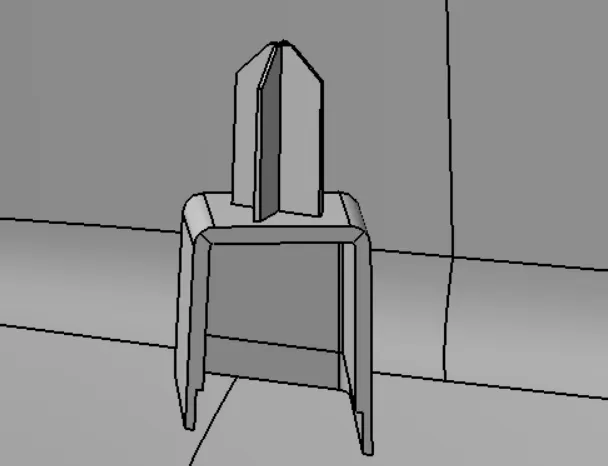
Dog House With 4-Way Locator
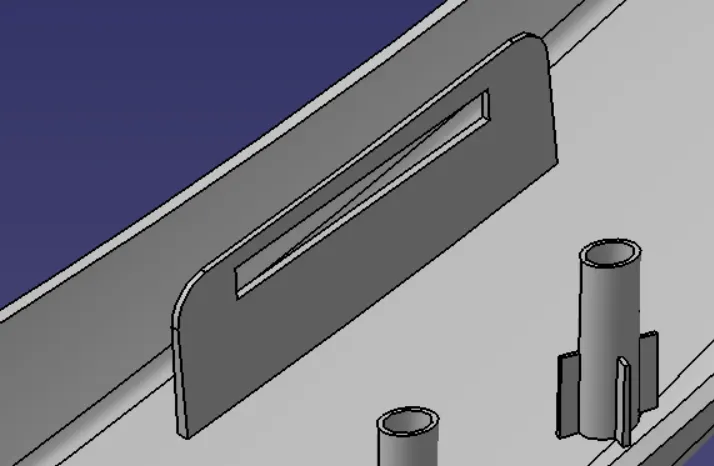
Rib for Snap Fit
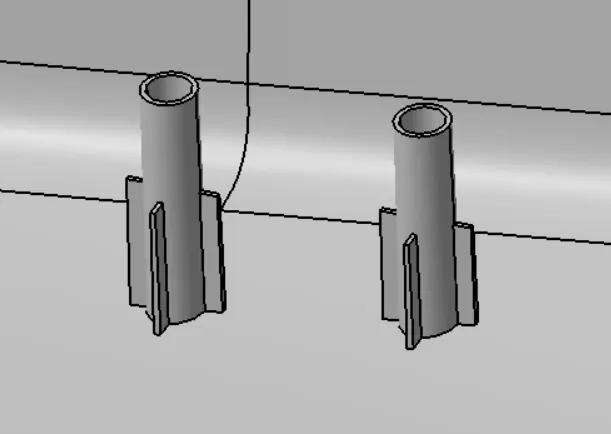
Heat Stakes
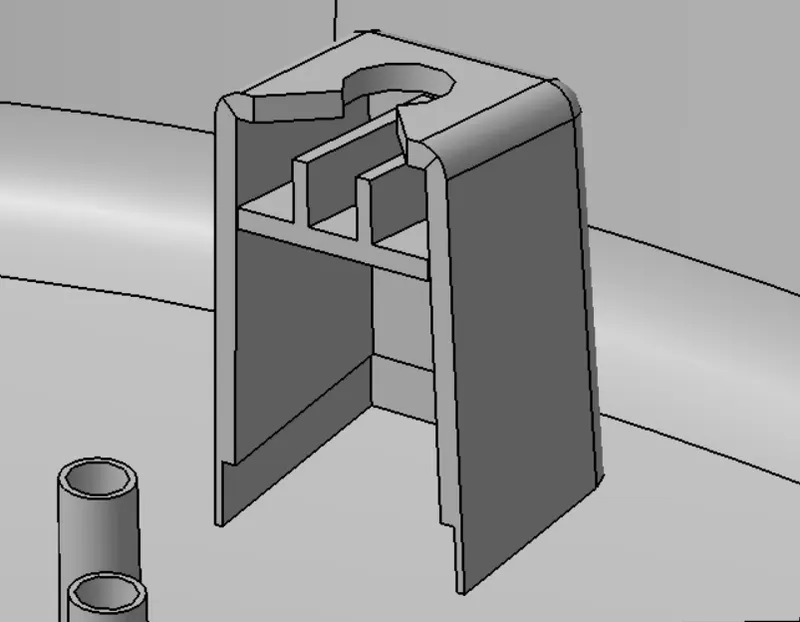
Dog House for Push Pin
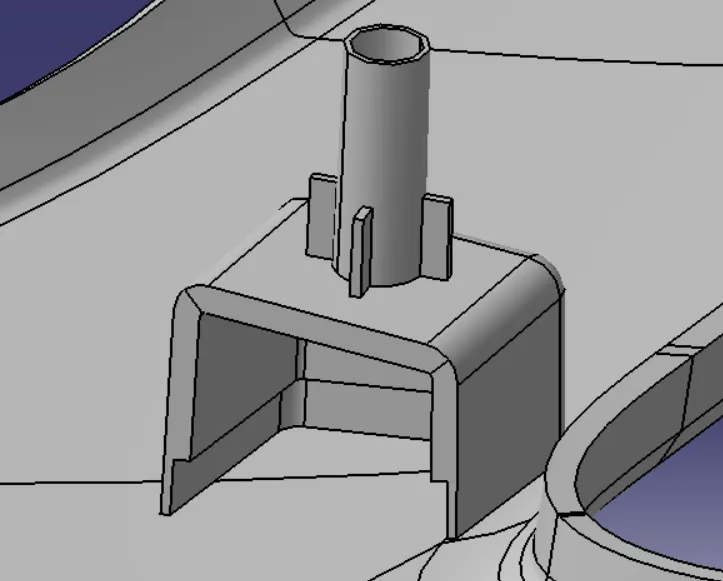
Heat Stake With Dog House
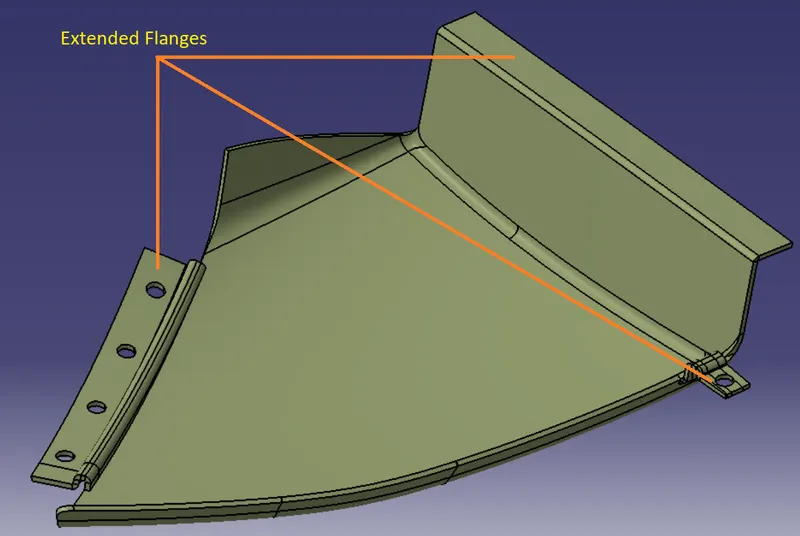
Flanges
Design Requirements for assembly and Boolean Network:
- All the individual engineering features with all design requirements for manufacturing feasibilities must be satisfied before proceeding into design requirements for assembly and boolean networks.
- The gap between the highest elevation of the part and the flange must be between 10 to 15 mm.
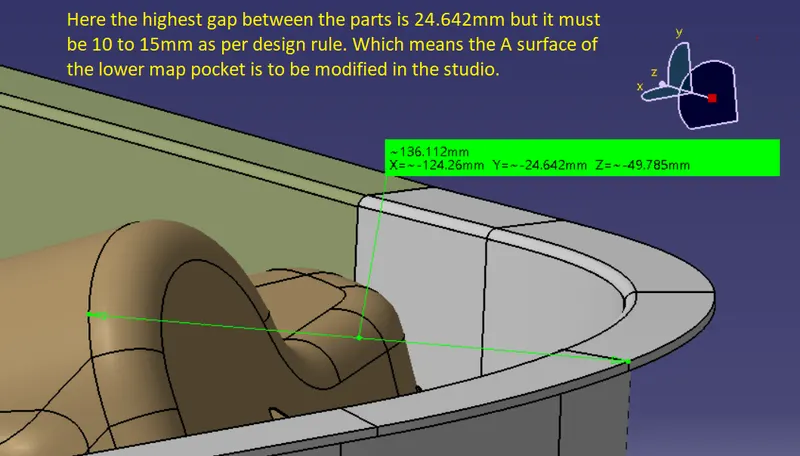
The gap between the highest elevation of the part and the flange
- The attachment strategy must obey the 3 point principle.
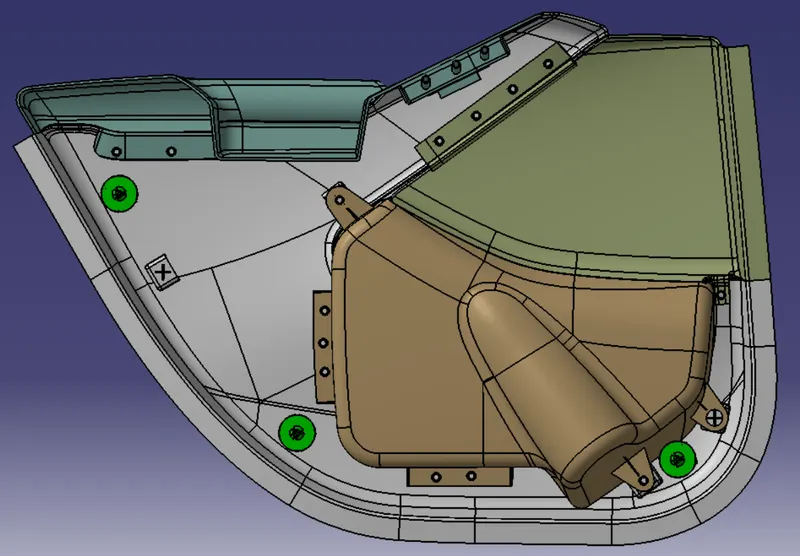
The Attachment Positions of the Push Pins
- Maximum the cover area (surface area) of locators, the better will be the assembling processes.
- The heights should be more or less even for all the pushpin dog houses, for making a better attachment with the BIW system. The height of the pushpin dog house must be between 35 to 55 mm. For example, if the first push pin dog house is 40.37 mm in height, then the second and the third dog house can be 40.15mm and 40.66mm (approx) respectively. Further, these attachment positions of co-ordinates are changed with respect to the development requirements.
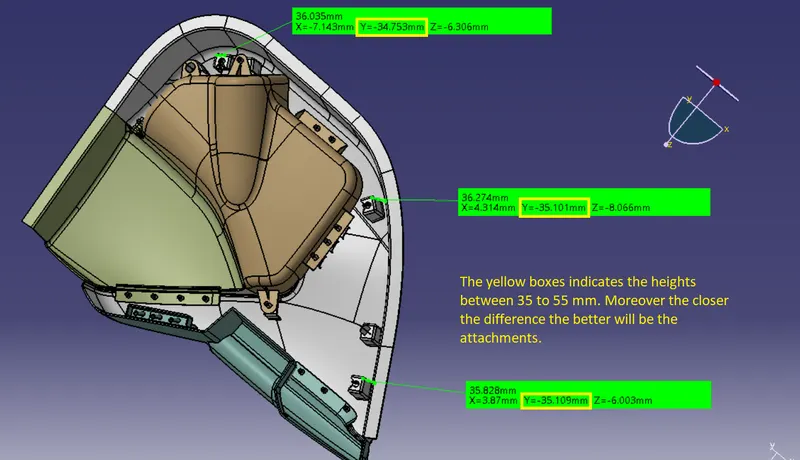
Height Difference of the Push Pin Dog Houses
- The gap between the dog house and the wall connecting the flange must be a minimum of 25 mm apart.
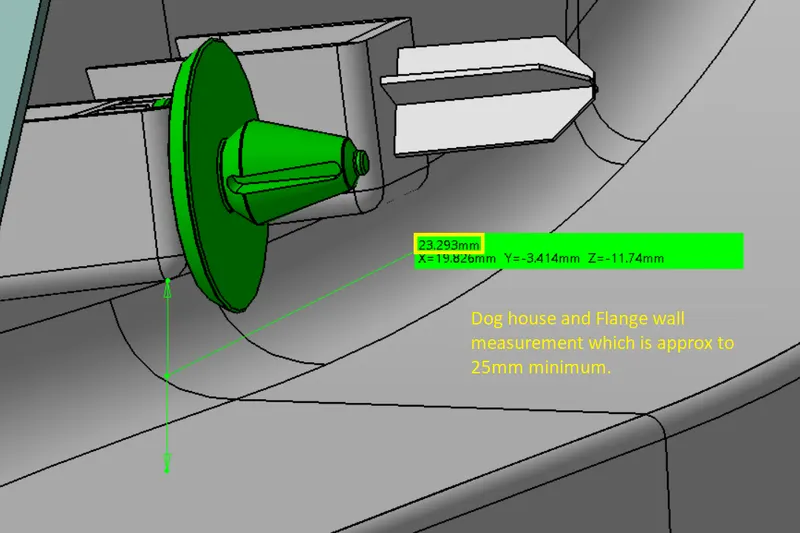
Dog House and Flange Gap Measurement
- The travel space for the slider movement must be a minimum of 3 times more than that of the width of the dog house. The slider movement almost resembles a flight take-off on a runway. On most occasions, the sliders are used for making small parts.
- All the heat stakes exceeding the height of 7mm should have a dog house and the extension of the height from the part which is to be connected must be a minimum of 12mm. So that a better fix could be attained while joining the mating parts together.
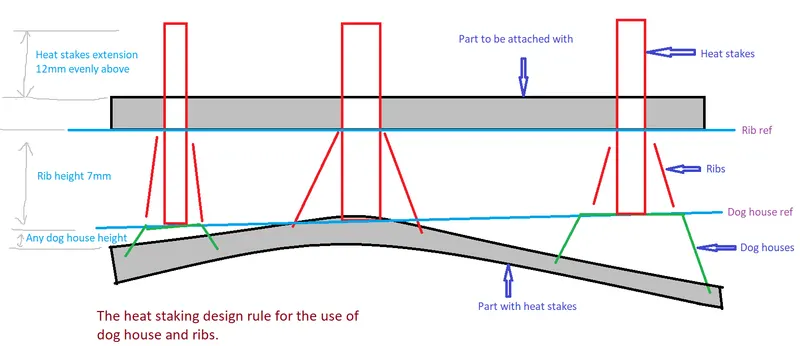
Heat Staking Design Rule for the use of dog house and ribs
- If a dog house is to be made is by lifters instead of sliders then the dog houses must be designed based on parallel curve reference. Since the space constraints and manufacturing cost is less for lifters than that of sliders, so lifters are mostly preferred when compared to sliders.
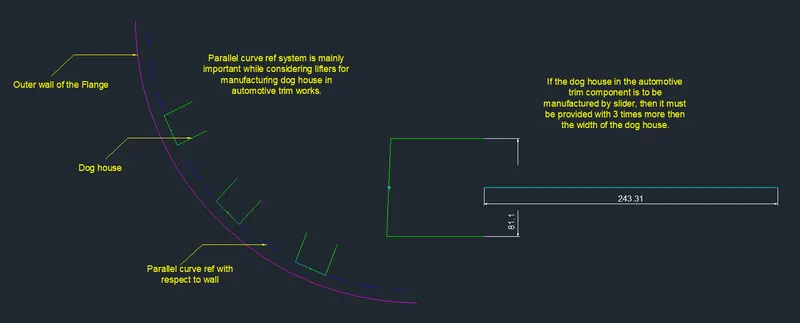
Manufacturing Considerations for Sliders and Lifters
Design of Snap-Fit (Self Research):
- The unclipping angle can be 15 to 35 and the clipping angle can be 15 to 40 as per the requirement of industries, based on past industrial researches.
- The clipping length can be 6 to 8x then the clip width.
- The clip width must follow the rib root diameter parameters, in order to avoid the sink marks on A surfaces.
- The snaping position with the mating part must be at the mid of unclipping angled surface.
- The hole clearance must be provided good enough for creating assembly and disassembly with the mating part.
- The fatigue and force parameters are the major sources required for creating a snap-fit as per the functional requirements.
- The functional design parameters must be followed properly to achieve a quality product.
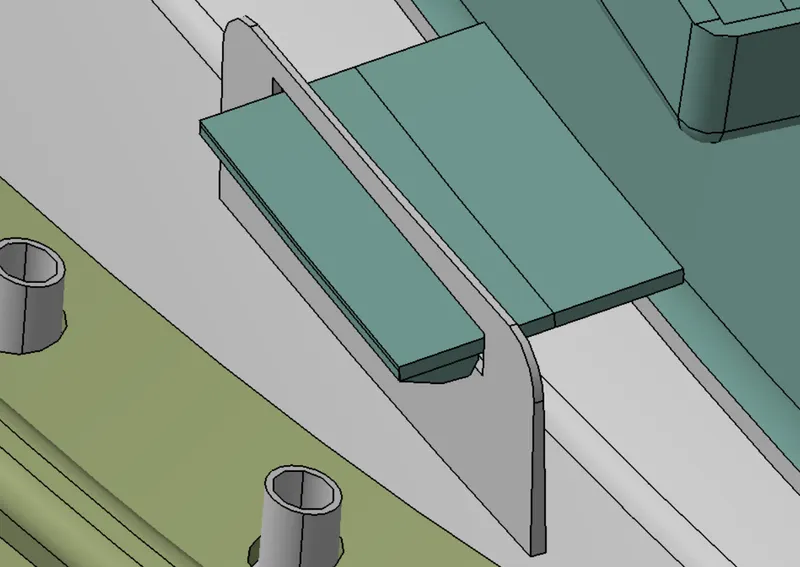
Snap Fit of Lower Substrate with a segment of Door Arm Rest
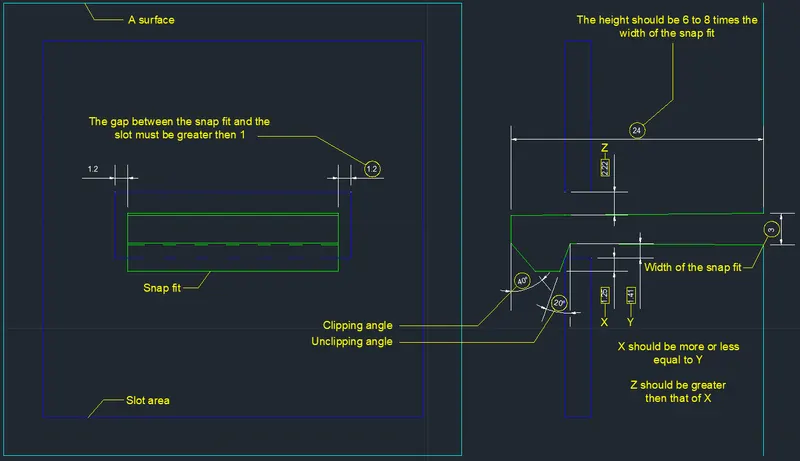
Functional Design and Dimensional Parameters of Snap Fit
Material Selection:
- Polyethylene terephthalate (PET) is used for Map Pockets mainly for two reasons. The map pocket acts as a bottle holder and further on undergoing cleaning processes the properties of the material should not be affected.
Since the material requires chemical resistance, water repellent, strength, and dimensional stability properties, PET material is selected over here. - Dynamic fatigue resistance, hardness, rigidity, impact strength, ability to withstand the forced damping vibrations, and crack resistance at stress concentration zone are the important properties for Push Pin Attachments and so Polyamide (Nylon) material is used.
- The Door Arm-Rest is an automotive trim component that comes in direct contact with the human and hence high rigidity, good insulating properties, good weldability, and aesthetic properties are important over here. Acrylonitrile Butadiene Styrene (ABS) seems to be a perfect match for attaining all these interior trim properties which come in direct contact with the human interface.
- The Lower Substrate is a part that holds about 3 parts together and hence it must have multiple properties which cannot be attained by a single material and hence a blended material of ABS/PC blend is used over here. High heat resistance, dimensional stability, high rigidity, good insulating properties, good weldability, aesthetic properties, resistance to weak acids, hydrocarbons, and oils are the properties that are attained on this material as a combined benefit of blending.
Master Section:
All the part models are done as per the master section and class A which is provided as the input. The complete door panel development is done with respect to manufacturing, assembly, design, material, analytical and aesthetic requirements. The heat stakes and the attachment features must be created with external link references having the tooling axis as its major reference element. Moreover, the designer must be updated based on the manufacturing, analytical and aesthetical design requirements. For example, modeling as per the lifter motion is to be preferred than slider motion to avoid excess cost. All the heat stakes are designed with 12mm extension on flanges to obtain better fixation and comfort the analytical abilities of the product, with respect to its requirements. The design rule should be followed properly to avoid sink marks on the class A surface. The attachments designed must be efficient enough to make easy assembly processes in production for attaining its benefits in the form of profit.
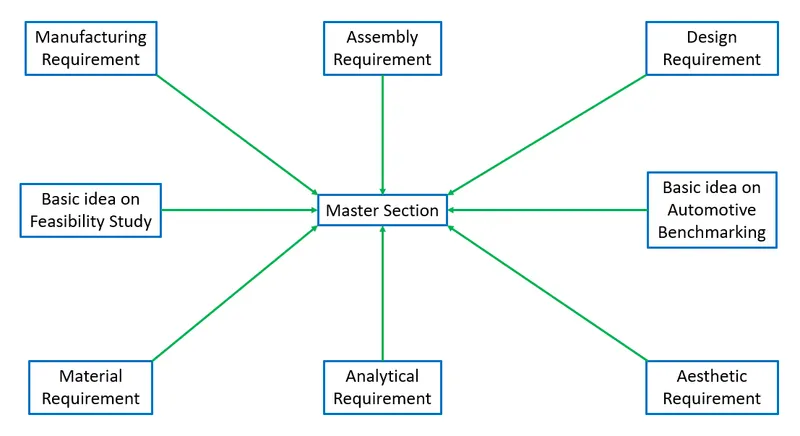
General requirements for creating master section
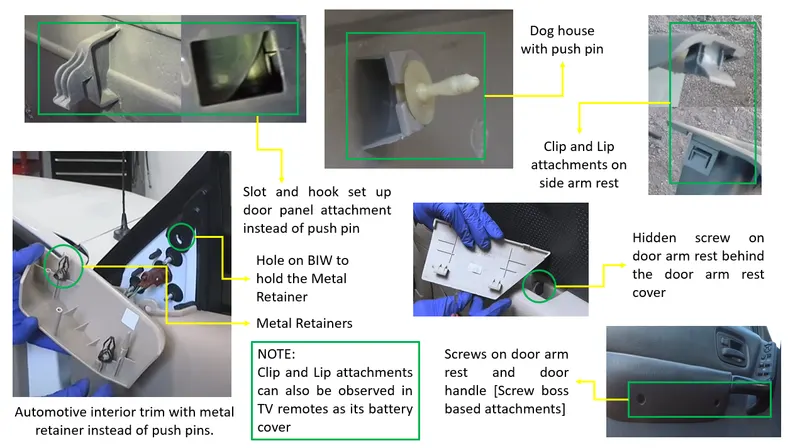
Different types of automotive trim attachments without heat stakings
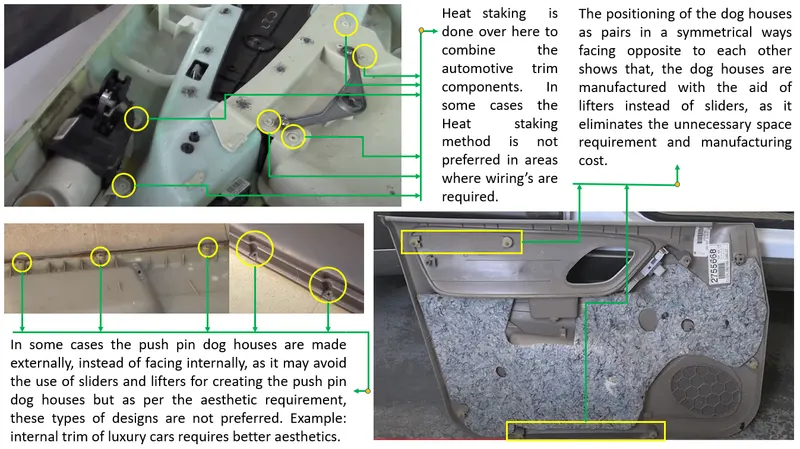
Information on automotive trim work manufacturing and assembly
Modeling Feasibility:
The design which is created must be flexible for modeling and redesign. Feature isolation, parallel curve point network, paste special with external references, parent and a child tree network, Feature dependent axis orientations, translation, and rotation with respect to positioned sketch concept are some of the tooling terms which play a major role in modeling feasibility.
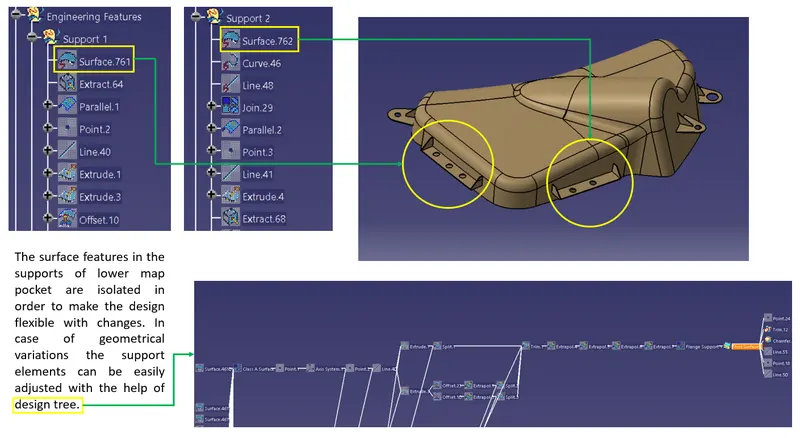
Modelling Feasibility
Assembly Feasibility:
The assembly is done as per the automotive axis requirement, that's why the positioning sketch-based modeling system is used in automotive plastic trim works. If a subassembly is to be adjusted, they are done as per the co-ordinate reference of that automotive system, so that the changes could be adopted easily.
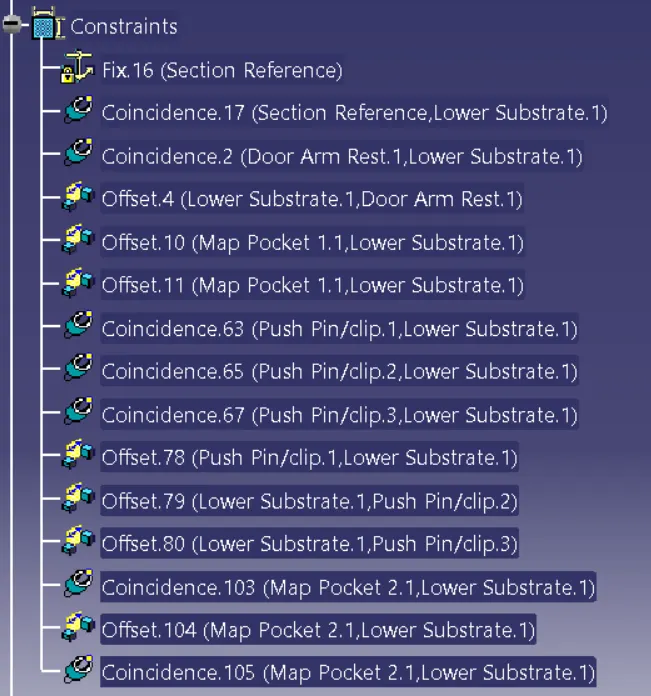
Assembly Constraints
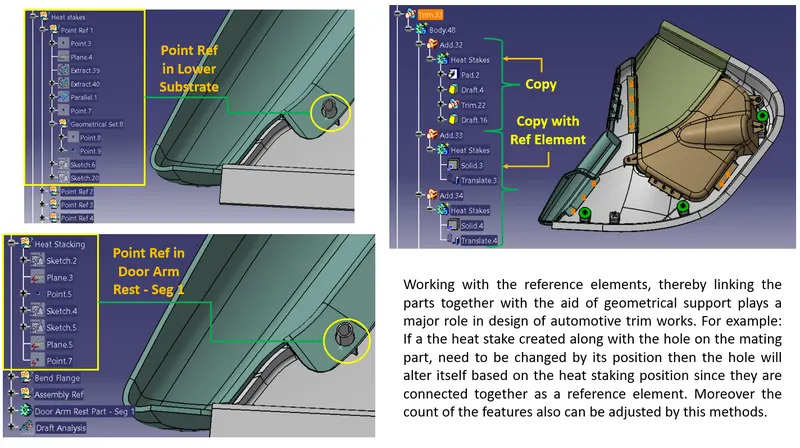
Assembly Feasibilities
Post-Processing Draft Analysis:
The post-processing draft analysis is conducted in two steps, before completing the flange and attachment requirements or after completing the complete functional model and assembly requirements. Since the work should not mess up the things in future, the part draft analysis is conducted in two steps. But, the final draft which is obtained after finishing the complete part model with flange and attachment features is shown as output, since those are the technical requirements that are needed for future proceedings. The draft of 3 degrees must be given for A and C surfaces, a maximum draft of 1.5 degrees can be given for the external wall of the dog houses, and a minimum draft of 0.5 degrees should be given for all the attachment features.
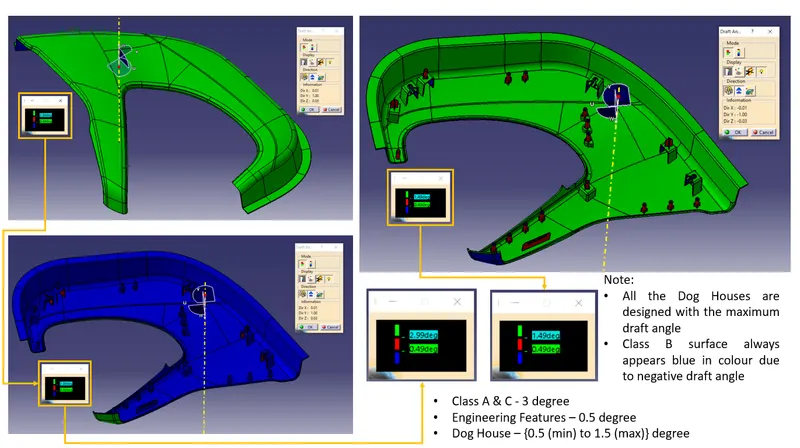
Lower Substrate part Draft Analysis
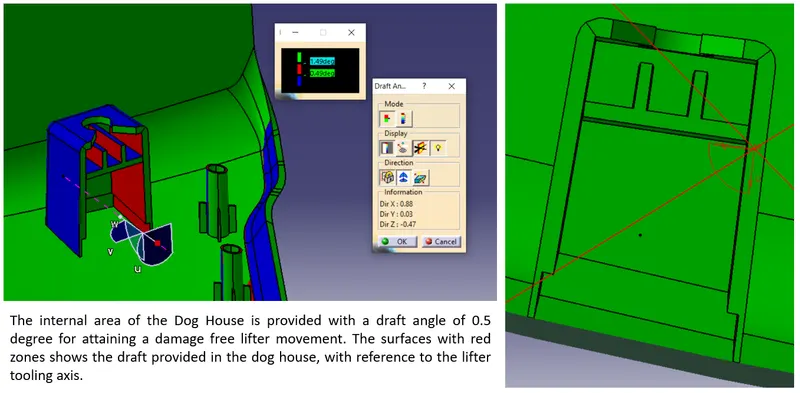
Dog House Internal features Draft Analysis
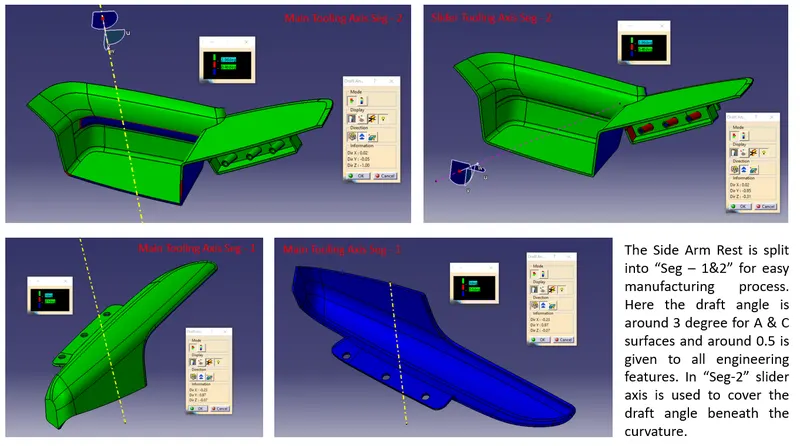
Side Arm Rest part Draft Analysis
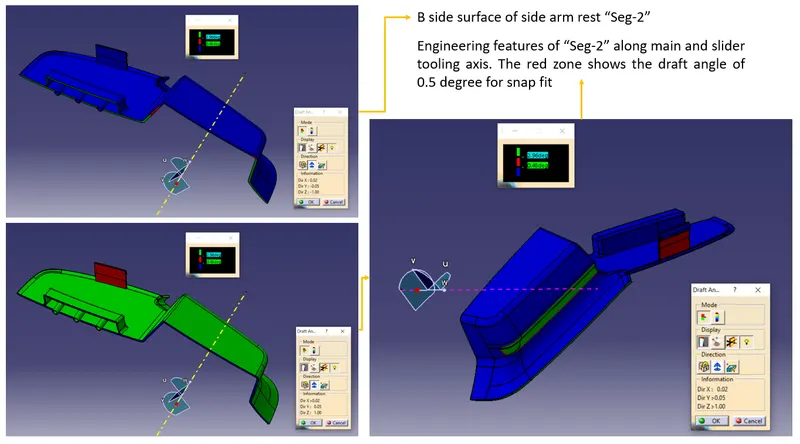
Side Arm Rest feature Draft Analysis
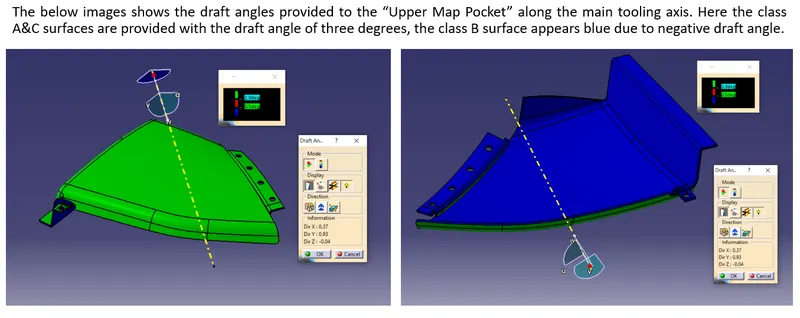
Upper Map Pocket part Draft Analysis
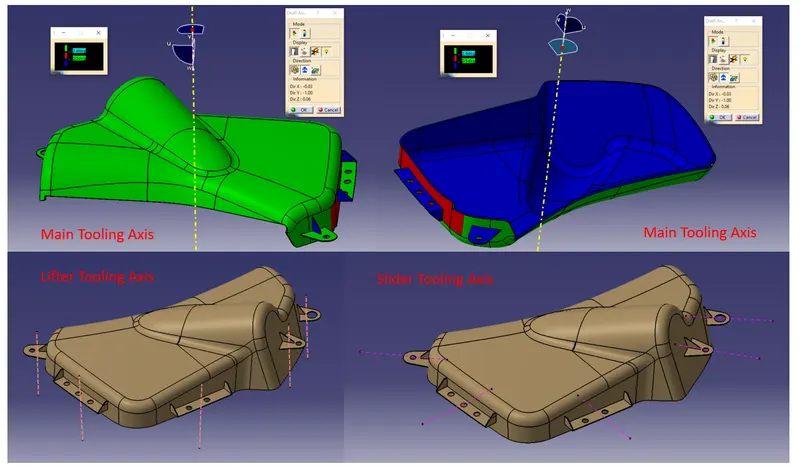
Lower Map Pocket part Draft Analysis
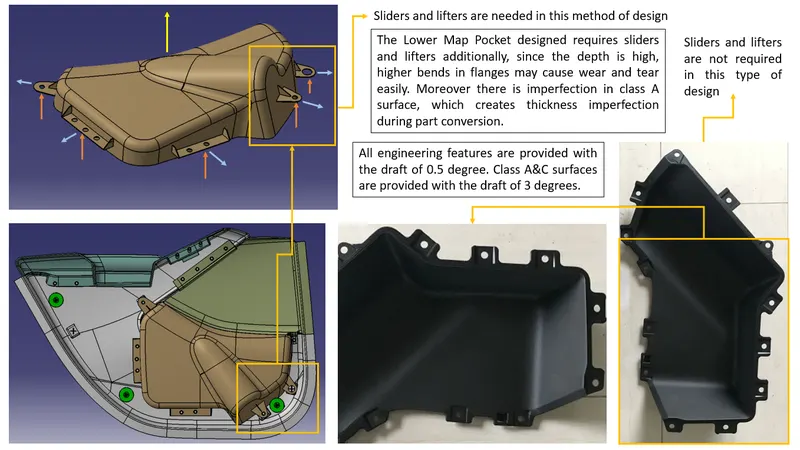
Lower Map Pocket information for future Developments
Assembly and Publication:
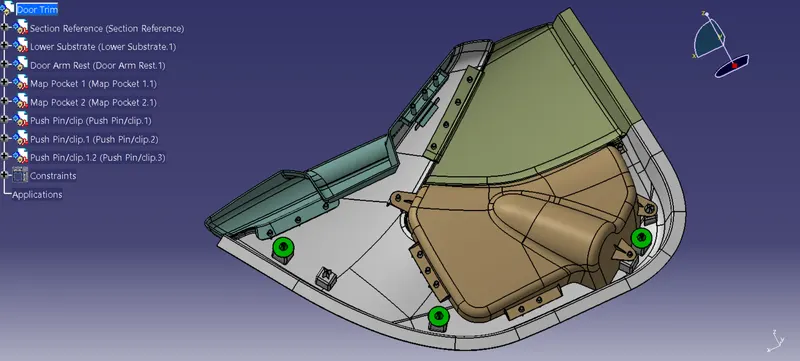
The Assembly must be done with the automotive coordinate system as its origin. The parts must be assembled as per the parents and child relationship so that the subsequent parts with external links as their reference will get changed automatically while making changes. All the results are published to visualize the results easily.
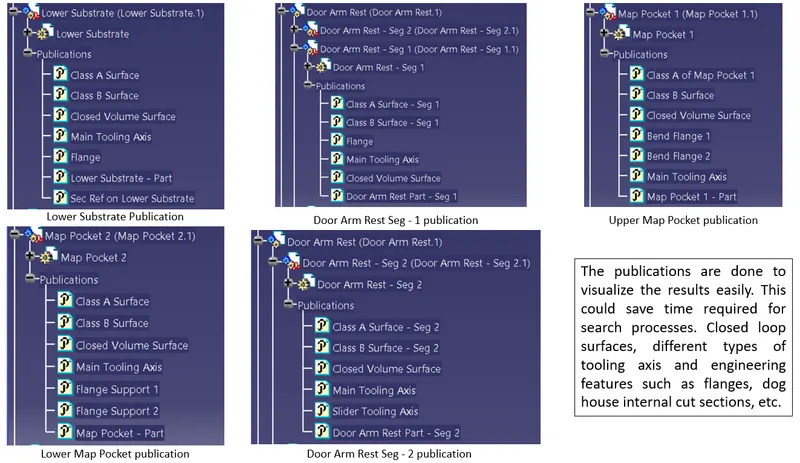
Publications
Door Trim Final Project - Assembly