Week-11 Challenge: Braking
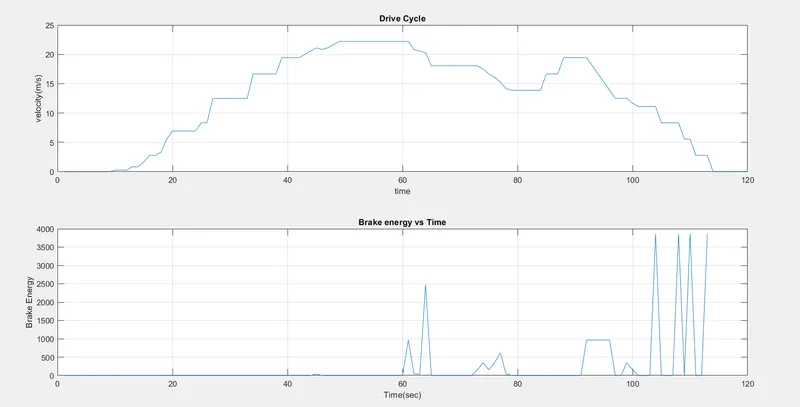
Q1)For a defined driving cycle, calculate the energy required for braking.
solution:
Here we made a drive cycle in excel sheet and using this drive cycle we built a mathlab script for the calculation of energy during the braking.
As we know the Energy during the deceleration is = (1/2)*mass*(Vf- Vin)^2
Script

Solution:
Electric motor can’t develop braking torque at high speed similar to starting because peak acceleration and peak deceleration not equal because during deceleration time motor acts as generator, during this case the Electric machine is working in field weakening region, so torque is compramised. So we cannot get all the power back during regenerative braking.
Brakes Coordination
In electric vehicle, Brake distribution between regenerative braking and mechanical braking should be done very efficiently because there is a limitation in charging current for battery during regenerative braking. Battery can only accept a typical charging current. So if power requirement during regenerative braking is greater than the battery capacity we must also apply mechanical braking. So for the distribution these braking there is brake control strategies
There are mainly two brake control strategies
- Series
- Parallel
In series control strategy we apply brake one after the another. That is only one brake at a time either regenerative or mechanical braking.
In parallel braking we apply both regenerative and mechanical braking at a time.
A practical control strategy is developed by nissan leaf. This strategy is EDIB( electric driven intelligent braking). it is a combination electric and mechanical braking. Based on control signal obtained from the brake pedal we distribute the braking. That is if vehicle speed very high we apply both the mechanical and electrical braking and if the vehicle speed is low we go for regenerative braking.
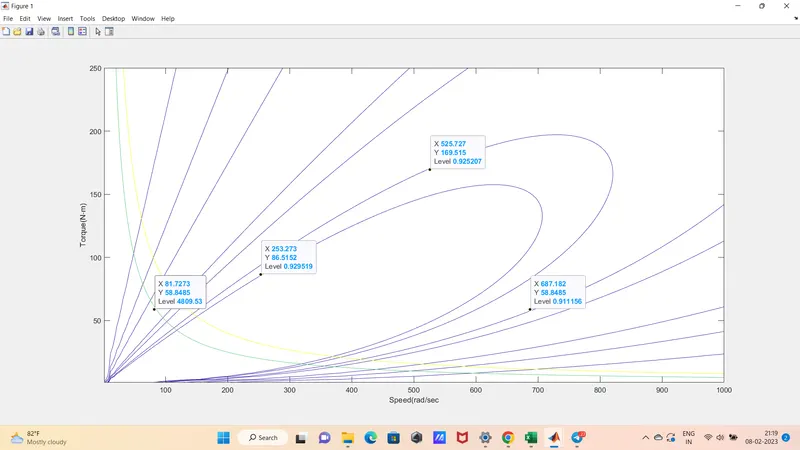
Q3)Make a MATLAB program which plots contour of given motor speed, torque and efficiency values. Attach the code as a .m file attach a screenshot of all the plots.
Solution:
We know inputpower = outputpower + Losses
The losses are Copper loss, wintage loss, iron loss, and constant loss
efficiency = Output power/input power
The matlab script for contour of give motor speed , torque and efficiency is given below
matlab script