Week-11 Challenge: Braking
1.For a defined driving cycle, calculate the energy required for braking.
Ans :As we know that the energy can never be created or niether destroyed with the today's developmentwe have been able to utilize the energy which is been wasted at the time of braking. The kinetic energy which assist the vehicle to move also gets dissipated while the braking is done. Though it depends on multiple parameters on how efficient the braking would be it can be depended upon.
Number of Brake Pistons
Duration and Degree of Brake Pedal been Pressed
Road Condition
Temprature
Brake Pad and Disc Condition
Mass of the Vehicle
Still with a basic operation where the vehicle in motion and the brakes are applied the same efficiency could be calculated by the given equations.
BE=12mv2">BE=1/2mv^2
BE = braking energy
m = mass of the vehicle
v = velocity
In this manner the same calculation is been carried out for calculating the brake efficiency that would be required at the peak point. It bieng a drive cycle with speed variations the braking power required would vary but still the highest braking power required is mentioned below-
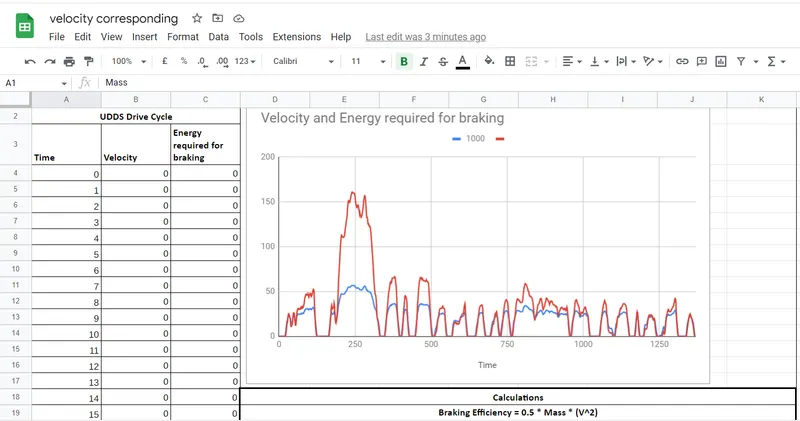
BRAKING ENERGY REQUIRED = 160 KJ FORR THE SPEED OF 57 KMPH.
IMPORT DATA TO MATLAB :
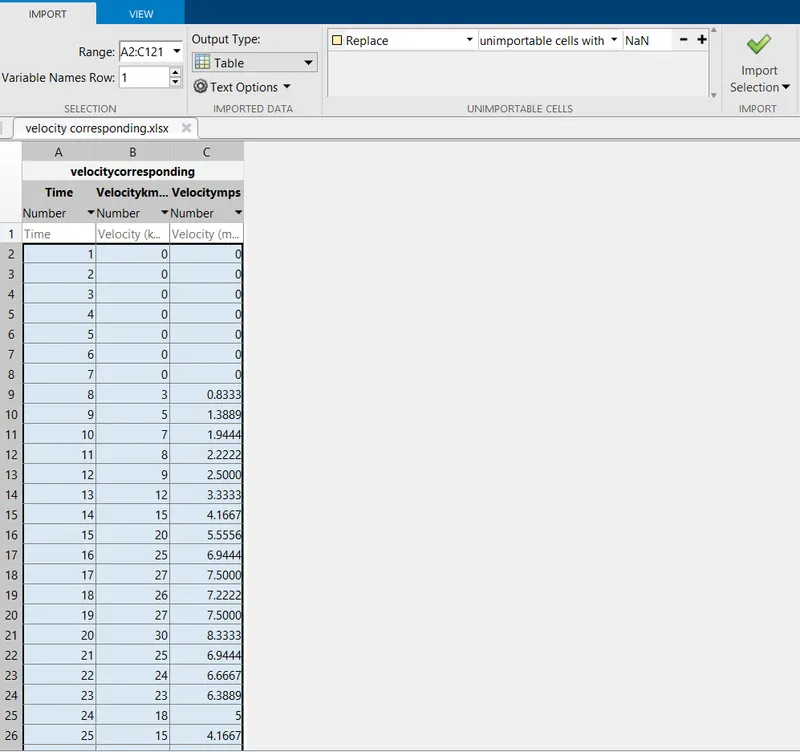
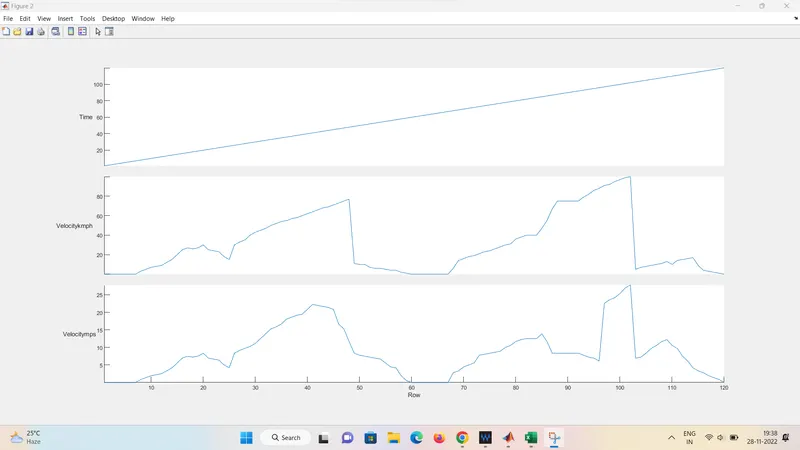
Result :
2.Why electric motor can’t develop braking torque at high speed similar to starting? How electric and mechanical brakes are coordinated?
Ans :
Electric Motor Braking :
Eectric motor can’t develop braking torque at high speed similar to starting, because Braking torque is applied in the opposite direction of the rotation. We can use a mechanical brake to produce a braking torque. We can also do it electrically.
Regenerative Braking: It is a form of braking in which the kinetic energy of the motor is returned to the power supply system.
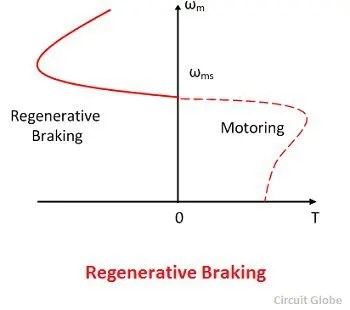
Fig : Speed-Torque Characteristics of Regenerative Braking
Regenerative braking takes place whenever the speed of the motor exceeds the synchronous speed. This baking method is called regenerative baking because here the motor works as generator and supply itself is given power from the load, i.e. motors. The main criteria for regenerative braking is that the rotor has to rotate at a speed higher than synchronous speed, only then the motor will act as a generator and the direction of current flow through the circuit and direction of the torque reverses and braking takes place.
Sometimes after accelerating you can't reach the maximum torque. The reason is that no matter how much the current loop wants to increase current (proportional to torque) by increasing the PWM duty cycle of the power stage, the Vmotor is too close to Vbemf and therefore current can't increase more.This situation does not occur at the beginning of an acceleration because most of the torque is used to increase the kinetical energy of the load (and motor). But when the speed is already high and no extra load is applied it is not possible to increase the torque.
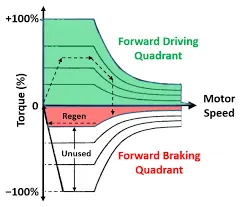
Fig : Acceleration Torque vs Deceleration Torque
Peak Acceleration Torque and Peak Deceleration torque are not equal for Electric Vehicle Motor. So the Peak Torque during acceleration and the Peak torque during deceleration or braking are not equal. Acceleration is usually higher, at low speed we get higher Torque but high speed the value of the torque gets lower. So we cannot say that the motor which is producing 7Nm Torque for Acceleration can also produce -7Nm of Braking Torque. So beacuse we Operating the Motor in Field Weakening region or we are operating the Motor above base speed we must know that the torque is compromised or the torque value is lower. So Electric motor can’t develop braking torque at high speed similar to starting, because Braking Torque of an EV Motor is not as high as the Acceleration Torque. Therefore Regenerative braking is cannot happen so effectively that we can get all the power back to the battery.
To plot contour line for a given Motor. A Motor have various types of losses happening inside. The various types of losses are
Copper Losses - I2⋅RI2⋅R, where R is the Armature resistance and we say that Torque is proportional to Current, this copper loss can be consider askc⋅kc⋅T2kc⋅T2.where kckc is to take care of resistance of brushes and also take care of flux and its effect.
Copper losses = kc⋅T2kc⋅T2
Iron Losses - Iron Losses are nothing but Magnetic losses, which is denoted as ki⋅ωki⋅ω, where kiki factor is based on the Magnetic field effect. For Permanent Magnets have constant Magnetic field and this Iron losses is based on the value of kiki and this are going to change according to the Speed. At Various Speed have different value of Back EMF and that is going to affect the Iron Losses.
Iron Losses = ki⋅ωki⋅ω
Windage Losses - This is a Mechanical or friction of Windage losses. This is based on size of shape of Motor and the amount of windage losses that the motor is going to experience.
Windage Losses = kw⋅ω3kw⋅ω3
Constant Losses - This is denoted as C.
Total Losses - The Total Losses are considering the above four losses and denoted as,
Total Losses = ki⋅ωki⋅ω+ kw⋅ω3kw⋅ω3kw⋅ω3 + C
All Motors are model as per the above equation of losses. This above equation is not only applicable for Permanent Magnet DC Motor, but other motors as well like induction motor
MATLAB Program to Plot Motor Speed-Torque Contour Efficiency :
clear all
close all
clc
% Plotting Efficiency Contour for Electric Motor
%Input of Speed & Torque
Speed=linspace(1,1000);
Torque=linspace(1,250);
%Losses
kc=0.2; % For Copper Loss
ki=0.008;% For Iron Loss
kw=0.00001;% For Windage Loss
C=20;% For Constant Motor Loss
%Meshing
[S,T]=meshgrid(Speed,Torque)
%Calculating Power = Speed * Torque
Outputpower=(S.*T);
%Calculating Losses
Cu=(T.^2)*kc;%Copper Losses
Fe=S*ki;%Iron Losses
W=(S.^3)*kw;%Windage Losses
Inputpower = Outputpower+Cu+Fe+W+C;
Efficiency = Outputpower./Inputpower;
%Now Set the Efficiency to plot Contour
V=[0.70,0.80,0.85,0.90,0.91,0.92,0.925,0.93];
box off
grid off
contour(S,T,Efficiency,V)
xlabel('Speed(rad/s)')
ylabel('Torque(Nm)')
title('Motor Speed-Torque Efficiency Contour Plot')
hold on
%Now Plot a contour of Power Output
%Additionally Plotting contour of 8kw and 10kw
V=[8000,10000];
contour(S,T,Outputpower,V)
Explanation for above Program :
Step-1 : Assign Input of Speed and Torque in an array using 'linspace' Command and allocate Constant Values for four losses(Copper Loss, Iron Loss, Windage Loss and Constant Motor Loss)
Step-2 : Mesh the Speed and Torque values using 'meshgrid' command.
Step-3 : Calculate the Output Power by multiplying Speed and Torque values.
Step-4 : Calculate Copper Loss, Iron Loss, Windage Loss using those formulas.
Step-5 : Calculating Inputpower by adding Output Power and Four Losses(Copper Loss, Iron Loss, Windage Loss and Constant Motor Loss).
Step-6 : The ratio of Output Power and Input Power we can get the Efficiency.
Step-7 : Now Set the Efficiencies for which a contour will be plotted. The range of contour efficiency is to plot from 70% to 93% efficiency. V is the Mapping of those efficiency points.
Step-8 : Plot the Contour Efficiency using 'contour' command and plot Speed,Torque,Efficiency and V.
Contour : contour(Z) creates a contour plot containing the isolines of matrix Z, where Z contains height values on the x-y plane. MATLAB automatically selects the contour lines to display. The column and row indices of Z are the x and y coordinates in the plane, respectively. 'contour(X,Y,Z)' specifies the x and y coordinates for the values in Z.
Step-9 : Now plot a contour of Power Output. Plotting contour of 8kw and 10kw of a Motor.
Step-10 : Run the Program and get the Motor Speed-Torque Efficiency Contour Plot.
Result :
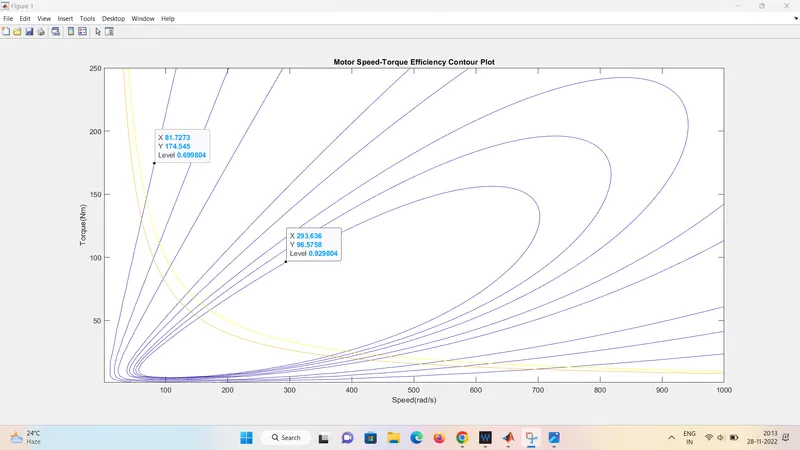
The above Plot shows the Motor Speed-Torque Efficiency Contour Plot. A Point is denoted in innermost contour line is group of efficiencies which is highest value of the efficiency as 93%, because where the height is maximum and another point is denoted outermost contour line is contain group of efficiencies which is the lowest value of efficiency as 70%, because where the height reduces. Increasing efficiency order as going inward and Decreasing efficiency order as going outward. The yellow line shows the 8kw and 10kw Power.