Week-11 Challenge: Braking
1)
Here, we used UDDS cycle for which energy required for braking is calculated.
The formula for Braking Energy is

Braking energy is calculated in excel as shown below.
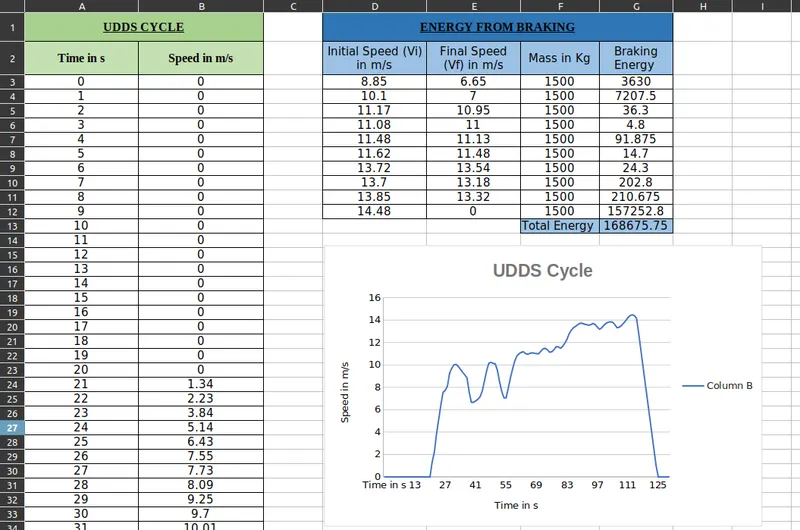
Total energy required for braking is 168.675 KJ.
2)
Take a look at the torque speed characteristics of typical AC induction motor
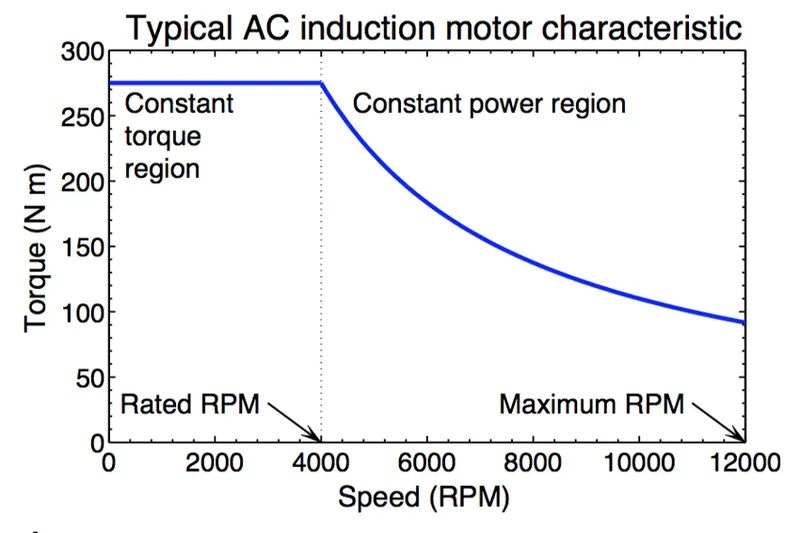
This curve has two regions: constant torque and constant power. The motor produces peak torque until it reaches a certain motor speed range, after which it rapidly drops. The drop in torque is caused by the motor shaft reaching critical speed, and the area where the peak torque is constant is known as the motor's constant torque region. The constant power region is where the torque decreases and the power generated by the motor is at its maximum.
Because the torque produced in the constant power region is so low, developing enough braking torque in this region is impossible. The amount of braking torque produced rises as speed decreases.
Co-ordination of Electric and Mechanical brakes :
Many conditions, such as a high State of Charge (SOC) or a high battery temperature, preclude the usage of the regenerative braking system. In these instances, the mechanical braking system operates to provide the whole braking torque required.
Thus, torque integration refers to the collaboration between the mechanical braking system and the regenerative braking system, which is an important aspect of the design of the EV braking management strategy.
For Braking Combinations, there are two control strategies:
- Series Control Strategy
- Parallel Control Strategy
Series Control Strategy
- Combination of a friction-based mechanical braking system and a regenerative braking system that transfers energy to the battery via an integrated control that distributes the required brake force between the mechanical and regenerative braking systems.
- The Series Startegy could boost fuel efficiency by 15-30% and provide more consistent braking due to its good torque blending capability.
Parallel Control Strategy
- Without an integrated control, a combination of mechanical and regenerative braking systems is used.
The regenerative braking force is added to the uncontrollable mechanical braking force. - The regeneration torque is calculated by taking into account the motor capacity, battery state of charge, and vehicle velocity. The brake control unit calculates the regenerative braking force by comparing the demanded brake torque to the available motor torque.
EDIB Braking Combination Application (Electric Driven Intelligent Brake)
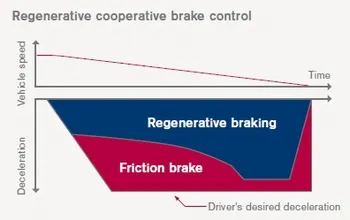
- EDIB permits and controls regenerative and regular friction brake optimization (hydraulic brake).
- The technology generates an acceptable braking force while increasing energy regeneration as much as feasible.
graph - At greater speeds, regeneration and friction braking are used in tandem.
- Regenerative braking is given a bigger proportion at lower speeds to maximise energy conversion.
3)
Required matlab code
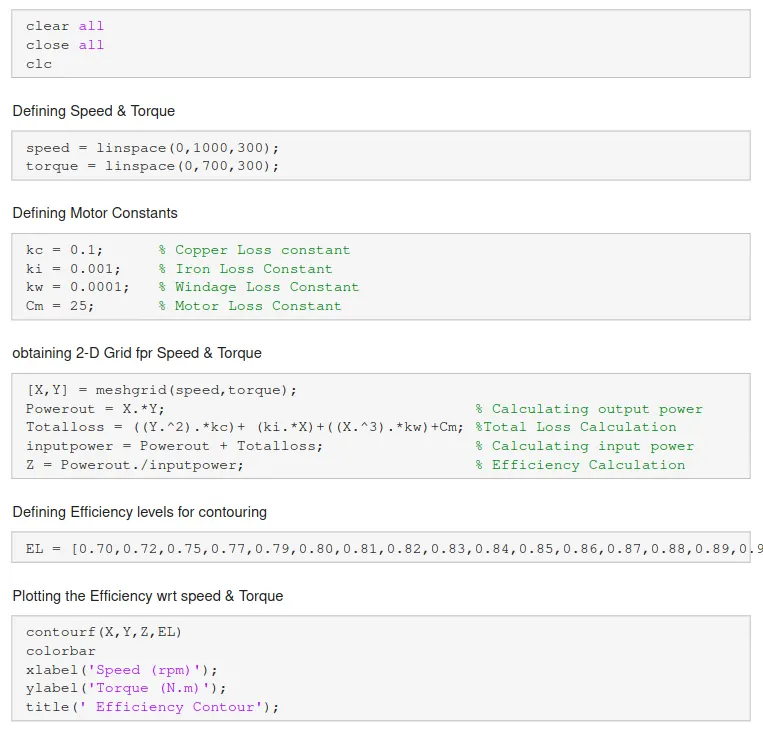
Efficiency contour
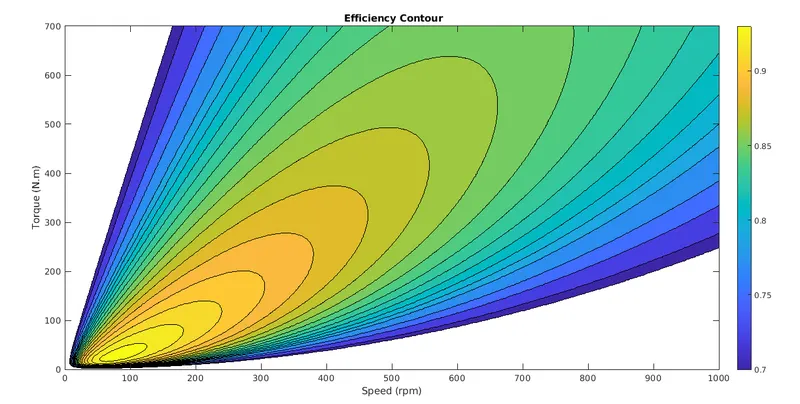
Based on efficiency, the contour plot for a motor with defined constants is drawn in the Speed Vs Torque Region. The efficiency of the motor gradually declines as the speed and torque increase. The level of efficiency is represented by a colorbar.