Week-11 Challenge: Braking
Question 1
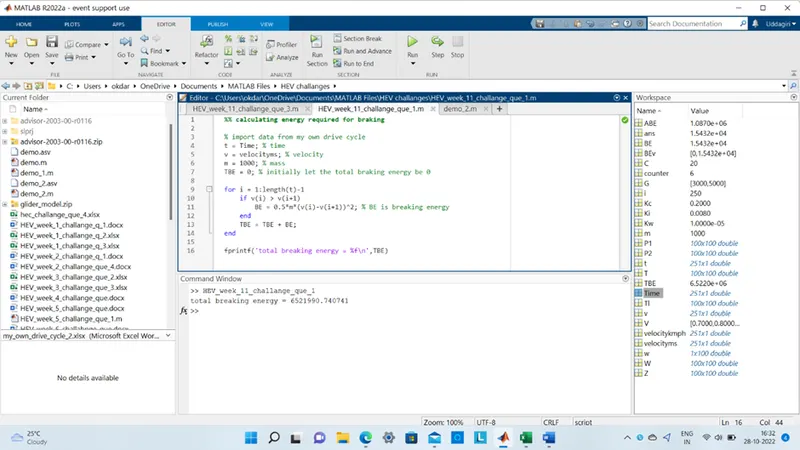
steps to calculate braking energy in matlab
- Import data from drive cycle
- The duty cycle is prepared by me named my_own_drive_cycle_2
- The formula for Breaking Energy `K.E = 1/2m*v^2`
- To find this I developed a matlab program logic using for loop and a conditional satement if
- The matlab file is attached in the bottom
- The Total Breaking Energy is came out as 6521kw
Question 3
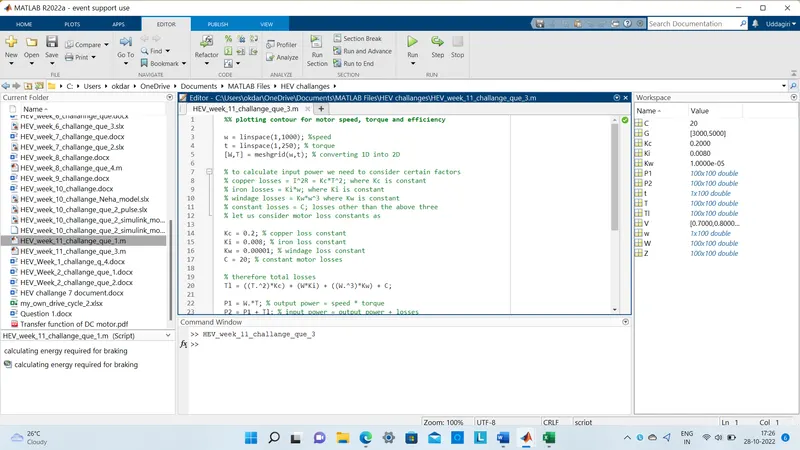
continution program
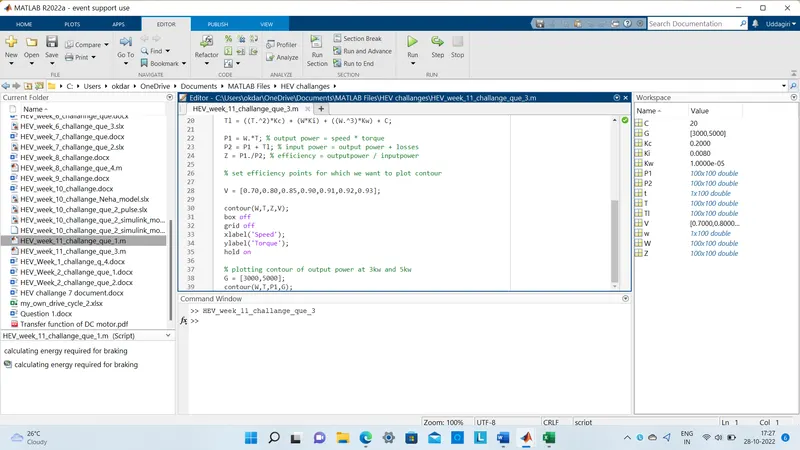
Results are
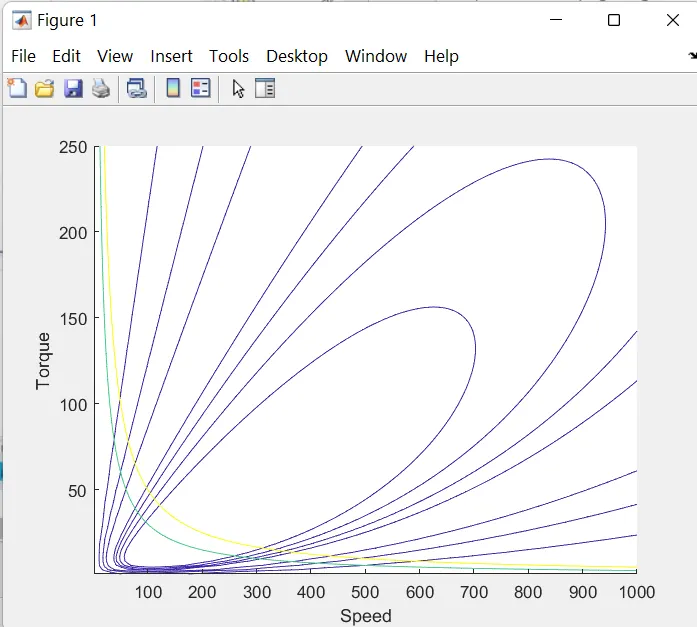
steps to plot contour of motor speed, torque and efficiency :
- Take random vectors using linspace for speed and torque
- We have to plot a contour which is a 3D figure on 2D image so we have to convert speed and torque into 3D
- Speed and torque are converted into 3D by using mesh grid command
- To calculate input power we need to consider certain factors
- copper losses = I^2R = Kc*T^2; where Kc is constant
- iron losses = Ki*w; where Ki is constant
- windage losses = Kw*w^3 where Kw is constant
- constant losses = C; losses other than the above three
Total losses
`Tl = T^2*Kc + W*Ki + W^3*Kw + C`
1.Outputpower(P1) = speed*torque
2.Inputpower(P2) = Outpower + TotalLosses
3.`Efficiency(Z) = (Outputpower)/(Inputpower) = (P1)/(P2)`
Now I created a vector V where we want to plot or point out efficiency
By using contour command I plotted a contour of moter speed, torque and efficiency
And I also plotted a Output power contour at 3kw and 5kw
Question 2
In motor operation the speed is inversely proportional to torque it means as the speed increases torque decreases. Initially speed is zero, so torque is high. But as the speed increases torque decreases. If we talk particularly about breaking torque, it is produced in opposite direction to the speed
That is why Electric motor can’t develop braking torque at high speed similar to starting.
Regenerative Breaking :
Regenerative braking takes place whenever the speed of the motor exceeds the synchronous speed. This baking method is called regenerative baking because here the motor works as generator and supply itself is given power from the load, i.e. motors. The main criteria for regenerative braking is that the rotor has to rotate at a speed higher than synchronous speed, only then the motor will act as a generator and the direction of current flow through the circuit and direction of the torque reverses and braking takes place.
Coordination of Electrical and mechanical breaking
In practical case breaking is done by the combined response of regenerative breaking and mechanical breaking. This combination is done in particular ways, which is known as brake control strategies.
Brake control strategies
- Series : In the strategy we apply regenerative braking and mechanical braking one after another. We apply either regenerative breaking or mechanical drinking at a time. We can’t do both at a same time in this. This type of braking gives comfort.
- Parallel : In the strategy we apply regenerative breaking and mechanical breaking at a time. This is more energy efficient compared to the series breaking.
- Electric driven intelligent break(EBIB) : This breaking is developed by Nissan Leaf. The major strategy in this breaking is at low speed this uses regenerative breaking, at high speed this combines both regenerative breaking and friction breaking.