Week-11 Challenge: Braking
Q1)For a defined driving cycle, calculate the energy required for braking.
ans-
1) In electric vehicle is require by vehicle for acceleration as well as deacceleration of vehicle also. As we require to stop vehicle in stipulated time, we cannot allow vehicle to stop as per its inertia value, for stopping vehicle we require to apply brake. Braking of vehicle require to deaccelerate vehicle to lower speed within a given time.
Suppose we have UDDS cycle: -
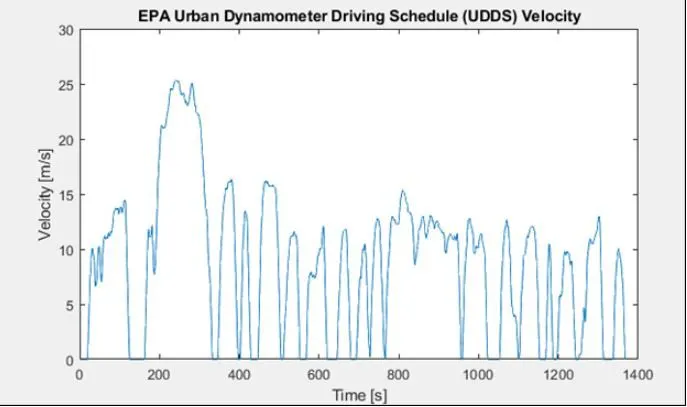
2)We can observe in this test cycle vehicle needs to stop in given time at some instance also for this we will apply brakes. We will calculate the power require for braking operation.
- To reduce speed from 80 to 40 Kmph in 20 sec = 292 KJ
- To reduce speed from 80 to 0 Kmph in 10 sec = 560 Kj
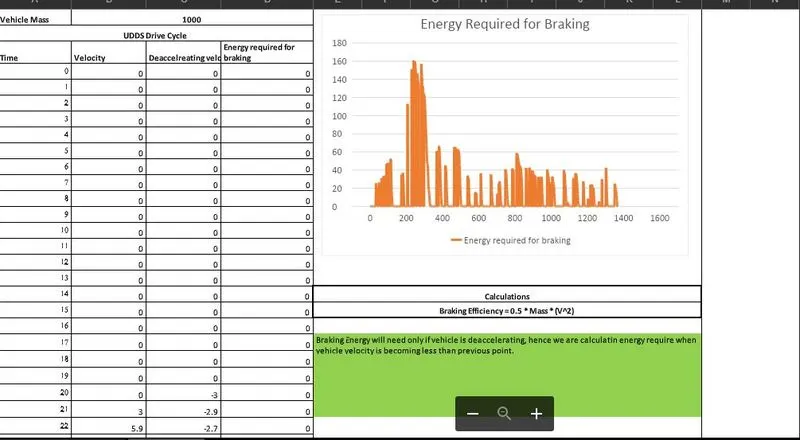
calculation-
Formula:

33 decelerations were made during this driving cycle, So 33 braking energy is to be calculated and sum it up to get the Total braking energy.
Calculations:
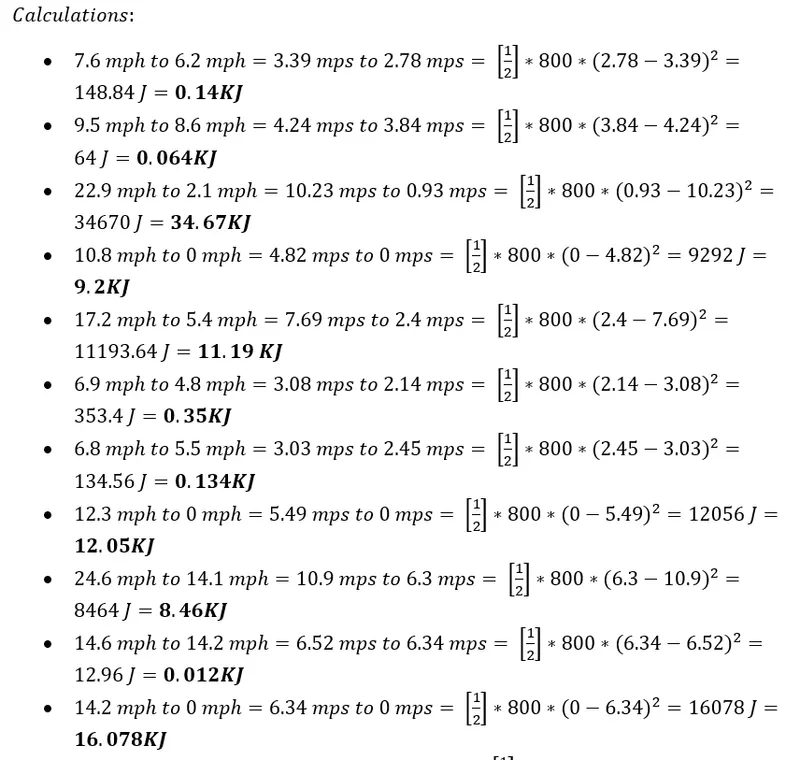
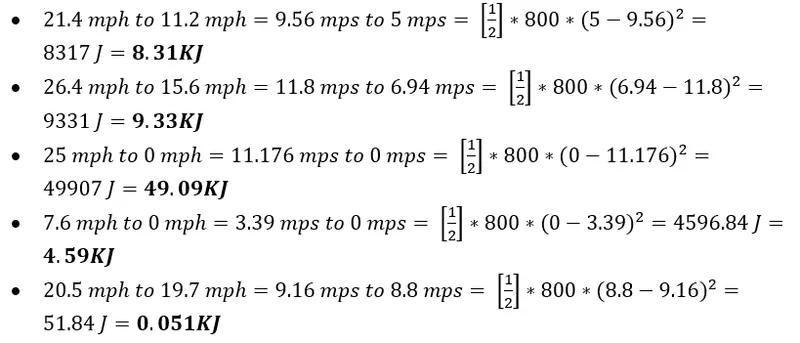
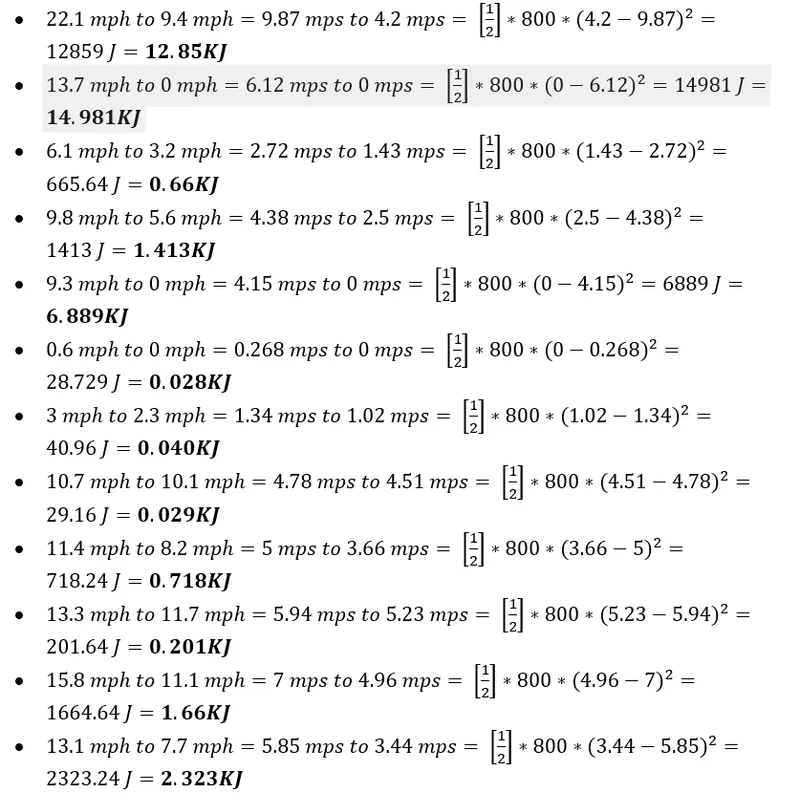
The total breaking energy equal to sum of all this energys which is 316.147KJ
Q2Why electric motor can’t develop braking torque at high speed similar to starting? How electric and mechanical brakes are coordinated?
ans-
1)electric motor braking-
Eectric motor can’t develop braking torque at high speed similar to starting, because Braking torque is applied in the opposite direction of the rotation. We can use a mechanical brake to produce a braking torque.
2)Regenerative braking-
It is a form of braking in which the kinetic energy of the motor is returned to the power supply system.
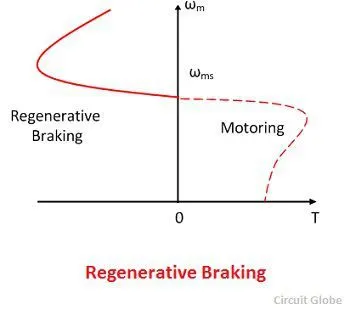
3) Regenerative braking takes place whenever the speed of the motor exceeds the synchronous speed. This baking method is called regenerative baking because here the motor works as generator and supply itself is given power from the load, i.e. motors.
4)The main criteria for regenerative braking is that the rotor has to rotate at a speed higher than synchronous speed, only then the motor will act as a generator and the direction of current flow through the circuit and direction of the torque reverses and braking takes place.
5) Sometimes after accelerating you can't reach the maximum torque. The reason is that no matter how much the current loop wants to increase current (proportional to torque) by increasing the PWM duty cycle of the power stage, the Vmotor is too close to Vbemf and therefore current can't increase more.
6).This situation does not occur at the beginning of an acceleration because most of the torque is used to increase the kinetical energy of the load (and motor). But when the speed is already high and no extra load is applied it is not possible to increase the torque.
7)Peak Acceleration Torque and Peak Deceleration torque are not equal for Electric Vehicle Motor. So the Peak Torque during acceleration and the Peak torque during deceleration or braking are not equal
8). Acceleration is usually higher, at low speed we get higher Torque but high speed the value of the torque gets lower. So we cannot say that the motor which is producing 7Nm Torque for Acceleration can also produce -7Nm of Braking Torque.
9)So beacuse we Operating the Motor in Field Weakening region or we are operating the Motor above base speed we must know that the torque is compromised or the torque value is lower. So Electric motor can’t develop braking torque at high speed similar to starting,
10)because Braking Torque of an EV Motor is not as high as the Acceleration Torque. Therefore Regenerative braking is cannot happen so effectively that we can get all the power back to the battery.
Coordination of Electric and Mechanical Brake :
1)Brake Force distribution must be uniform, If the Regenerative braking power requirement is more than the charging limit of the battery or more than regenerative capacity of the machine we must apply Mechanical brakes as well.
2) So usually it is combined response of Mechanical brake and Regenerative brake. The reason for how these brake force are combined, that particular phenomena is called Brake Control Strategies. There are two Brake Control Strategies, which are
Series - In case of Series we apply Mechanical brake and Regenerative electric brake one after another. We can apply only one brake strategy at a time either apply Regenerative or apply Mechanical brake.
Parallel - In case of Parallel we apply both brakes simultaneously. This Particular Parallel braking is going to happen both at a time.
Electric Driven Intelligent Brake (EDIB) is a combination of Hydraulic brake or Mechanical brake along with a Regenerative brake. It is a Parallel braking technique. The Control criteria such that at low speed use regenerative braking higher and at high speed or during initial braking period we actually combine the both.
Q3Make a MATLAB program which plots contour of given motor speed, torque and efficiency values. Attach the code as a .m file attach a screenshot of all the plots.
ans-
MATLAB program:
clear all
close all
clc

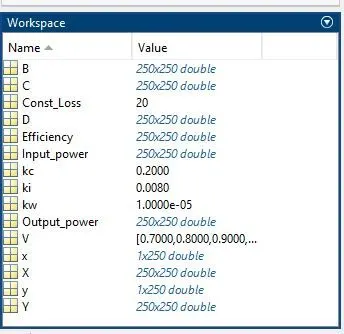
x=linspace(1,1000,250); %Speed in rad/sec
y=linspace(1,250,250); %Torque in Nm

%Motor loss constants
kc=0.2;  %Copper loss constant
ki=0.008;  %Iron loss constant
kw=0.00001;  %Windage loss constant
Const_Loss=20;  %Constant motor loss

[X,Y]=meshgrid(x,y); %Converting to 2D
Output_power=(X.*Y); %Power = Torque x Speed

B= (Y.^2)*kc; %Copper loss
C= X.*ki; %Iron loss
D= (X.^3)*kw; %Windage loss
Input_power = Output_power + B + C + D + Const_Loss;
Efficiency= Output_power./Input_power; %Eff of the motor
V = [0.70,0.80,0.90,0.91,0.92,0.925,0.93]; %Efficiencies to be plotted
box off
grid off
contourf(X,Y,Efficiency,V);
contourcbar
title('Speed-Torque-Efficiency Characteristics of Motor');
xlabel('Speed (rad/sec)');
ylabel('Torque (Nm)');
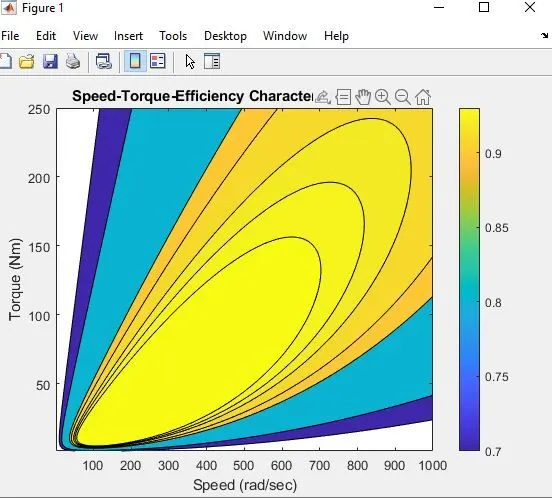
This clearly shows that maximum efficiency of 93% is achieved by 691.1rad/sec and at 147Nm.
The lowest Efficiency is achieved at 223 rad/sec and at torque of 105.3Nm .And this Contour plot clearly gives the idea on Speed, Torque and Efficiency relationship of the motor.
The color indicates the efficiency denoted in the right side with the colorbar.