Week-11 Challenge: Braking
SOLUTION 1):
. The function of the braking system is to retard the speed of the moving vehicle or bring it to rest in the shortest possible distance whenever required.
. Brakes are mechanical devices for increasing the frictional resistance that retards the turning motion of the vehicle wheels. It absorbs either kinetic energy or potential energy or both while remaining in action and this absorbed energy appears in the form of heat.
. While moving down a steep gradient the vehicle is controlled by the application of brakes.
. Kinetic energy is the force that keeps the vehicle moving. This energy is provided by the engine in order to accelerate the vehicle from a standstill to desired speed. Kinetic energy is dissipated as heat by the brakes during application of breaks.
. The brakes must be capable of decelerating a vehicle at a faster rate than the engine is able to accelerate it. Normally brakes have to absorb three times the amount of engine horsepower energy in its equivalent form.
SOLUTION 2):
. The electric motor can't develop braking torque at high speed similiar to starting because once the electric supply is pulled off from the motor,it acts as a generator and due to the flux weakening effect of the electric generator,the generator produces low torque as expected.
Coordination of Electric and Mechanical Brake :
In an electric Motor, the Total Brake distribution is in two aspects which are Electrical Brake which is called Regenerative Brake, and Mechanical Brake or Classical Brake with a hydraulic cylindrical system. Brake Force distribution must be uniform, If the Regenerative braking power requirement is more than the charging limit of the battery or more than the regenerative capacity of the machine we must apply Mechanical brakes as well.
In a practical case, the combination of these two is applied. So usually it is a combined response of Mechanical brake and Regenerative brake. The reason for how this braking force is combined, that particular phenomena are called Brake Control Strategies. There are two Brake Control Strategies, which are Series - In case of Series, we apply Mechanical brake and Regenerative electric brake one after another. We can apply only one brake strategy at a time either apply Regeneratively or apply Mechanical brake.
SOLUTION 3):
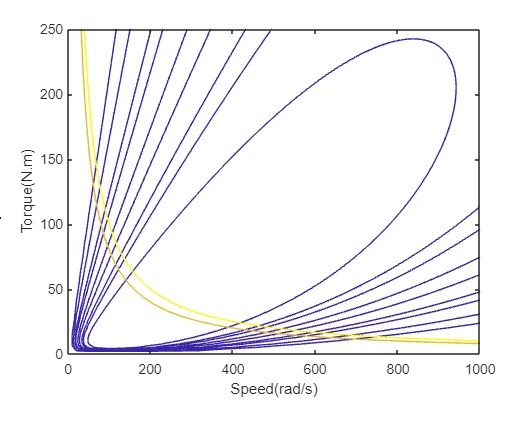
To plot contour , A Motor have various types of losses happening inside. The various types of losses are:
Copper Losses - I2RI2R , where R is the Armature resistance and we say that Torque is proportional to Current, this copper loss can be consider as .where is to take care of resistance of brushes and also take care of ux and its effect.
Copper losses = kc⋅T2kc⋅T2
Iron Losses - Iron Losses are nothing but Magnetic losses, which is denoted as , where factor is based on the Magnetic eld effect. For Permanent Magnets have constant Magnetic eld and this Iron losses is based on the value of and this are going to change according to the Speed. At Various Speed have different value of Back EMF and that is going to affect the Iron Losses.
Iron Losses = ki⋅ωki⋅ω
Windage Losses - This is a Mechanical or friction of Windage losses. This is based on size of shape of Motor and the amount of windage losses that the motor is going to experience.
Windage Losses = kw⋅ω3kw⋅ω3
Constant Losses - This is denoted as C.
Total Losses - The Total Losses are considering the above four losses and denoted as,
Total Losses = kc⋅T2+ki⋅ω+kw⋅ω3+Ckc⋅T2+ki⋅ω+kw⋅ω3+C