Week-11 Challenge: Braking
For a defined driving cycle, calculate the energy required for braking.
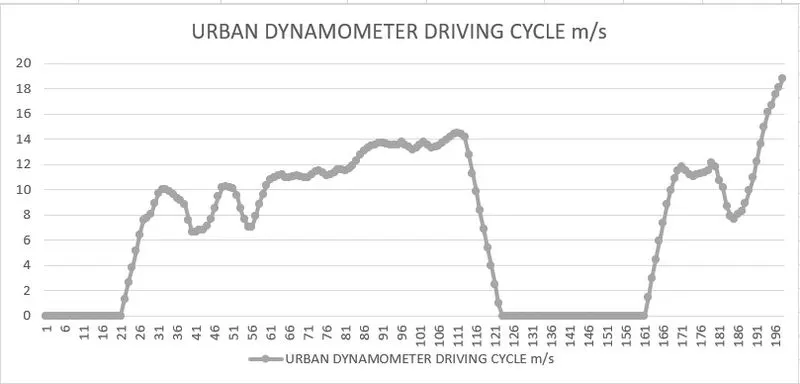
Here we choose urban dynamometer driving cycle (UDDS) here we take the cycle of time from 0 to 200 sec to calculate the energy required for braking.Excel file consist of time,Speed in Kmph ,Speed in m/s.
Braking energy can be found by taking the initial velocity and final velocity during the braking.
The equation for kinetic energy for braking is
KE=1/2*m*(Vi-Vf)^2
M=mass
Vi=initial velocity
Vf=Final velocity
Plot of UDDS Cycle
From the driving cycle 8 braking points are found.and the mass is set to 1300 kg.
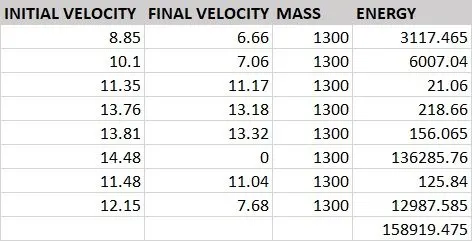
Total energy required for braking is 15.89 Kw

Why electric motor can’t develop braking torque at high speed similar to starting? How electric and mechanical brakes are coordinated?
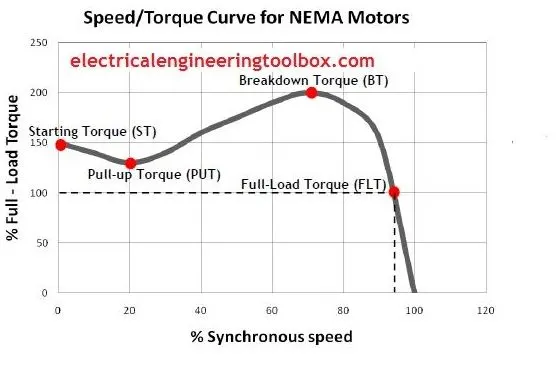
Electric motor cant develop braking torque at high speed similar to starting because there is a pull up torque which is the minimum torque developed by an electrical motor when it runs from zero to full load speed before it reaches the maximum torque after that the torque decreases is known as the power generated by the motor.Since the torque produced at the constant power region is very low, it is not possible to develop enough braking torque in this region. The braking torque produced increases as the speed decreases.
How electric and mechanical brakes are coordinated
Electric brake systems include systems which has devices that operate with electric power when driver operates brake to stop the car or to work to connect between devices. Foundation brakes equipped with electric actuators are divided into Electric service brakes and electric parking brakes.
Regenerative braking
this is atype of kinetic energy where the kinetic energy stored to potential energy to slow down the vehicle.in electric vehicle as a result of this energy is converted into it.it can improve consumption and reduce overall braking load
Advantages of
- Brake Pads & Rotors May Last Longer
- Extended Range Possibilities for EVs
- Better Fuel Efficiency for Hybrids
- May Be Less Effective at Lower Speeds
- Brake Pedal May Feel Different
- Potentially Less Stopping Power
in regenerative braking system the motor will act as a generator when reversed here are certain limitation with RBS the electric motor is unable to provide all the brake torque necessary for large decelerations. In case of braking if the braking torque is applied only one axle there are chances stability and maneuverability issues can occur. So to avoid such situation regenerate braking is operate in conjunction with a friction mechanical brake system.
The RBS and mechanical brake system are used in strategic manner which is called as brake control strategy
- Series brake control or series RBS:
In this type of control system the mechanical brakes and regenerative (electric) brakes are applied one after the another we can only apply one brake system at a time either RBS or mechanical brakes
The series brake system is further classified:
- Comfort of the drive
- Braking according to the energy efficiency
- Parallel brake control or parallel RBS:
In this type of brake control system both the mechanical brakes and RBS are applied simultaneously
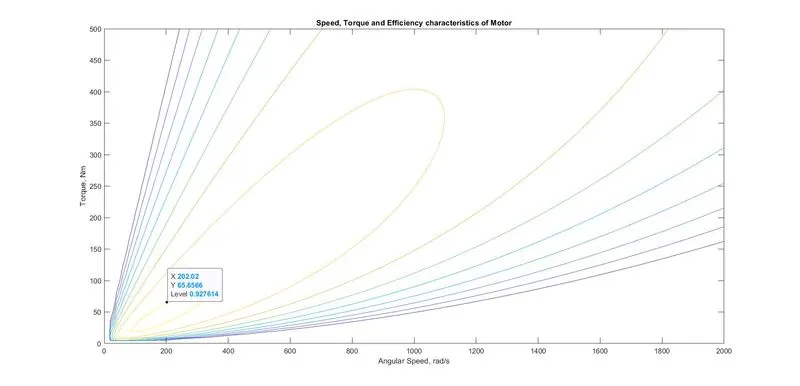
Make a MATLAB program which plots contour of given motor speed, torque and efficiency values. Attach the code as a .m file attach a screenshot of all the plots.
Losses occur in motor
- copper losses
- iron losses
- windage losses
- conduction losses
in the matlab file speed and torque are inserted using linspace
efficiency =poutput/pinput
poutput=pin+losses
Matlab file
clc
clear all
w=linspace(0,500,100); %speed
T=linspace(0,2000,100); %torque
[X,Y]=meshgrid(T,w);
copper=0.16; %copper loss
iron=0.006; %iron loss
windage=0.00001; %windage loss

Copper_losses=copper*(Y.^2); %copper losses
iron_losses=iron*(X.^2); %iron losse
win_losses=windage*(X.^3); %windage losse
cond_loss=18; %conduction losses

P_out=(X.*Y); %power output
P_in=P_out+(Copper_losses)+(iron_losses)+(win_losses)+(cond_loss); %input power
n=((P_out)./(P_in)); %efficiency

W = linspace(0.75, 0.95, 10);
contour(X,Y,n,W)
xlabel('Angular Speed, rad/s')
ylabel('Torque, Nm')
title('Speed, Torque and Efficiency characteristics of Motor');
Output