Week-11 Challenge: Braking
Que.1:For a defined driving cycle, calculate the energy required for braking.
Ans:
Braking is the process of controlling the velocity of an object by inhibiting its motion. An object in motion possesses kinetic energy and to bring the object to a stop this kinetic energy must be removed. Removing the kinetic energy can be accomplished by dissipating the energy to the atmosphere through friction or by converting it into another form of energy.
As with any system, the process of braking must follow the principal of conservation of energy."Energy neigther be created nor be destroyed but it only converted from one form to another", it is given as:
∴∑Ein=∑Eout.
Still with a basic operation where the vehicle in motion and the brakes are applied the same efficiency could be calculated by the given equations,

From this above equation, and assuming the mass of the object is constant, it is clear the in order to remove the kinetic energy from the system, the velocity must be brought to zero.
Observations/Calculations:
A)Driving cycle:
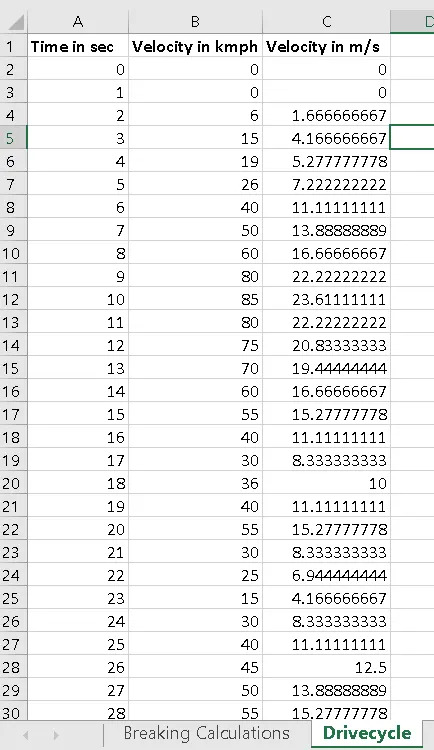
B)Braking Energy Calculatons:
(i)M-script file: First importing drive cycle from above given excel sheet to matlab.
%%Braking Energy calculation%%
Mass=1000;                                     %Mass of Vehicle in Kg
Drivecycle=brakingcalculationS1;
Time = Drivecycle(:,1);                        %Time in sec
Vel = Drivecycle(:,2);                         % Velocity in m/s
for i = 1:(length(Drivecycle)-1)
    if Vel(i)>Vel(i+1)
        E(i) = 0.5*Mass*(Vel(i)-Vel(i+1))^2;
    end
end
fprintf('Total Braking energy is %d',sum(E))
fprintf('\nAverage Braking energy is %d',mean(E))
figure(1)
subplot(2,1,1)
plot(Time,Vel,'linewidth',3,'color','y')
xlabel('Time(sec)')
ylabel('Velocity(m/s)')
title('Drivecycle')
hold on
subplot(2,1,2)
plot(E,'linewidth',3,'color','b')
xlabel('Time(s)')
ylabel('Energy(J)')
title('Brakingenergy')
Result/Plot:
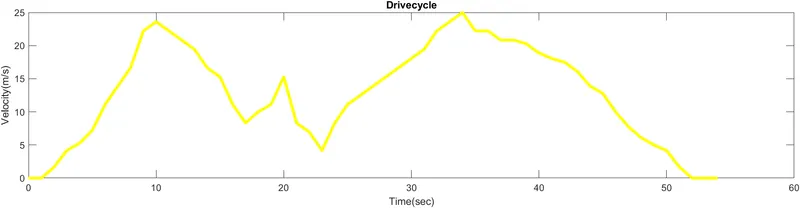
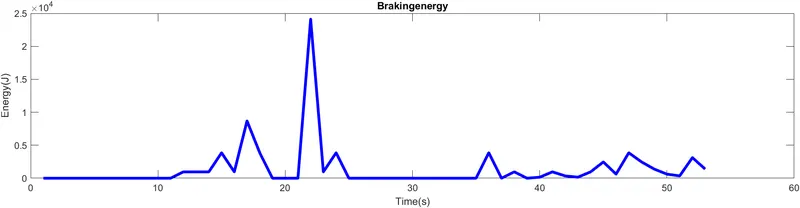
Cammand Window & Workspace:

(ii)Ms-Excel calculation:
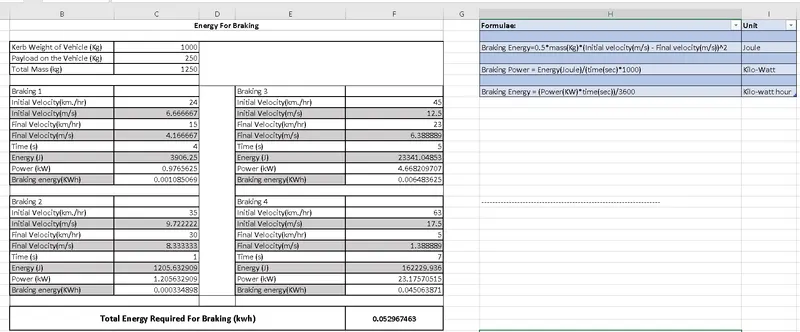
Que.2:Why electric motor can’t develop braking torque at high speed similar to starting? How electric and mechanical brakes are coordinated?
Ans:
A)Why electric motor can’t develop braking torque at high speed similar to starting?
Electric motor can’t develop braking torque at high speed similar to starting, because Braking torque is applied in the opposite direction of the rotation. We can use a mechanical brake to produce a braking torque, we can also do it electrically.
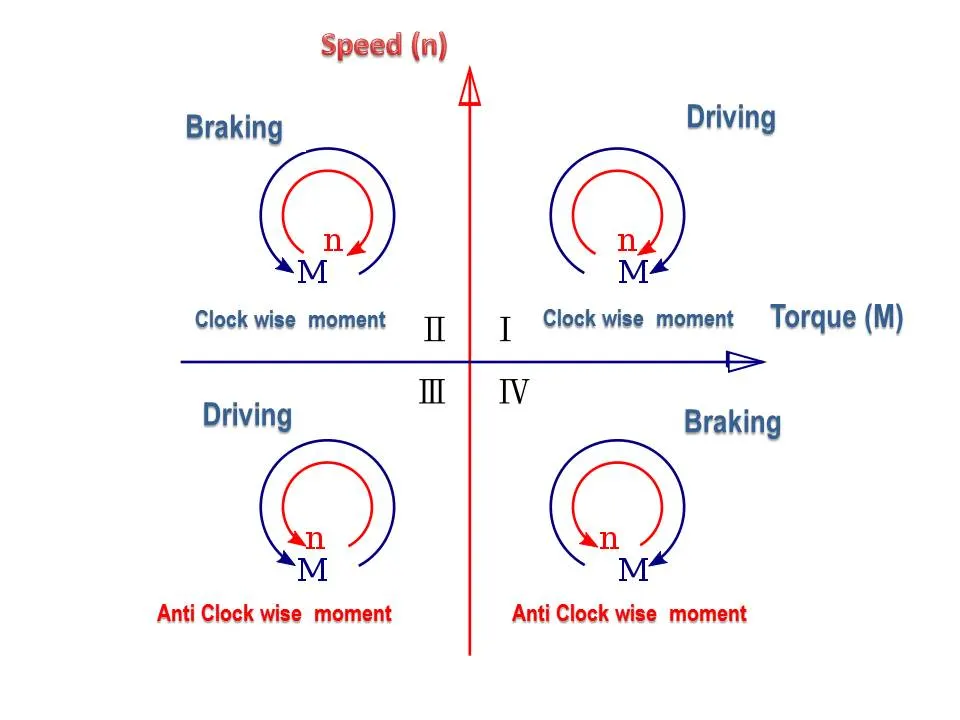
The motor drives for EVs are always four-quadrant drives, meaning that the electric motor is controlled by the drive to deliver positive or negative torque at positive or negative speed. The transition from forward motoring to regeneration can be explained with the help of above Figure for four-quadrant induction motor drives.
Electrical motor uses regenerative braking which develops counter torque to stop the Electric vehicle.In Regenerative braking the motor itself act as generator so the efficiency as a generator is less than motor. During the starting of Electric vehicle it draws large amount of current and produces large amount of torque. As the motor speed (rpm) increases the current drawn by the vehicle decreases then the torque will gradually decreased.In the braking mode of operation, the slip of the motor is more than unity. If the actual speed of the motor is more than the synchronous speed of the motor, the motor works as a generator. If the rotating kinetic energy of the motor is dissipated as heat the braking torque is produced and this braking torque will bring the motor speed down.
Regenerative braking:Regenerative braking takes place whenever the speed of the motor exceeds the synchronous speed. This braking method is called regenerative braking because here the motor works as generator and supply itself is given power from the load, i.e. motors. The main criteria for regenerative braking is that the rotor has to rotate at a speed higher than synchronous speed, only then the motor will act as a generator and the direction of current flow through the circuit and direction of the torque reverses and braking takes place.
The induction machine works as a generator when it is operated with a negative slip, i.e., the synchronous speed is less than the motor speed. Negative slip makes the electromagnetic torque negative during regeneration or the generating mode. In the negative slip mode of operation, voltages and currents induced in the rotor bars are of opposite polarity compared to those in the positive slip mode. Electromagnetic torque acts on the rotor to oppose the rotor rotation, thereby decelerating the vehicle.
Peak acceleration torque and peak deceleration torque are not equal for Electric Vehicle motor. So the peak torque during acceleration and the Peak torque during deceleration or braking are not equal. Acceleration is usually higher, at low speed we get higher Torque but high speed the value of the torque gets lower. So we cannot say that the motor which is producing positive torque for acceleration can also produce same amount of negative torque for braking.So, beacuse we operating the motor in field weakening region or we are operating the motor above base speed we must know that the torque is compromised or the torque value is lower. So, electric motor can’t develop braking torque at high speed similar to starting, because braking torque of an EV Motor is not as high as the acceleration torque. Therefore regenerative braking is cannot happen so effectively that we can get all the power back to the battery.
B) Co-ordination of Electric and Mechanical Brake: In a electric motor the total brake distribution is in two aspects which are electrical brake which is called Regenerative Brake and mechanical brake or classical brake with hydraulic cylindrical system. Brake Force distribution must be uniform, If the Regenerative braking power requirement is more than the charging limit of the battery or more than regenerative capacity of the machine we must apply Mechanical brakes as well. In practical case the combination of these two is applied. So usually it is combined response of Mechanical brake and Regenerative brake. The reason for how these brake force are combined, that particular phenomena is called Brake Control Strategies. There are two Brake Control Strategies, which are:
(i)Series: In case of series we apply Mechanical brake and regenerative electric brake one after another. We can apply only one brake strategy at a time either apply regenerative or apply mechanical brake. The Series Brake Control Strategy has further classification, that is based on whether we want comfort of driver or Brake behaviour compared to energy efficiency.
(ii)Parallel: In case of parallel we apply both brakes simultaneously. This perticular parallel braking is going to happen both at a time.
(iii)Electric Driven Intelligent Brake (EDIB) is a combination of Hydraulic brake or Mechanical brake along with a regenerative brake. It is a parallel braking technique. The control criteria such that at low speed use regenerative braking higher and at high speed or during initial braking period we actually combine the both.
Que.3:Make a MATLAB program which plots contour of given motor speed, torque and efficiency values. Attach the code as a .m file attach a screenshot of all the plots.
Ans: A MATLAB program which plots contour of given motor speed, torque and efficiency values:
M-Script:
clear
close
clc
%%Plotting a contour of a motor with speed, torque & efficiency values%%

x=linspace(1,1000);                                 % Speed in rad/s
y=linspace(1,250);                                  % Torque in N-m

%Entering the values of motor loss constants
Kc = 0.21;                                          % copper loss constant
Ki = 0.008;                                         % iron loss constant
Kw = 0.00001;                                       % winding loss constant
ConL = 20;                                            % Motor loss constant

%Creating a mesh
[X,Y] = meshgrid(x,y);
Po =(X.*Y);                                         %Output power = Torque X Speed.

Pc=(Y.^2)*Kc;                                       % Copper loss
Pf= X*Ki;                                           %Iron loss
Pw=(X.^3)*Kw;                                       % windage loss
Pi = Po + Pc + Pf + Pw + ConL;
Z = Po./Pi;

%Setting the efficiencies for which contour shold be plotted
V=[0.60,0.75,0.90,0.91,0.925,0.94,0.95,0.955];
box off
grid off
contour(X,Y,Z,V);
title('Motor Speed-Torque Efficiency Contour Plot')
xlabel('Speed in rad/s');
ylabel('Torque in N-m');
hold on
In the above M-Script the range of speed is 0 to 1000 in x-axis and Torque is 0 to 250 in y-axis with the help of array called linspace.
For calculating the efficiency, various losses and their constants are to be determined
efficiency (η ) = Output power/Input power
for a motor
Input power = output power +copper loss+Iron loss +windage loss
copper loss = I2*R=Kc*T2
Iron loss = Ki*w
windage loss = Kw*w3
Observation/Results:
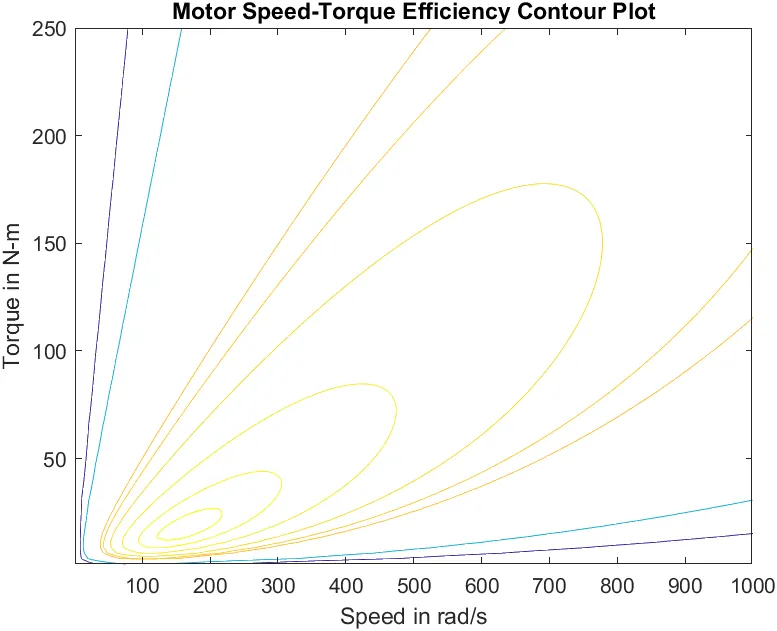
The above Plot shows the Motor Speed-Torque Efficiency Contour Plot. A Point is denoted in innermost contour line is group of efficiencies which is highest value of the efficiency as 95.5%, because where the height is maximum and another point is denoted outermost contour line is contain group of efficiencies which is the lowest value of efficiency as 60%, because where the height reduces. Increasing efficiency order as going inward and Decreasing efficiency order as going outward.