Week-11 Challenge: Braking
For a defined driving cycle, calculate the energy required for braking?
ANS:
- A driving cycle commonly represents a set of vehicle speed points versus time. It is used to assess fuel consumption and pollutants emissions of a vehicle in a normalized way, so that different vehicles can be compared.
- Driving cycles are produced by different countries and organizations to assess the performance of vehicles in various ways, as for instance fuel consumption, electric vehicle autonomy and polluting emissions.
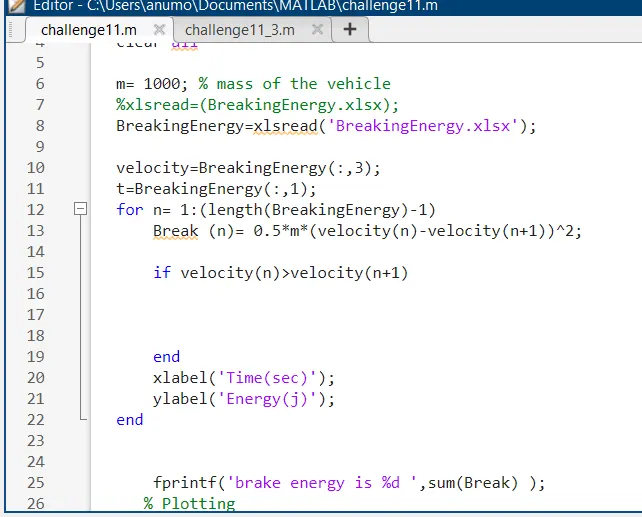
for calculate the energy requirment for braking
lets assume the vehicke mass (m) = 1000 kg
V(i)= initial velocity = 100 kmph
V(f)= final velocity= 0kmph
braking energy formula : 1/2 mv^2
- Why electric motor can’t develop braking torque at high speed similar to starting? How electric and mechanical brakes are coordinated?
- In the second quadrant, the direction of the rotation is positive i.e. speed is positive and the torque is negative. Hence, the developed power is negative and the machine operates as a generator which opposes its motion. The kinetic energy of the moving parts of the machines is converted into electrical energy. Therefore, the operation of motor in second quadrant is called forward breaking .
- The braking torque makes the motor run at constant speed, arresting its tendency to rotate faster. Due to the effects of stator resistance.
- we know that peak acceleration torque is not equal to the peak deceleration torque.
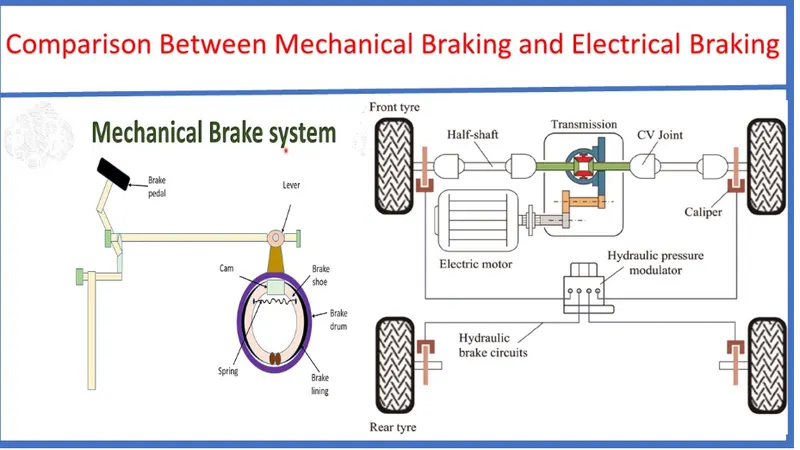
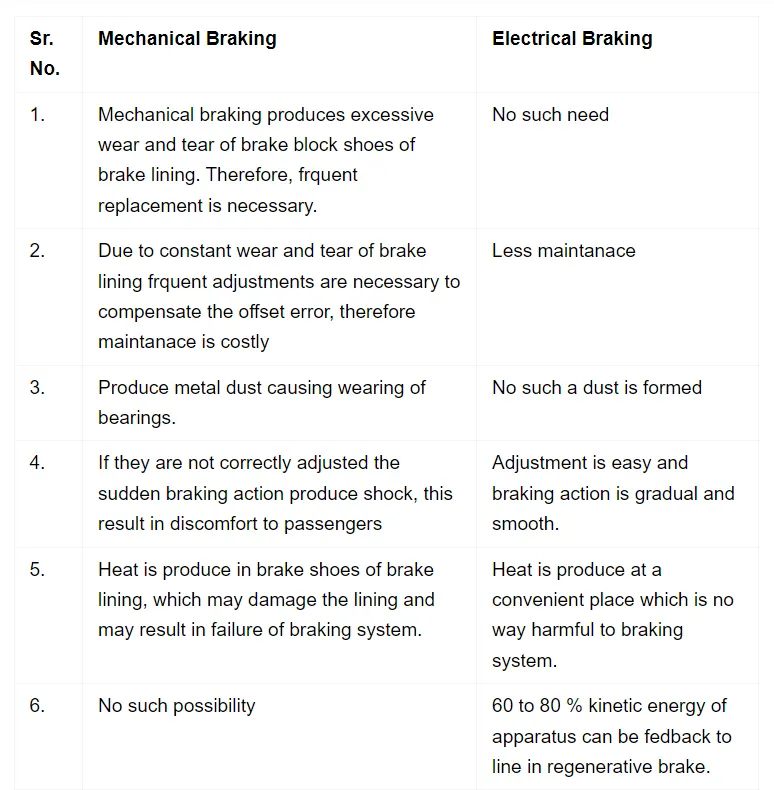
- Brake torque is essentially the power of the braking system. The brake caliper acts on the disc at a certain distance from the hub center, known as the effective radius. The force exerted by the caliper, multiplied by the effective radius of the system equals the brake torque.
electric brakes:
- When the electricity stops flowing, the shaft that turns the wheels are forced to spin the opposite way. This is what helps the vehicle to brake.
- The faster the vehicle travels, the more revolutions goes with each minute, the more force it makes for braking with the vehicle.
- Ironically the effectiveness of electric brakes goes down at slower speeds, because the magnet in the center is spinning at a slower speed.
- Example Electric braking- Tesla Model S Use regenerative type electric braking.
Mechanical Brakes :
- It is the type of braking system in which the brake force applied by the driver on the brake pedal is transferred to the final brake drum or disc rotor through the various mechanical linkages like cylindrical rods, fulcrums, springs etc. In order to de accelerate or stop the vehicle.
- When we accelerate the vehicle, energy in the battery flows to the electric machine to drive it. The energy required to move the vehicle is taken from the battery of the electric vehicle.
- The actuator pedal is released to slow down the vehicle and when it is completely released, the power flow to the motor from the battery stops. As a result, the vehicle starts to decelerate due to the aerodynamic drag, rolling friction,and other forces that oppose the movement of the vehicle.
- But those friction forces are not sufficient to stop the vehicle and hydraulic brakes are also applied. So, the kinetic energy is converted to heat energy at the brake, and the vehicle stops.
- Example :Mechanical brakes- Cars like Ford Model Y and bikes like Bajaj pulsar 180cc.
Along with the friction brake system, another type of braking is also possible in an electric vehicle. It is known as regenerative braking.
- Make a MATLAB program which plots contour of given motor speed, torque and efficiency values. Attach the code as a .m file attach a screenshot of all the plots.
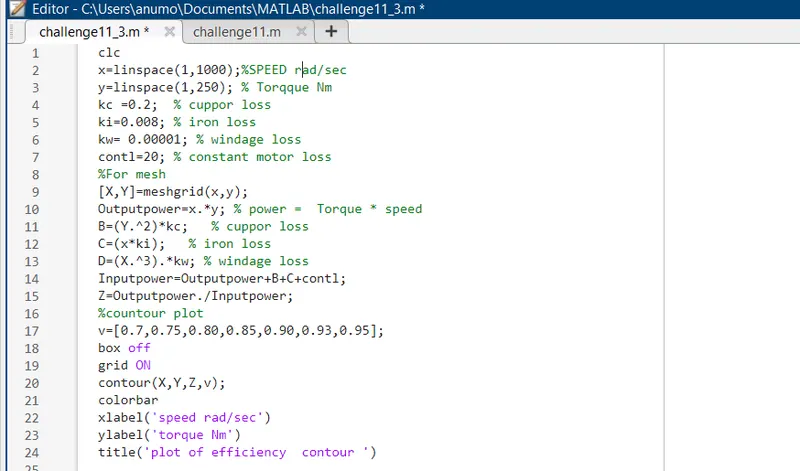
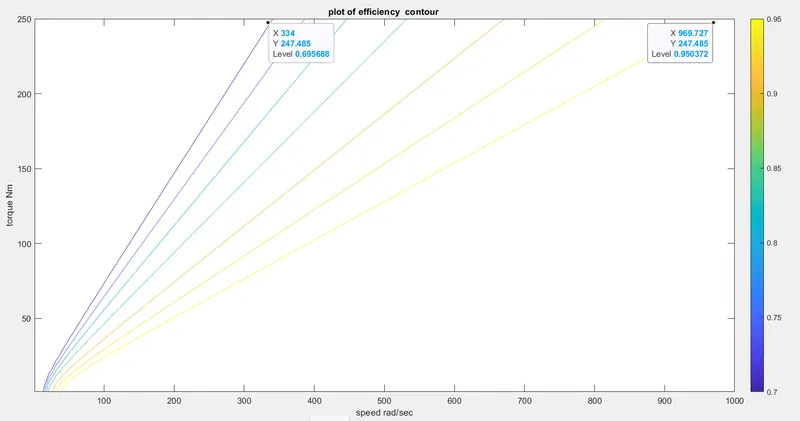
we got following contour plot, we can see when vehicle at low speed , Torque decreases significantly as speed increases for the same efficiency is 69 %.
and when vehicle at very high speed , efficiency 95%.
Greater the motor efficiency, lower speed torque combination required to the overcome the losses.