Week-11 Challenge: Braking
Aim:
- For a defined driving cycle, calculate the energy required for braking.
- Why electric motor can’t develop braking torque at a high speed similar to starting? How electric and mechanical brakes are coordinated?
- Make a MATLAB program that plots the contour of given motor speed, torque, and efficiency values. Attach the code as a .m file and attach a screenshot of all the plots.
For a defined driving cycle, calculate the energy required for braking.
Braking is the process of controlling the velocity of an object by inhibiting its motion. An object in motion possesses kinetic energy and to bring the object to a stop this kinetic energy must be removed. Removing the kinetic energy can be accomplished by dissipating the energy into the atmosphere through friction or by converting it into another form of energy. The most common type of braking is a mechanical brake which inhibits motion through friction brake pads. A mechanical brake applies a friction force to convert the kinetic energy of the vehicle into thermal energy which then dissipates into the atmosphere. Braking systems which don't use friction are referred to as regenerative braking systems (RBSs). In RBSs, the kinetic energy is converted into other forms of useful energy, which can be stored for later use, increasing fuel efficiency.
The braking energy can be calculated by the given equation of kinetic energy
KE = 1/2*mv^2
where,
KE = kinetic energy
m = mass of the vehicle (kg)
v = velocity (m/s)
Let us assume that the following parameters of the vehicle
Mass of the vehicle = 1200kg
initial velocity = 25 m/s
final velocity = 0 m/s
on putting the above value in KE formula
KE = 1/2*mv^2
= 1200*(0-25)^2
= 1200*-625
= -750,000 J
therefore the Braking energy of the vehicle is -750 kJ (here the negative sign shows the deaccelaration)
Link for the spreadsheet of the drive cycle with the braking energy calculation
https://docs.google.com/spreadsheets/d/14vSmU3hdcFmVBbV5vccVdSKA-BmpORhxiBtcZkUAI6E/edit?usp=sharing
Why electric motor can’t develop braking torque at a high speed similar to starting? How electric and mechanical brakes are coordinated?
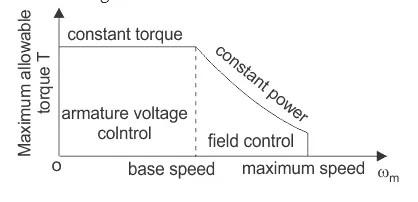
fig (1)
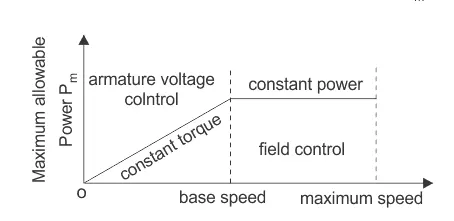
fig (2)
As shown in fig 1 at the initial state the torque supply is maximum till the base speed. after which when the motor further gains the speed to the maximum speed the torque started to decrease and the curve represents the constant power zone.
the constant torque area is controlled by the armature voltage and the constant power area is field control.
Armature controls
armature voltage control is preferred because of its high efficiency and good speed regulation and good transient response. But the only disadvantage of this method is that it can only operate under the rated speed because the armature voltage cannot be allowed to exceed the rated value.
Field control
When speed control is required above the rated speed, field flux control is used. Normally in ordinary machines, the maximum speed can be allowed up to twice the rated speed and for specially designed machines this can be allowed up to six times the rated speed.
In fig 2, the graph has been plotted between the max allowable power and the speed, in which at starting of the motor the power is gradually increasing w.r.t speed, and after crossing the base speed or the rated speed the power becomes the constant due to the field control and reach to the maximum speed.
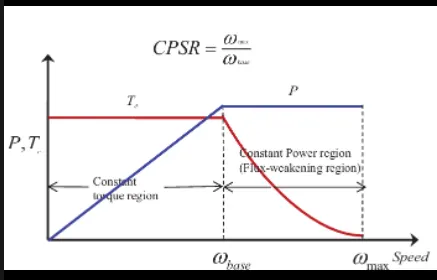
Braking is a very important operation for DC motor drives. The need of decreasing the speed of a motor or stopping it totally may arise at any moment, that’s when braking is applied. braking of DC motors is basically developing a negative torque while the motor works as a generator and as a result, the motion of the motor is opposed.
In the above figure, it is clearly shown that after crossing the base speed the torque gradually decreases at the maximum speed. if it is a braking torque then it also decreases with the increase in the speed. So it's not possible for the motor to develop a high braking torque at maximum speed since the speed is controlled by the field flux controlled the speed in the field controlled become twice or greater than the rated speed it is not possible to develop the high torque at high speed.
electric and mechanical brakes are coordinated
hybrid drive trains are the capability to recover the kinetic energy of the bodies
translating mass that is otherwise dissipated as heat by the friction brakes. Such a system is called a
regenerative brake system (RBS). The majority of current hybrid electric vehicles operate the traction
motor as a generator, providing a brake torque to the wheels. The energy recovery takes place by
transforming this torque into electrical energy via the generator that stores it in an energy storage
system (e.g. battery)
the electric motor is unable to provide all the brake torque
necessary for large decelerations. If regenerative brake torque is only applied to one axle, stability and
maneuverability issues can occur. Therefore, regenerative braking is operated in
conjunction with a friction brake system. A frequently used name for regenerative braking is ‘hybrid’
braking, as it obtains the total brake torque from two different sources . Two groups of
regenerative brake systems (RBS) can be roughly distinguished named parallel RBS and series RBS, or
“without torque blending” and “with torque blending”
In both braking systems, a portion of the kinetic energy is recuperated by the RBS and the
remainder is dissipated by the friction brakes. Just like vehicle propulsion, the braking can be divided into
three different working stages;
- Generator (electric) braking
- Hybrid braking (Add-on or blended)
- Friction braking
Parallel braking
A parallel RBS works ‘in parallel’ with a friction brake system, meaning that the conventional
brake system layout remains virtually unchanged. The brake pedal is mechanically coupled with the
brake caliper and the brake pressure is proportional to the pedal travel and force. The electric motor (in
generator mode) will add an additional brake torque. The driver’s brake pedal feel must be the same as
a conventional brake system. That means, with the same pedal input (i.e. travel and force), the total
brake force of the parallel RBS should reach the same deceleration as the conventional system.
Therefore, the brake torque added by the generator can’t be very large and the recuperation potential is
limited. A big advantage of parallel RBS is that there is no requirement for brake-by-wire.
Series braking
Series RBS realizes truly blended braking between the friction brake system and the generator. The aim
of the series or blended brake control is, to achieve a speed-independent constant deceleration for a
given brake pedal position, thus ‘blending’ regenerative torque and friction brake torque. This is
particularly important for high power generators, as they can be used for a large portion of the
requested brake torque. The regenerative brake is prioritized over the friction brake system, especially at
low deceleration braking. When the brake pedal is further or faster depressed, the brake control unit
(BCU) adds friction brake torque to gain deceleration.
Make a MATLAB program that plots the contour of given motor speed, torque, and efficiency values. Attach the code as a .m file and attach a screenshot of all the plots.
%MATLAB program which plots contour of given motor speed, torque and efficiency values
 clear all
 close all
 clc

 % values of Speeed in RPM
 x = linspace(0,1500,500);
 % values of torque in N-m
 y = linspace(0,500,100);

 % input paramerters
 Kc = 0.2; %constant copper losses
 Ki = 0.008; %constant Iron losses
 Kw = 0.00001; %constant windage losses
 Cl = 20; % constant losses

 % creating a mesh between speed and torque

 [X,Y] = meshgrid(x,y);
 OP = (X.*Y); %calculating output power
 % calculating the losses
 A = (Y.^2).*Kc; %copper losses
 B = x*Ki;  %Iron losses
 C = ((X.^3).*Kw); %windage losses

 IP = OP+A+B+C+Cl;  % calculating input power

 Z = OP./IP;

 % inputing the different values of efficiency
 E = [0.70,0.75,0.80,0.85,0.90,0.923];

 %making a contour plot for the speed Torque and Efficiency

 grid off
 contour (X,Y,Z,E,'ShowText','on');
 title ('contour plot betn speed,torque, efficiency')
 xlabel ('Speed (RPM)')
 ylabel ('Torque (N-m)')
 colorbar
 hold on
Code description:
- the value of speed and torque is taken in an equally spaced vector by using linspace command.
- The input parameters are then assumed to find the different losses.
- For efficiency, the row matrix different values are made
- the meshing is done between the speed and torque by using meshgrid command
- To plot the contour plot the contour plot is used.
- the color bar shows the value of efficiency on the different color lines.
Calculations :
Losses:
- copper losses: these are the losses generated by the copper wire
I^2 *R = Kc *T^2
where, Kc = constant
- Iron losses: These losses are generated by magnets and they are also called magnetic losses.
Ki*W
where Ki = magnetic field constant
W = speed
- Windage losses: These are friction or mechanical losses depending on the size and shape of the motor
Kw*W^3
where Kw = windage constant
W = speed
Now the
As we know that the
power = speed*Torque
therefore the output power = speed*torque
and the Input power = output power + copper losses + iron losses+windage losses+constant losses(C)
Therefore. efficiency = Output power/input power.
Result:
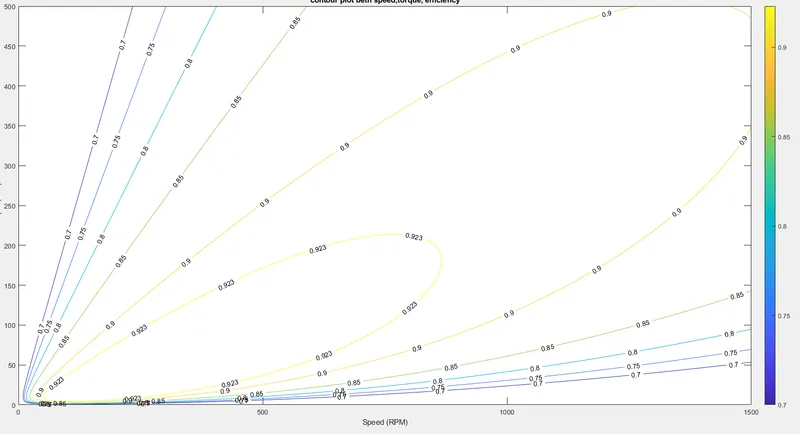
the graph shows that at any value of the speed and torque what will be the efficiency
or for any efficiency what will be the speed and torque.
Conclusion:
a MATLAB program that plots the contour of given motor speed, torque, and efficiency values is successfully coded.