Week-11 Challenge: Braking
CASE-1 For a defined driving cycle, calculate the energy required for braking.
The following formula is used to calculate the braking force of a car given a speed, weight, and stopping distance.
F = (0.5*m*v^2)/d
Where ,
- F-is the required force to stop in distnace d
- m-is the mass of the car
- v-is the velocity of the car before braking
- d-is the stopping distance
Braking force :
Alternatively known as Brake Power, the braking force refers to the total amount of force exerted on a moving body that causes it to slow to a halt.The bodyor the vehiclemust be traveling at a known constant velocity for this force to be calculated correctly. The brake force is measured in newtons “N.”For us to calculate the braking force, we must first know the moving body’s constant speed, weight, and stopping distance. After acquiring these factors, apply the equation.
Kinetic Energy = Force x Distance
First, we calculate the kinetic energy. For the brake to stop a car, the kinetic energy has to be a zero. And so, the car’s
speed and weight (divided by the value of gravity) are used to calculate it.
Braking Energy = ½ x Mass x Velocity
The accuracy of these calculations is limited by several conditions, though. If the surface of the road is icy or wet, such parameters can change completely.
Drive-cycle :
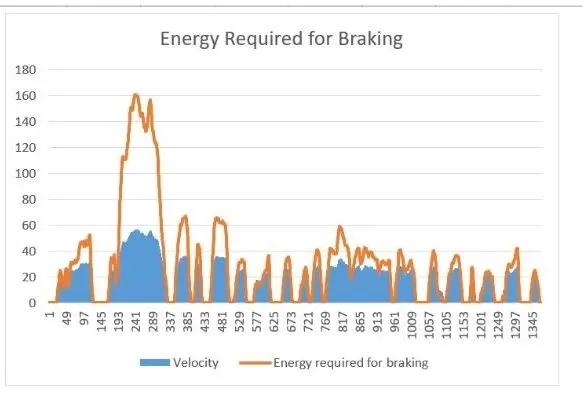
here we can calculte the braking energy for each time seconds slowdown - and stop the vehicals in this case we calculate the braking energy by using UDDS drive cycle.
here we consider the value of mass of vehicals is 1000 and other value may take velocity with respects to time instants
we performs such calculations of braking energy .

CASE-2
Why electric motor can’t develop braking torque at high speed similar to starting? How electric and mechanical brakes are coordinated?
Why electric motor can't develop braking torque at high speed similar to starting ?
When the motor is at rest and it has to operate from standstill position to the reach the moderate speed the higher torque is required to bring the motor in operation . Whereas when the vehicle is already at high speed the copping or the limit is reached by the motor operation and thus any further higher torque could not be obtained while broking The braking operation happens in the motion which is been distributed as per proportion in the BRAKE ENERGY and the REGENERATIVE BRAKING .
How electric and mechanical brakes are coordinated ?
In Mechanical braking which we usually see and experience in all vehicles the brake pedal in the vehicle cabin helps us to engage or disengage the brakes Currently the braking technology have done wonders by inventing life saving braking technologies such as ABS , EBD , BA and mny others . All these technologies play vital role in stopping the vehicle and coming back to rest from a high speed in all these vehicles when the driver opplies the brakes the brake peds come closer to the disc connected with the driving disc . The brake pads usually help in efficient braking.
There are two generic methods by which the vehicle could be braked in the ELECTRIC BRAKES .
Series - The Regenerative Braking or the Mechanical Braking both are applied one after another .
Parallel- The Regenerative Braking or the Mochnical Braking both are applied Parallely.
When the brake pedal is pressed the hydraulic fluid reaches the brake piston and created the braking pressure on the wheels and the same kinetic energy is been used by the Regenerative Braking for generating more power using the Bi - directional motor which operates as a generator while braking.
An example of the proposition of Regenerative Braking and the Mechanical Braking,
NISSAN LEAD - EDIB ( ELECTRONIC DRIVEN INTELLEGENT BRAKING )
EDIB ( Electric Driven Intelligent Brake ) controls the regenerative brake and friction brake to support both of these requirements . Further , it also controls the reactive force from the pedal in order to unify the feeling when stepping down on the pedal and the sense of deceleration .
CASE-3
Make a MATLAB program which plots contour of given motor speed, torque and efficiency values. Attach the code as a .m file attach a screenshot of all the plots.
clear
close
clc
%speed array
w=linspace(0,1000);
% torque array
T=linspace(0,300);
%loss coefficients
kc=0.18; % coppeer losses
ki=0.006; %Iron losses
kw=0.000015; % windage losses
% meshgrids
[x,y]=meshgrid(w,T);
copper_loss=(y.^2)*kc ;
iron_loss=x*ki;
windage_loss=(x.^3)*kw;
k=20;
output_power=x.*y;
input_power = (copper_loss)+(iron_loss)+(windage_loss)+(output_power)+k;
Eff=(output_power)./(input_power);
n=linspace(0.7,0.95,10);
contourf(x,y,Eff,n);
title('speed torque characteristics ')
xlabel('speed rad/s')
ylabel('torquen N-m')
Result Graph:-
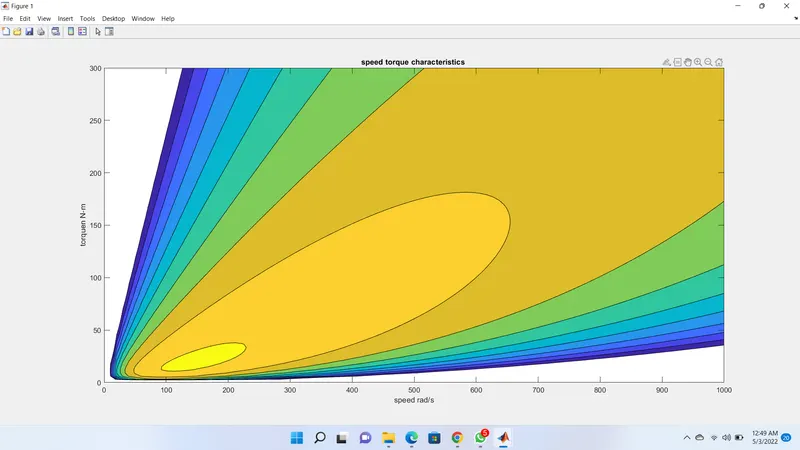
from the above graph we can see that particular speed and torque efficiency is maximum i.e 95 % where the speed is x=151 rad/sec @24 N-m speed increase the efficiency of motor will reduce.