Week-11 Challenge: Braking
1
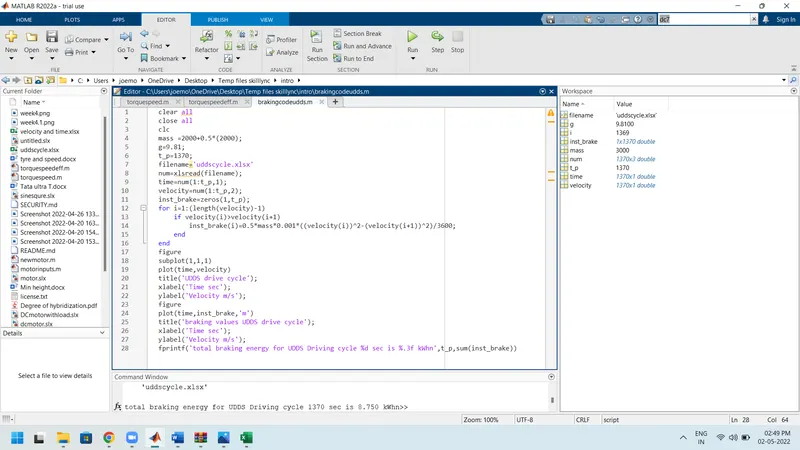
clear all
close all
clc
mass =2000+0.5*(2000);
g=9.81;
t_p=1370;
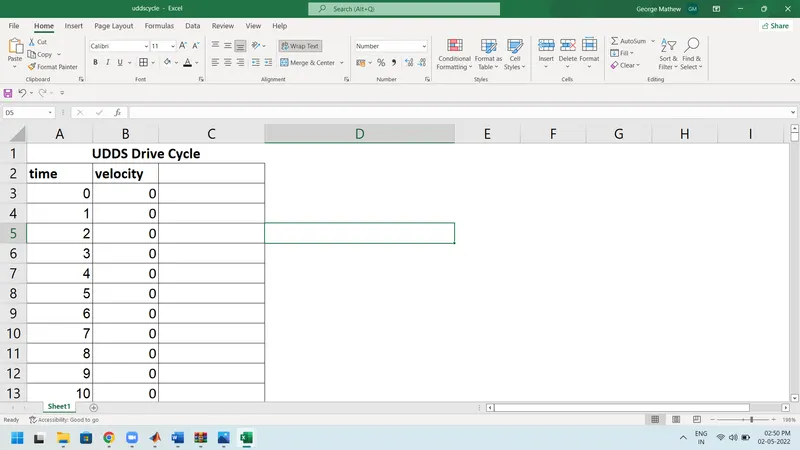
filename='uddscycle.xlsx'
num=xlsread(filename);
time=num(1:t_p,1);
velocity=num(1:t_p,2);
inst_brake=zeros(1,t_p);
for i=1:(length(velocity)-1)
    if velocity(i)>velocity(i+1)
        inst_brake(i)=0.5*mass*0.001*((velocity(i))^2-(velocity(i+1))^2)/3600;
    end
end
figure
subplot(1,1,1)
plot(time,velocity)
title('UDDS drive cycle');
xlabel('Time sec');
ylabel('Velocity m/s');
figure
plot(time,inst_brake,'m')
title('braking values UDDS drive cycle');
xlabel('Time sec');
ylabel('Velocity m/s');
fprintf('total braking energy for UDDS Driving cycle %d sec is %.3f kWhr',t_p,sum(inst_brake))
.
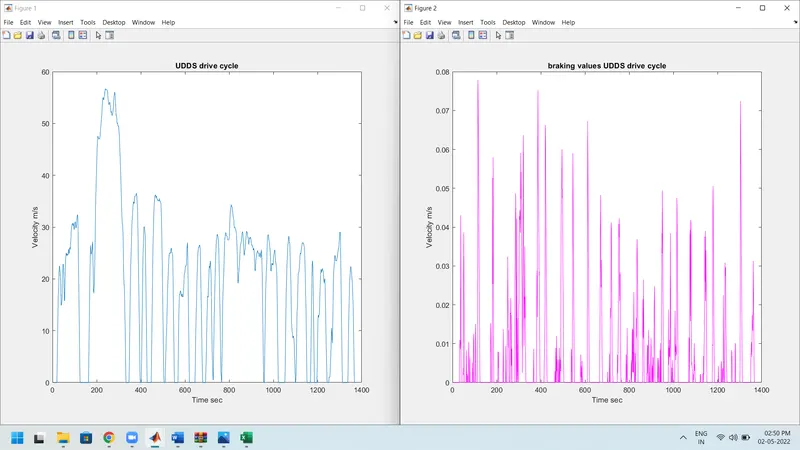
UDDS driving cycle, the energy required for braking 8.750.
2. AC motor and DC motor there is no torque at maximum speed and hence the torque decreases at high speed as the speed tends to be at high speed. This situation does not occur at the start of the acceleration because most of the torque is used to inc. the kinetic energy of the load and when the speed is already high and no extra load can be applied it is not possible to increase the torque as well as to develop braking torque Therfore the braking operation happens in the motion which is been distributed as per the proportions in the regenerative braking and the Brake Energy.
There are two types of braking
Mechanical Braking: Mechanical brakes all act by generating fictional forces as two surfaces rub against each other. The stopping power or capacity of a brake depends largely on the surface area of frictional surfaces as well as on the actuation force applied. (Band brakes, Drum brakes, Disc brakes)
Electric and Mechanical brake :
There are mainly 2 ways by which the Electric Vehicles could be stoped:
• Series Regenerative braking and mechanical brakes both are pressed one after another.
The brake pedal is depressed and depends on the level of depression, brake torque is carried forward Now this brake torque passes into the brake control strategy block and then it is checked if battery state-of-charge is below 80% which is set as the maximum permissible level of charge. If that condition is ok, then the battery is recharged. If the overall brake torque requested is less than or equal to the maximum regenerative torque, then the vehicle brakes purely on regenerative torque and the battery is charged.
• Parallel- Regenerative braking and mechanical brakes both applied.
When brake pedal is depressed the hydraulic fluid reaches the brake pistons and created the braking pressure on the wheels and the same kinetic energy is been used by the Regenerative Braking for generating more power using the Bi-directional motor which operates as a generator while braking.Motor-generator can provide a maximum of 322 Nm of generator torque at or under the normal speed. The generator is such that the normal speed of the generator corresponds to a velocity of 124 kmph, which is the maximum speed limit on highways. Hence regeneration works, as long as the vehicle is braking from a speed of under 124 kmph and the requested brake torque on the front driven wheels, after the front rear brake split is greater than or equal to max. generator torque. If that condition is satised, then regenerative and friction braking operates or it's just the friction brakes at the driven and non-driven axle.
3.A MATLAB program which plots contour of given motor speed, torque and efficiency values.
clear all
close all
clc
v=linspace(1,1200);
t=linspace(1,500);
Lcu=0.1;
Li=0.006;
Lw=0.0001;
Lc=20;
[X,Y]=meshgrid(v,t);
P_out=(X.*Y);
P_c=(Y.^2)*Lcu;
P_i=X.*Li;
P_w=(X.^3)*Lw;
P_in=P_out+P_c+P_i+P_w+Lc;
eff=P_out./P_in;
N=[0.75,0.8,0.85,0.86,0.87,0.88,0.89,0.90,0.91,0.92,0.93,0.94,0.95];
figure(1)
box off
contourf(X,Y,eff,N);
colorbar
title('Torque-speed efficiency');
xlabel('Speed Rpm');
ylabel('TorqueN-m');
zlabel('Motor efficiency');

figure(2)
surf(X,Y,eff)
colorbar
title('Torque-speed efficiency');
xlabel('Rpm');
ylabel('N-m');
zlabel('Motor efficiency');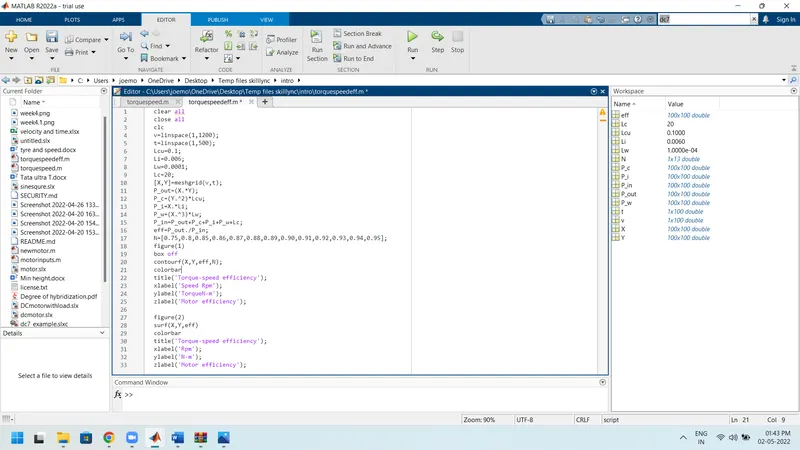
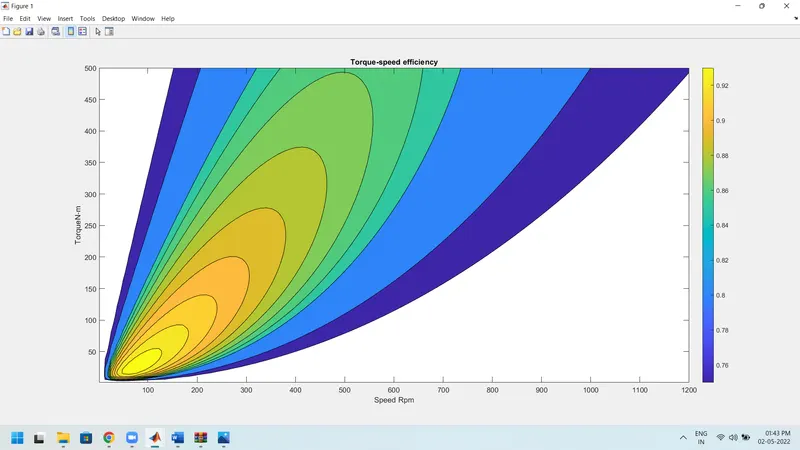
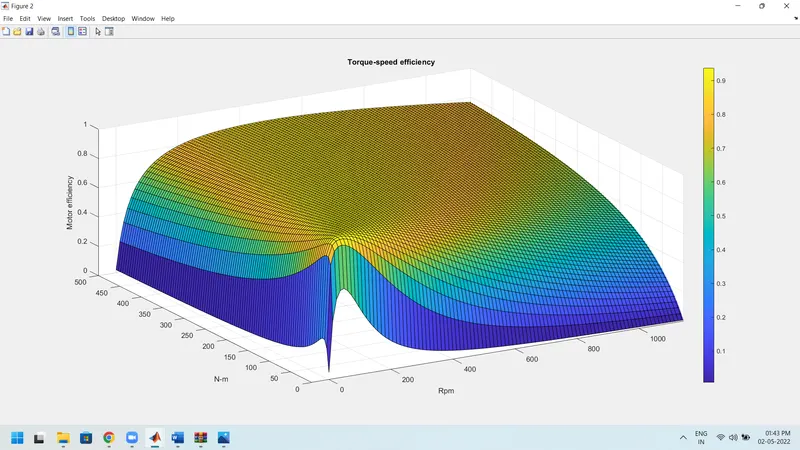
Attached the code as a .m file attach a screenshot of all the plots.