Week-11 Challenge: Braking
1. Energy required for braking :-
Drive cycle :-
It is a set of point drawn between speed vs time of a vehicle to experience its performance , stability , efficiency etc. By using this cycle we can compare different types vehicles .
Breaking :-
Its function is to retard the moving vehicle from motion to rest by producing its best performance .
Breaking plays an important role in vehicle in every conditions . Automobiles are using two breaks one is leg pedal break abd other is hand break ,the leg pedal break is used to slow down the vehicle while hand break are used when the vehicle is parked like in a cliff road. The moving vehicle have some kinetic energy while breaking its converted to heat energy in the breaks which are connected to the wheels of the vehicle and then it comes to rest position.
Kinetic energy is given by = 1/2 *M*(Vi - Vf)^2
M = mass of the system
Vi = initial velocity of the system
Vf = final al velocity of the system
Here we have to create a excel sheet then by importing it to the matlab we can get the breaking energy .
DRIVE CYCLE :-
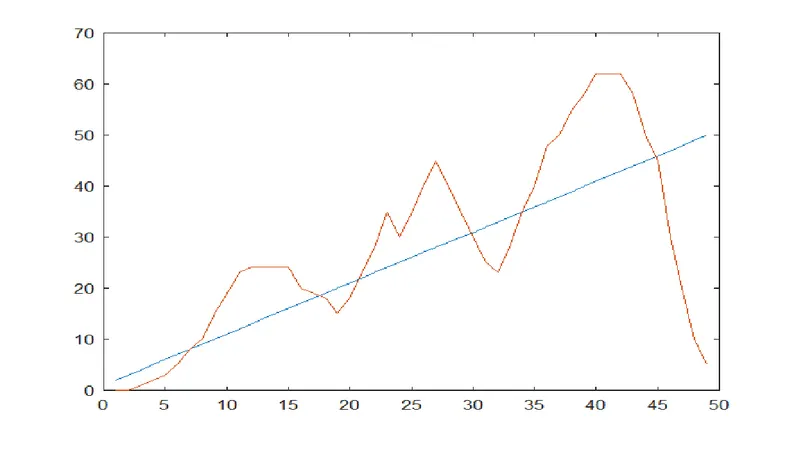
Here we prepare an excel sheet where the values of time and velocity are given and time of breaking also given so by looking into this data we can calculate the breaking energy of thr vehicle .
Lets by taking M = Total weight = 500 kg
We have taken four cases of breaking applied so
for 1st breaking its energy will be = 1/2 * 500 (24-15)^2
= 20.25 kj = 0.02025 joule
for 2nd breaking its energy will be = 1/2 * 500 (35-30)^2
= 6.25kj = 0.00625 joule
for 3rd breaking its energy will be = 1/2 * 500 (45-23)^2
=5.500kj =0.0055 joule
for 4th breaking its energy will be = 1/2 * 500 (62-5)^2
= 14.250kj = 0.01425 joule
Total energy required for breaking is = sum of energy at all four instant
=46.25 Kj
Hence ,here the total energy required is 46.25 Kj .
2.
Electric motor can’t develop braking torque at high speed because when its started breaking then the supply from the main will be cut off so here the motor starts acting like generator which induces less torque as it will have a weaked field interaction.
Breaking can be achived by both mechanical and regenerative method .
Mechanical method :-
Here the vehicle in breaking condition change its energy from kinetic energy to heat energy . Take a case that a vehicle is moving with a speed , it has its acceleration and it applys break here the moving vehicle starts deacelerating and finally comes to rest here its energy converted to heat energy of the break pedal that are connected to the wheel and finally wheel stops rotating .
Regenerative method:-
Here while applying the brake the energy will converted and we can store it . When breaks are applied the motor behaves like generator and produce electrical energy which we can store or recharge the battery pack. To run the motor some current is required but when some externl force is applied to run th emotor (while breaking) then its acts like generator and that produced electrical energy . When motor rotate in one direction it converts elctrical energy to mechanical energy and its a function of accelerating and when it rotates in other direction it converts mechanical energy to electrical energy then its a case of deaccelerating or breaking .
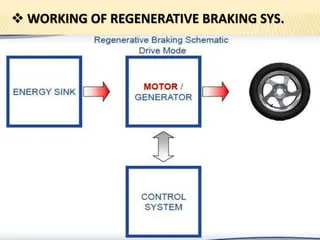
Breaking should be distributed in both the wheels like front and back to maintain stability of the vehicle . Here in regenerative breaking rate of charging is less than rate of discharing .
Electric and mechanical brakes are coordinated :-
In an electric motor the breaking system is distributed in two ways one is electric breaking and the other is mechanical breaking while electrical breaking is not much useful while in large deaccelerations so some mechanical breaks also used for better performance.
To avoid any bad functionalities these are connected in various manners like
1.Series connection
Here both the breakes are applied one after another to deaccelerate the vehicle .
2.Parallel connection
Here breaks are applied parallely to both of them . It is effective .
Hence , for higher speed both breaks application simuntaniously is more useful than only regenerative breaking and at low speed we can use regenerative breaking .
3. To plots contour of the motor :-
A motor has various types of losses in it which dereases its efficiency and power. Some losses are :-
1. Copper loss :-It is also called the (I^2*R) losses where
I = current
R = Resistance
As torque corresponds to the current it can be given as Pcu = Kc * T^2
Pcu = copper loss
Kc = constant
T = torque
2. Iron lossses :- These are called magnetic losses . It depends up on the speed
Pi = Ki*W
Ki = constant
W = angular speed
3. Windage loss:- This is a mechanical losses and it depends upon the shape and size of the motor
Pw = Kw * W^3
Kw= constant
W = angular speed
4. Constant losses :- These are the other losses found in the machine so we here we take this by taking some constant value C .
So the total loss = Pcu + Pi + Pw + C
= Kc*T^2 + Ki*W + Kw*W^3 + C
Efficiency = output power / input power
MATLAB CODE :-
clear all
close all
clc
speed= linspace (1,2000);
torque= linspace(1,500);
Kc=0.2;
Ki= 0.008;
Kw=0.00001;
con =20;
[X,Y]= meshgrid(speed,torque);
Outputpower = (X.*Y);
B= (Y.^2)*Kc;
C=X*Ki;
D= (X.^3)*Kw;
Inputpower = (Outputpower +B+C+D+ con);
Z= Outputpower./Inputpower;
V= [0.7,0.8,0.85,0.90,0.91,0.92,0.925,0.93];
box off
grid off
contourf(X,Y,Z,V);
xlabel=('speed');
ylabel= ('Torque');
OUTPUT:-
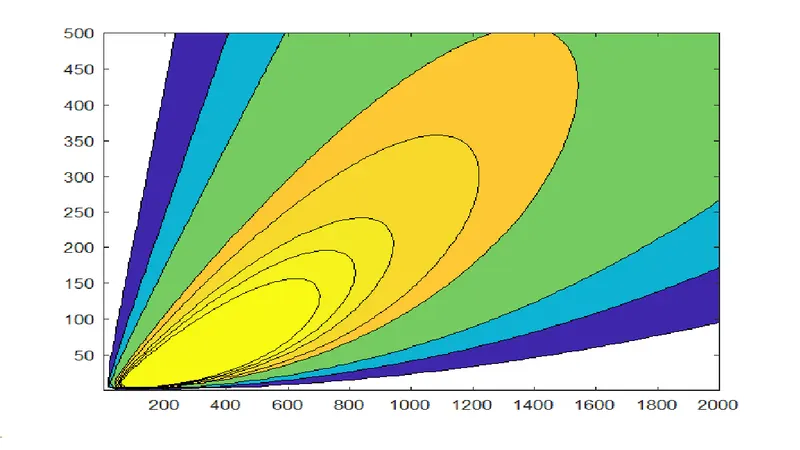
Hence , here discussed the losses of the machine which directly affect its efficiency , speed etc .