Week-11 Challenge: Braking
1. For a defined driving cycle, calculate the energy required for braking.
A: Drive cycle- it is the variation in speed with respect to time. It gives constant voltage computation. It helps to know about the fuel consuption of vehicles. It is more realistics case for better modeling of energy and range of battery. Mainly developed for practical test of emissions. A driving cycle is a reference driving pattern when discussing emmission and range.
What is braking?
- It is as important as acceleration or starting of vehicle.
- It is mainly for safety and stoping of vehicles.
- It requires power to slow down the vehicle.
- Usually brakes are applied by friction method.
- When brakes are applied there will be a stoping force that brings the vehicle to rest and dissipates kinetic energy in the form of thermal energy or heat.
Vehicle braking power requirement calculation:
For braking power requirement calculation we need to find what happens under decceleration condition then we can find the amount of power required.
Kinetic Energy, E= 1/2*m*V^2 (J)
E= 1/2*m*(Vf-Vi)^2
where,
m is the mass of vehicle in kg
V is velocity of the vehicle in m/s
By using an excel calculator lets define a driving cycle by our own and find the corresponding kinetic energy.
Result:
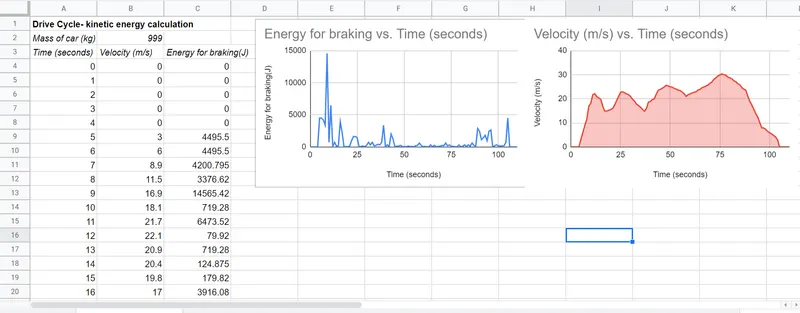
https://docs.google.com/spreadsheets/d/1n9vKcrtg_halK_9J6cOINh1jNuiTD4oePwKnFTggLL4/edit?usp=sharing
2. Why electric motor can’t develop braking torque at high speed similar to starting? How electric and mechanical brakes are coordinated?
A: Braking:
It is as important as acceleration or starting of vehicle. It is mainly for safety and stoping of vehicles. It requires power to slow down the vehicle. Usually brakes are applied by friction method. When brakes are applied there will be a stoping force that brings the vehicle to rest and dissipates kinetic energy in the form of thermal energy or heat.
- Why electric motor can’t develop braking torque at high speed similar to starting?
2 types of braking includes: Friction braking and braking without friction.
Engine braking is the conventional method which doesnot involve a pedal or brake. In electric braking motor inherently applies the brake similar to engine braking the propulsion source itself applies brakes. Mechanical braking systems uses a friction force to convert kinetic energy to thermal energy. Braking systems which doesnot involve friction braking is called regenerative braking system in which kinetic energy is converted to power supply.
Electric motor can't develop braking torque at high speed similar to starting, because Braking torque is applied in the opposite direction of the rotation. We can use a mechanical brake to produce a braking torque. When electric motor is at rest condition it has to operate from standstill position to reach moderate speed and a high torque is required to bring the motor into operation. But when vehicle is at high speed motor will be at its peak operation thus any further increase in torque couldnot be obtained by braking.
- How electric and mechanical brakes are coordinated?
Electric braking: Braking depends on direction of motor torque and flux of motor. It includes regenerative braking, plugging type, dynamic braking.
- Regenerative braking: When motor speed Nm is greater than synchronous speed Ns regenerative braking can occur. This is used with variable frequency source at sub synchronous speed.
- Plugging braking: Terminal of supply is reversed thus torque of motor reverses thus speed decreases.
- Dynamic braking: At running condition supply voltage is disconnected and a braking resistor is connected across the connection.
Mechanical braking: It is the type of braking system in which the brake force applied on the brake pedal is carried to the final brake drum or disc rotor by the various mechanical linkages like cylindrical rods, fulcrums, springs etc. In order to stop the vehicle.
In case of brake control strategies mechanical braking and electric braking techniques are combined. It includes series and parallel type control.
Series: Here mechanical brakes and electric or regenerative brakes are applied one after other. At a time only one brake system can be applied. It is further divided based on whether we want comfort of friver or brake behaviour compared to energy efficiency.
Parallel: Here both the mechanical brake and regenerative brakes are applied at the same time. Parallel braking happens both the time.
Electric driven intellegent brake ( EDIB): Considering an eg. case of brake by Nissan leaf. Here it is the combination of hydraulic + mechanical+ regenerative brake. At lower speed higher braking torque is neede and it use regenerative braking and at higher speed it combines all the braking methods.
3. Make a MATLAB program which plots contour of given motor speed, torque and efficiency values. Attach the code as a .m file attach a screenshot of all the plots.
A: Contour lines :It shows 3 dimentional surface in 2 dimensional plane. It is a representation in same height. All the points in same line has same efficiency. Used for motor efficiency mapping. Same program is used for all motors to find contour.
Motor has various types of losses during its working. It includes copper losses, iron losses, windage losses and constant losses.
- For copper loss, I^2*R ∝ T^2
I^2*R=Kc*T^2
- For iron loss / magnetic loss = Ki*W
- For windage loss = Kw*W^3
- Constant loss = C
Program:
clc
clear all
close all

Velocity=linspace(1,1000);
Torque=linspace(1,250);

kc=0.3;%constant for copperloss
ki=0.009;%constant for iron loss
kw=0.000015;%constant for windage loss
C=25;%constant motor losses

[X,Y]=meshgrid(Velocity,Torque);%to make mesh
Op_power=(X.*Y); %outputpower

Cu_loss=(Y.^2)*kc; %copperloss
Fe_loss=X.*ki; %ironloss
Windage_loss=(X.^3)*kw; %windageloss
Ip_power=Op_power+Cu_loss+Fe_loss+Windage_loss+C; %inputpower
E=Op_power./Ip_power;%efficiency
V=[0.55 0.60 0.65 0.70,0.75,0.80,0.82,0.85,0.875,0.9,0.91,0.92,0.93];%efficiency points for plotting contour

box off
grid off
contour(X,Y,E,V);
colorbar
xlabel('Rotor speed (rpm)')
ylabel('Torque induced N.m')
zlabel('Efficiency')
title('Torque Speed curve')Output:
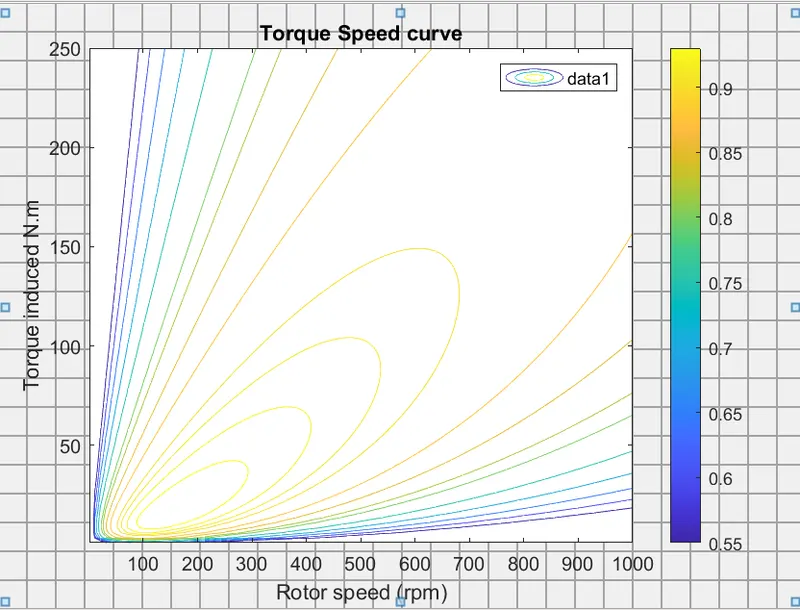
https://drive.google.com/file/d/1nRqXFQUBfPXFnqJ8M7rxd-QR7pqa8WAZ/view?usp=sharing