Week-11 Challenge: Braking
Q1. energy required for breaking based on a driving cycle
We know that the equation of kinetic energy from breaking is given as
E = (1/2) *m *(Vi – Vf )^2
Where,
M – mass of the vehicle in Kg
Vi – initial speed of the vehicle in m/s
Vf – final speed of the vehicle in m/s
Form the drive cycle 15 breaking points were obtained. The mass is set at a constant 2000. The energy required for breaking is given below.
|
no.of breaking |
initial speed (Vi) m/s |
final speed (Vf) m/s |
mass Kg |
breaking energy |
|
1 |
8.25 |
7.5 |
2000 |
562.5 |
|
2 |
10 |
7 |
2000 |
9000 |
|
3 |
9 |
5.8 |
2000 |
10240 |
|
4 |
11 |
10 |
2000 |
1000 |
|
5 |
11.5 |
9.2 |
2000 |
5290 |
|
6 |
10 |
7.7 |
2000 |
5290 |
|
7 |
12 |
8.3 |
2000 |
13690 |
|
8 |
12.5 |
0 |
2000 |
156250 |
|
9 |
13.5 |
10.5 |
2000 |
9000 |
|
10 |
15 |
11.2 |
2000 |
14440 |
|
11 |
11.4 |
9.2 |
2000 |
4840 |
|
12 |
15.3 |
11 |
2000 |
18490 |
|
13 |
11.2 |
10 |
2000 |
1440 |
|
14 |
13.4 |
12 |
2000 |
1960 |
|
15 |
15 |
0 |
2000 |
225000 |
|
total energy in KW |
476.4925 |
The total energy used for 15 time braking is 476.495
Q2
Why electric motors cannot develop breaking torque at high speeds. How are electric and mechanical breaks co – ordinated.
Let us consider the torque speed characteristics.
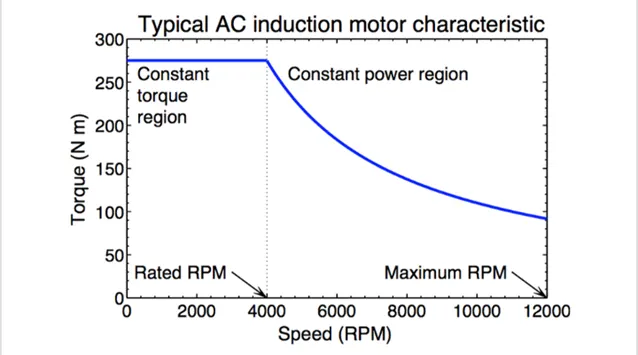
From the above curve we have two region constant torque and constant power region. at the start the motor achieves peak torque till reaches a certain motor speed range from where it will rapidly drop. The reason due to the drop in torque is due to the motor shaft reaching critical speed the area where the peak torque is constant is known as the peak constant torque region of the motor.
The region where the torque decreases is known as the constant power region as the Power generated by the motor will be at its peak.
Since the torque produced at the constant power region is very low it is not possible to develop enough braking torque in this region. The braking torque produced increases as the speed decreases.
How are electric brakes and mechanical breaks co – ordinated?
In electric vehicles two types of braking systems are used that are electric and mechanical braking system.
Electric braking system
In an electrical braking the winding of the motor is used to produce a braking torque. A braking torque is developed during the braking operation. This braking torque opposes the motion of the rotating member or shaft. This is achieved by suitably changing the electrical connection of the motor. The motor operates on a speed – torque characteristics, depending upon the method of braking employed.
Mechanical braking system
In mechanical braking the frictional force between the rotating parts and the brake drums produces the required braking. To achieve this mechanical equipment such as brake linings and brake drums are required. Whether electrical or mechanical the braking of the driver should stop the motor at the specified point of time and position.
Q3
clear all
close all
clc
p=linspace(0,2000);
q=linspace(0,850);
kc = 0.2; % copper losses constant
ki = 0.008; % iron losses constant
kw = 0.00001; % winding losses constant
[X,Y] = meshgrid(p,q); % to create a 3d array
cl =(Y.^2) * kc; % copper losses equation
il =X * ki; % iron losses equation
wl =(X.^3 ) * kw; % winding losses equation
k=20; % constant motor losses
outputpower=X.*Y; % power equation
inputpower=outputpower+cl+il+wl+k; % input power equation
Z=outputpower./inputpower; % efficiency
n=[0.7,0.8,0.85,0.9,0.91,0.92,0.93,10]; % mapping the contours of the efficiency
contourf(X,Y,Z,n);
title('speed torque characteristics')
xlabel('speed in rad/s');
ylabel('torque in N-m');
legend('0.7,0.8,0.85,0.9,0.91,0.92,0.93,10');
hold on
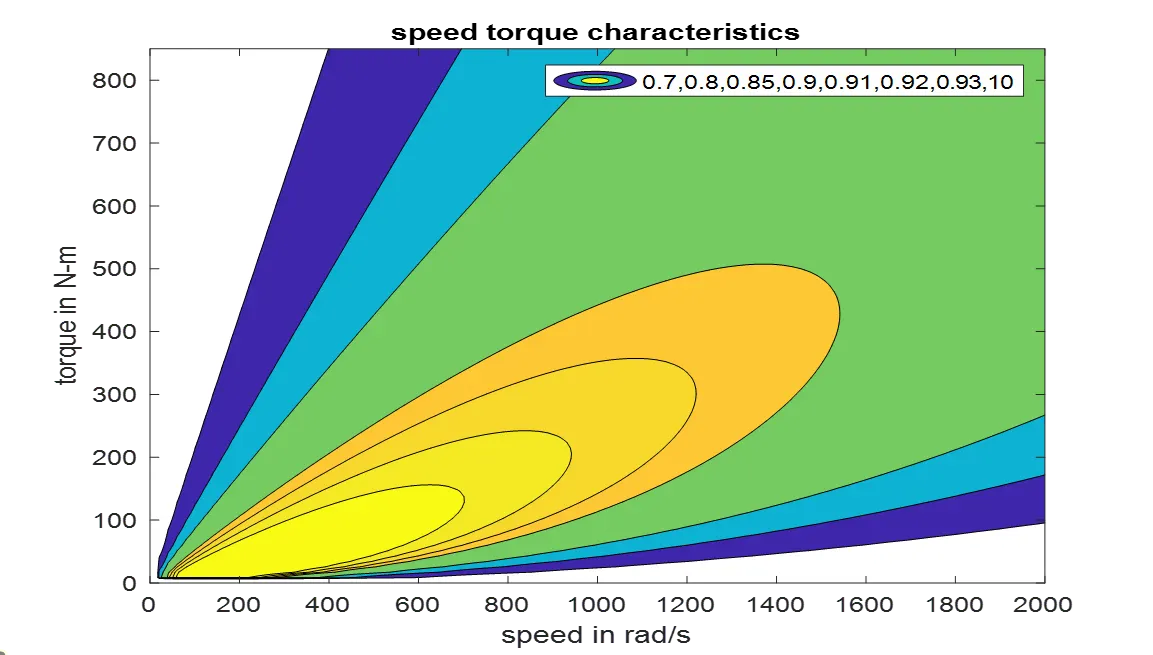
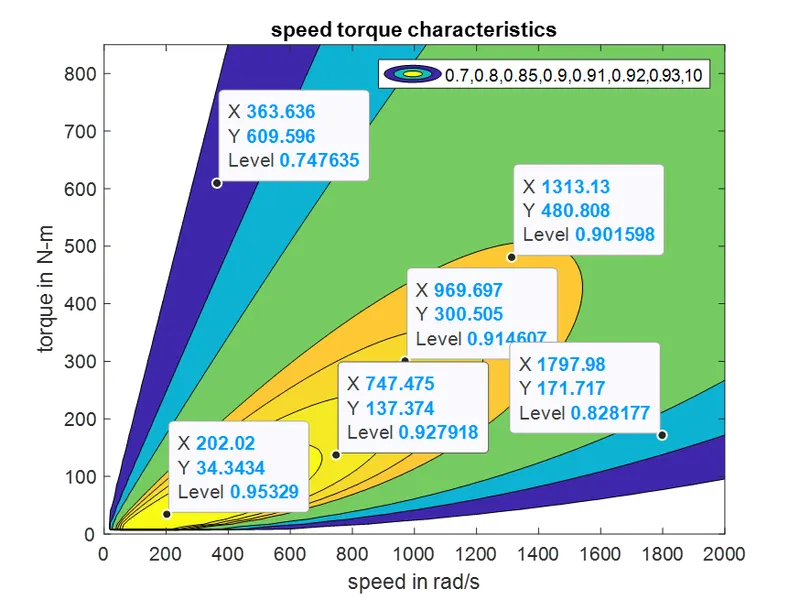
from the above result we could see that only at a paarticular speed and torque the efficiency i.e. at maximum95%
where, speed x=202.02 rad/s at 34.3434 N-m torque. as the speed increases the efficiencies of the motor will be reduced