Week-11 Challenge: Braking
1.
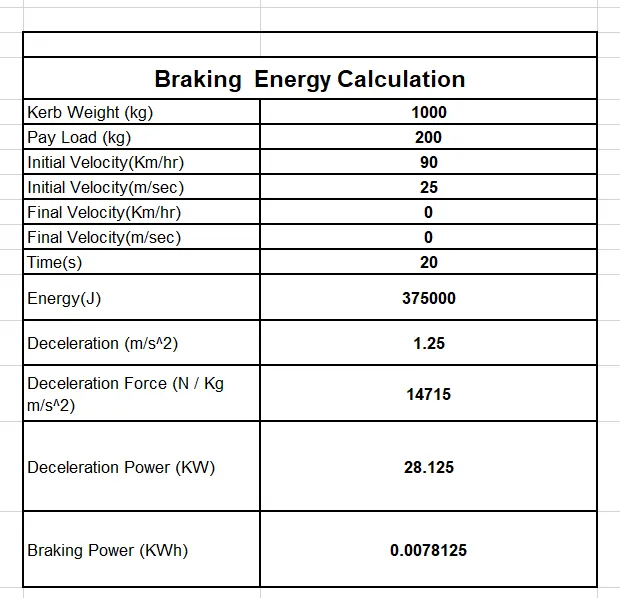
Decelerationis just same as accelaration.we can calculate it with same equation
Energy =1/2 (m*v^2)
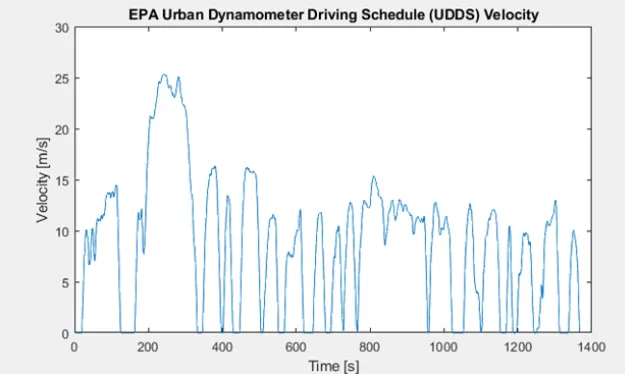
consider the UDDS cycle
Breaking energy calculation
2.The electric motor cant develop braking torque at high speeds. because once the electric supply is pulled off from the motor it acts as a generator and due tothe flux weakening effect of the electric generator the generator produces low torque as expected. Regenerative breaking is an energy recovery mechanism that slows down a moving vehicle or object by converting its kinetic energy into a form that can be either used or stored until needed. In this technique the motor uses vehicles momentum to recover energy that would otherwise lost as heat in break pads. In this set up motors work as a generator.
Coordination of electrical and mechanical break: Normally two type brakes are in a vehicle, regenerative breake or electrical break and Normal mechanical breaks.Currently vehicles has Electronic break distribution. so the ECU will decide how much amount of break should be distributed across different wheels and between the mechanical breaks and regenerative breaks.
3.
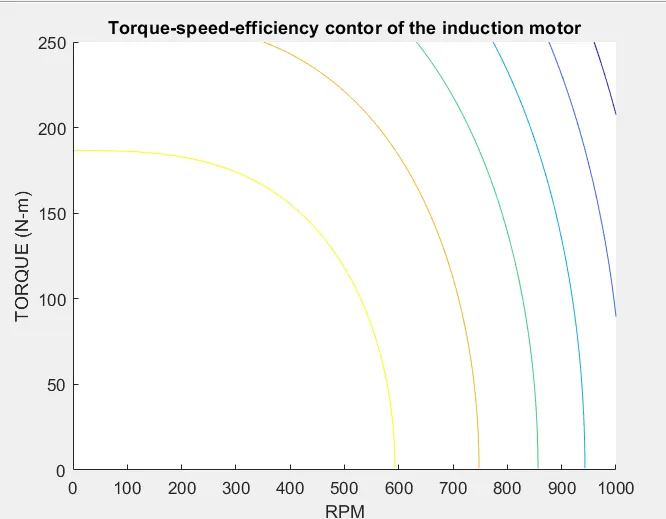
Torque=linspace(1,250,250)
Speed=linspace(1,1000,250)
[w,T]=meshgrid(Speed,Torque);
Kc=0.3;
Ki=0.009;
Kw=0.00005;
C=30;
Pout=w*T;
C_loss=Kc*(T.^2);
I_loss=Ki*w;
W_loss=Kw*(w.^3);
Pin=Pout+C_loss+I_loss+W_loss+C
eff=Pout./Pin
contour(Speed,Torque,eff)
title('Torque-speed-efficiency contor of the induction motor');
xlabel('RPM');
ylabel('TORQUE (N-m)');
PLOT