Week-11 Challenge: Braking
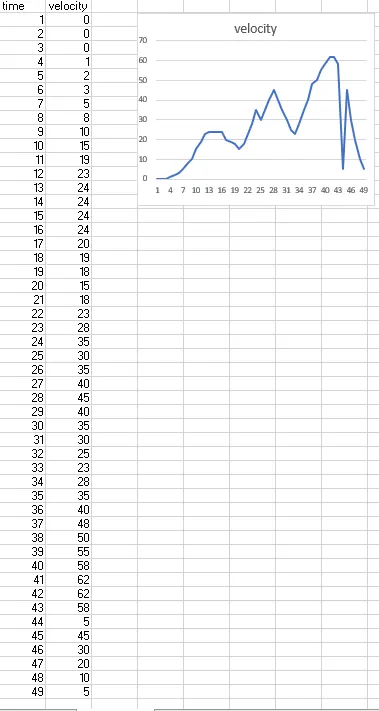
1.For a defined driving cycle, calculate the energy required for braking.
2.Why electric motor can’t develop braking torque at high speed similar to starting? How electric and mechanical brakes are coordinated?
The braking torque in a electric motor is not as high as that of the accelaration torque at higher speeds .this can be attributed to many different reasons .The rate of dischange of the battery is higher than tj=he charging rate it can be said that the dischange rate can betwice as that rate of changing rate.There are other limitations to themotors in the form of power converters too.This power converter is customised 3 phase inverters which are directional as it needs to comvert regnerative braking energyback to dc current for the battery and this reduces the efficiency of the power converter at low speed generative braking is very high as speed increases .The regenerative braking reduces as the effictiveness of inverter plays an important role and overall efficiency reduces resulting in reduced braking torque
There are different way of coordinating between the hydraulic brakes and regnerative brake one of the brakes control startegies involves series connection where both brakes are connected together which implies that in this scenario both brakes are used together and the next one in the parallel connection where either of the two brakes is operated individually whithout relying on one another depending on the braking requirements.
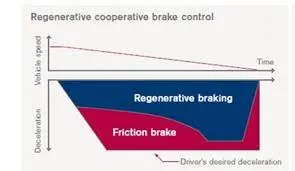
Electric and mechanical brakes are coordination:
There are two brake control strategies namely,SERIES&PARALLEL.
SERIES:
Brakes will be applied one after the another so which they are connected in series. Either one brake stragety at a time either Regenerative braking or Mechanical braking at a time.
PARALLEL:
In case of parallel both the brakes are applied simultaneously.both at a time
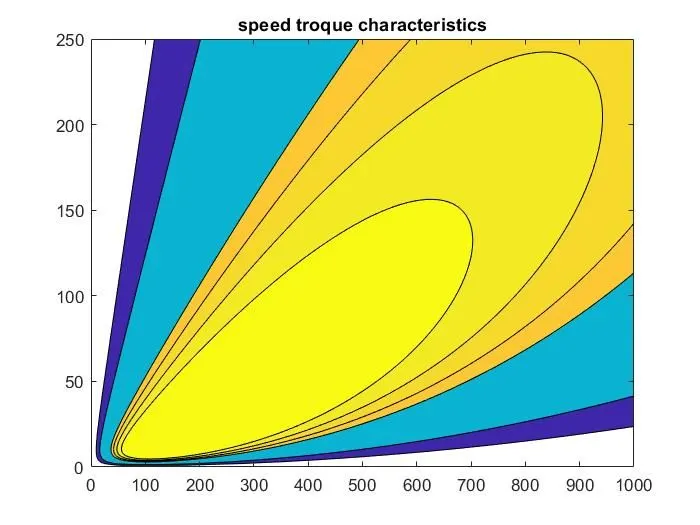
3.Make a MATLAB program which plots contour of given motor speed, torque and efficiency values. Attach the code as a .m file attach a screenshot of all the plots.
clear all
close all
clc
%speed array
x=linspace(0,1000,250);
%torque array
y=linspace(0,250,250);
%loss coefficients
kc=0.2; %copperlosses
ki=0.008; %iron losses
kw=0.00001; %windage losses
const_loss=20; %constant motor loss
%meshgrid
[x,y]=meshgrid(x,y); %converting to 2D
output_power=(x.*y); %power=torque x speed
B=(y.^2)*kc;%copper loss
c=x.*ki; %iron loss
d=(x.^3)*kw; %windage loss
input_power=output_power+B+c+d+const_loss;
efficiency =output_power./input_power;%efficiencies to be plotted
v=[0.70,0.80,0.90,0.91,0.92,0.93]; %efficiencies to be plotted
box off
grid off
contourf(x,y,efficiency,v);
title('speed troque characteristics')
xlable('speed')
ylable('troque')