Week-11 Challenge: Braking
1. For a defined driving cycle, calculate the energy required for braking.
AIM: Calculate the energy required for bracking for a defined drive cycle
DRIVEING CYCLE: Urban Dynamometer Driving Schedule
The EPA Urban Dynamometer Driving Schedule (UDDS) is commonly called the "LA4" or "the city test" and represents city driving conditions.
It is used for light duty vehicle testing. 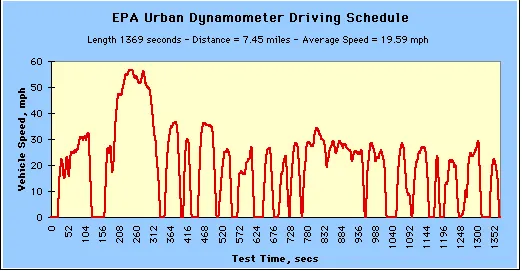
Formula:
B=1/2*mv^2
were, m= mass of vehicle
v= velocity
M=1000 kg
So, the energy required for bracking is 8.167 kj.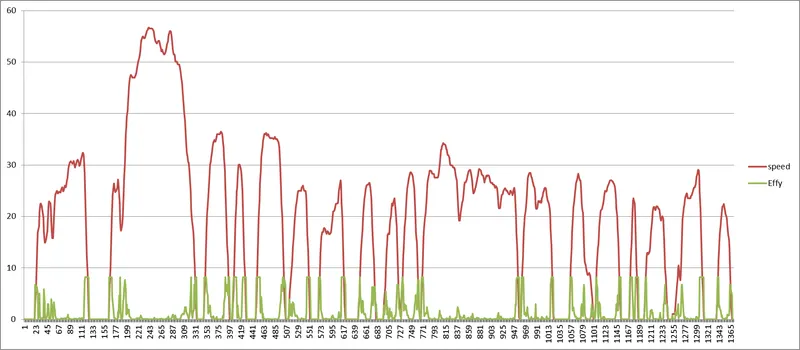
2. Why electric motor can’t develop braking torque at high speed similar to starting?
This situation does not occur at the beginning of an acceleration because most of the torque is used to increase the kinetical energy of the load (and motor). But when the speed is already high and no extra load is applied it is not possible to increase the torque. So the motor can't develop more torque at high speed.
calculate this based on your motor parameters.
How electric and mechanical brakes are coordinated?
Usually in electric vehicles we have electric and mechanical braking system.
Mechanical brakes are assemblies consisting of mechanical elements for the slowing or stopping of shafts in equipment drives. They use levers or linkages to transmit force from one point to another. Braking slows or stops the movement of the coupled shafts. There are several types of mechanical brakes. Band brakes, the simplest brake configuration, have a metal band lined with heat and wear resistant friction material. Drum brakes, which are commonly used on automobile rear wheels, work when shoes press against a spinning surface called a drum. Disc brakes are constructed of brake pads, a caliper, and a rotor. During operation, the brake pads are squeezed against the rotor. Cone brakes are made with a cup and a cone, which is lined with heat and wear resistant material. During actuation, the cone is pressed against the mating cup surface.
In electrical brakes are used to reduce or cease the speed of motors. We know that there are various types of motors available and the specialty and properties of these motors are different from each other, hence this braking methods also differs from each other. But we can divide braking in to three parts mainly, which are applicable for almost every type of motors.
- Regenerative Braking.
- Plugging type braking.
- Dynamic braking.
AIM: To make MATLAB program which plots contour of given motor speed, torque and efficiency values.
MATLAB SCRIPT:
% Contour of speed torque chara
clear all
close all
clc
t=linspace(0,250);
w=linspace(0,1000);
kc=0.15;
ki=0.005;
kw=0.000015;
[X,Y]=meshgrid(w,t);
copper_loss=(Y^2)*kc;
iron_loss=X*ki;
winding_loss=(X^3)*kw;
constant=30;
output=X.*Y;
input_power=(copper_loss)+(iron_loss)+(winding_loss)+(output)+(constant);
eff=(output)./(input_power);
n=linspace(0.5,0.25,20);
grid on
contour(X,Y,eff,n)
RESULT: