Week-11 Challenge: Braking
Question 1 :
For a defined driving cycle, calculate the energy required for braking.
SOLUTION :
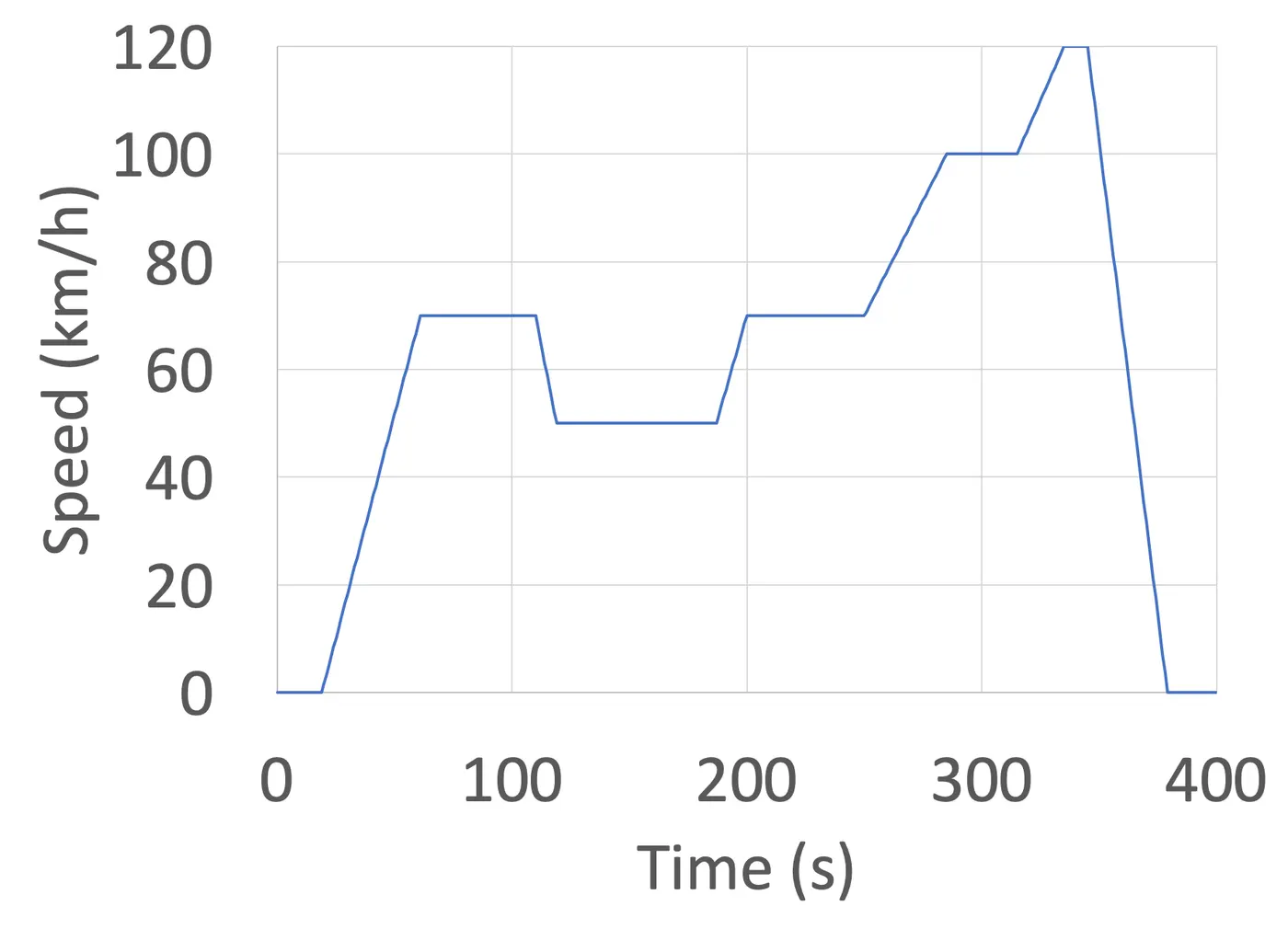
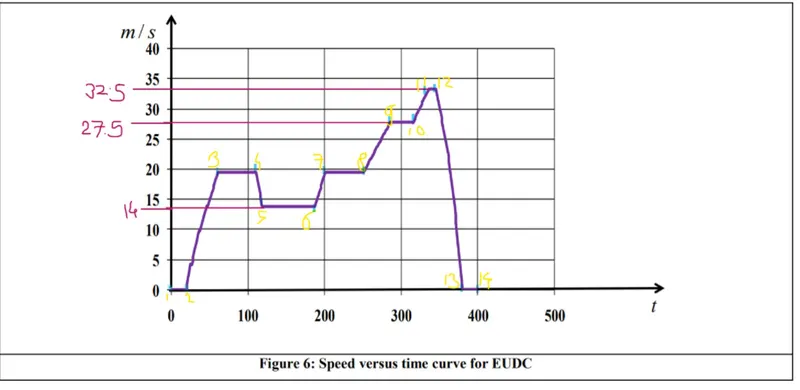
So, to calculate braking energy we consider9 point i.e. upto 300sec of drive cycle and calculate its braking energy during acceleration and deacceleration.
Total braking energy = kinectic energy of vehicle
=K.E+K.E
But we here consider only kinetic energy due to linear motion for simplicity.
Here,let mass of vehicle(m) = 1000kg
now take K.E. between point,
between pointb 1&point2
Braking energy = (K.e)2-(KE)1 = 0........................as velocity is same.
Braking point2&3
braking energy = (KE)3 _(KE)2
= (5*m*v^2)3 -(5*m*v^2)2
= (5*1000*20^2) - (5*1000*0^2)
= 2,00,000j
= 200kj
Between point3 &4
Braking energy =(KE)4 -(KE)3= 0
BEtween point4 & 5
Braking energy = (KE)5-(KE)4
= (5*1000*14^2) - (5*1000*20^2)
= -1,02,000j
= -102Kj..........................negative sign indicates Deacceleration
Between point 6 & 7
Braking energy = (KE)7 - (KE)6
= (5*1000*20^@)-(5*1000*14^2)
= 1,02,000j
Between point 8 & 9
Braking energy = (kE)9 - (kE)8
= (5*1000*27.5^2)-(5*1000*20^2)
= 1,78,125j
= 178.125kj
Between point 9 &10
Braking energy = (KE)10 - (KE)9 = 0 ..........as velocity is same.
Thus net braking energy during cycle = 0+200Kj+0-102 +102 +0+ 178.125 + 0
= 378.125 kj
so, we required 378.125 kj of braking energy upto 300sec of drive cycle.
QUESTION 2:
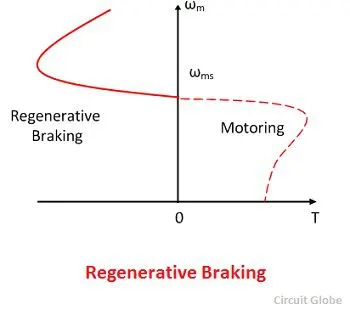
Why electric motor can’t develop braking torque at high speed similar to starting? How electric and mechanical brakes are coordinated?
ANSWER :
Braking:
The term braking comes from the term brake. We know that braking is equipment to reduce the speed of any moving or rotating equipment, like vehicles, locomotives. The process of applying brakes can be termed braking . we can classify the term braking into two parts. are as folllows :
# Mechanical braking.
# Electrical braking.
MECHANICAL bRAKING :
- Mechanical brakes all act by generating frictional forces as two surfaces rub against each other. The stoping power or capacity of a brake depends largely on the surface area of frictional surfaces as well as on the actuation force applied.
- The friction and wera encounteres by the working surfaces are serve.
- Yhus, the durability of a brake or service life between maintance depends heavily on the type of material used to line the shope or pad.
- Mechanical brakes are assemblies consisting of mechanical elements for the showing or stopping of shafts in equipment drives. They are used levers or linkages to transmit force from one poiny to another.
- Braking slows or stops the movement of the coupled shafts. There are sevral types of mechanical brakes.
- Band brakes is the simplest brake configuration , have a metal band lined with heat and wear resistance friction material. Drum brakes, which are commonly used on automobile rear wheels, work when shoes press against a spinning surface called a deum.
- DISC brakes are constructed of brake pads, a caliper, and a rotor. During operation, the brakes pads are squeezed against the rotor.
- Brakes are amde with a cup and acone, which is lines with heat and wear resistant material. During actuation, the cone is pressed against the mating cup surfaces.
ELECTRICAL BRAKING :
- Electric brakes are devices that use an electrical curren tor magnetic actuating force to slow or stop the motion of a roatating component. they are used in industrial and vehicular braking applications that require fast response timesand precise tension control.
- The magnet in the braking plate has 2 conductor wires which tap directly into the wiring.
- When the electricity is on , it magnetizes the brake magnet. The magnet is atttracted to the drum face.
- When it contacts this area, the friction causes it to rotate, which moves the actuating arm, and pushes the shoes out against the drum.
- Those shoes have a special brake pad material on them that resists the heat caused by that friction. When the shoes press against the inside of the drum, they prevent the hub and consequently the wheel thats touching the ground from spinning.
- The concept of regenerative braking can be implemented in conventional vehicles using flywheels. Flywheels are disks with high inertia that rotate at a very high speed. they act as a mechanical energy storage device by taking up (storing) the kinectic energy of the vehicle during braking.
- The energy recovered during the braking process can be used to assist the vehicle during starting or up- hill movement.
- In the mechanical braking system, a reverse torque is exerted on the wheel when we press the brake pedal.
- Similarly, in the regenerative braking mode, the speed of the vehicle is reduced by initiating a negative torque (opposing to the motion) in the motor with the help of the motor controller.
BRAKING TORQUE :
A torque that is meant to retard or stop a moving body is called braking torque. It is the amount of energy that is wasted in braking or stopping a moving body.
If torque = braking toreque is appkied the the motion of a body can be stopped or retarded.
QUESTION 3 :
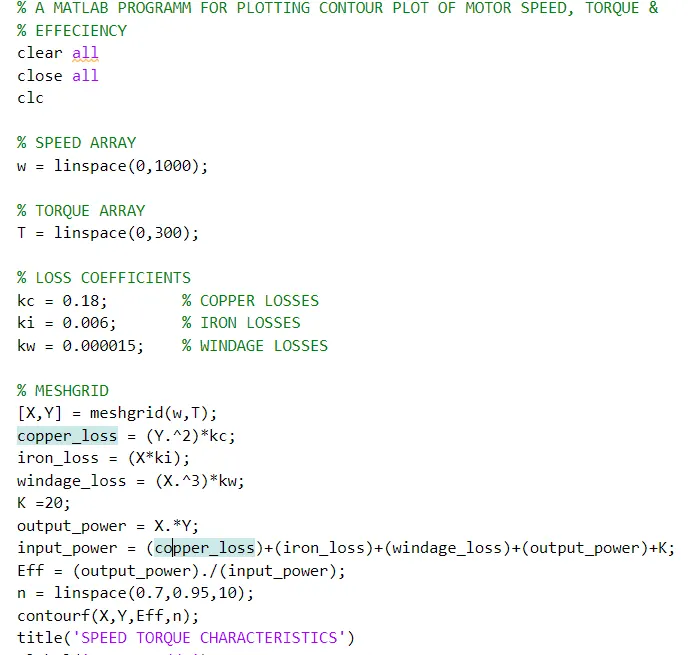
Make a MATLAB program which plots contour of given motor speed, torque and efficiency values. Attach the code as a .m file attach a screenshot of all the plots.
Matlab code
Plot reasult
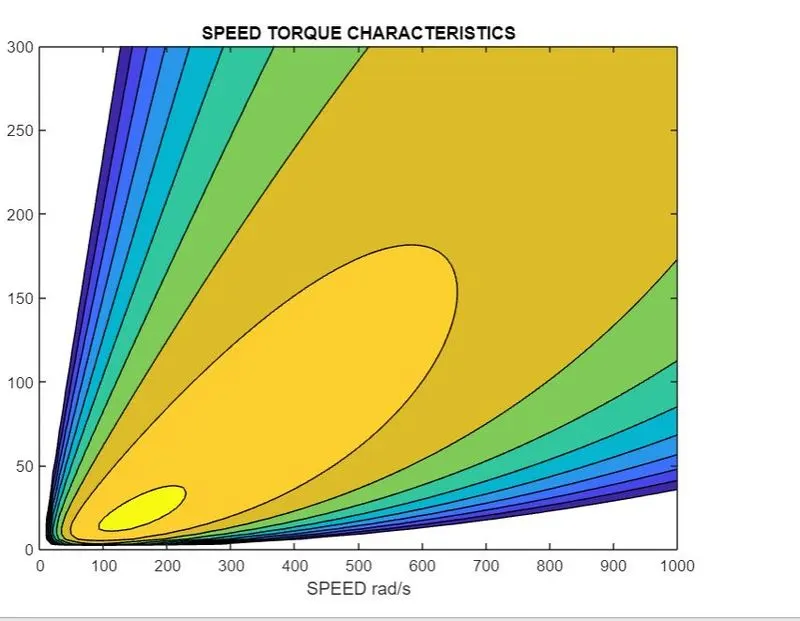
from this graph we can see that the only a perticular speed and torque the efficiency is at maxium.