Week-11 Challenge: Braking
Aim-
1.For a defined driving cycle, calculate the energy required for braking.
Ans-
In an automobile vehicle braking system is needed –
- To stop the moving vehicle.
- To de accelerate the moving vehicle.
- For stable parking of a vehicle either on a flat surface or on a slope.
- As a precaution for accidents.
- To prevent the vehicle from any damage due to road conditions.
In conventional vehicles braking process is done by with the help of brake pads brake shoes which create friction in the wheels,by this the kinetic energy is converted to heat energy and the vehicle will arrive at the stop condition.In electric vehicle we have regenerative braking in which the kinetic energy of the wheels are converted into storable energy which can be used later.So energy is not wasted in this type of system,So the vehicle will come to halt when the accelerator pedal is released,
So for calculating the energy required for braking we have to create a drive cycle which shows the velocity ,time and braking energy,
We have taken the mass of the vehicle as 500kg
and for braking energy we have to take the equation,
E=1/2mv^2
where m-mass of the system
v-velocity of the system(m/s)
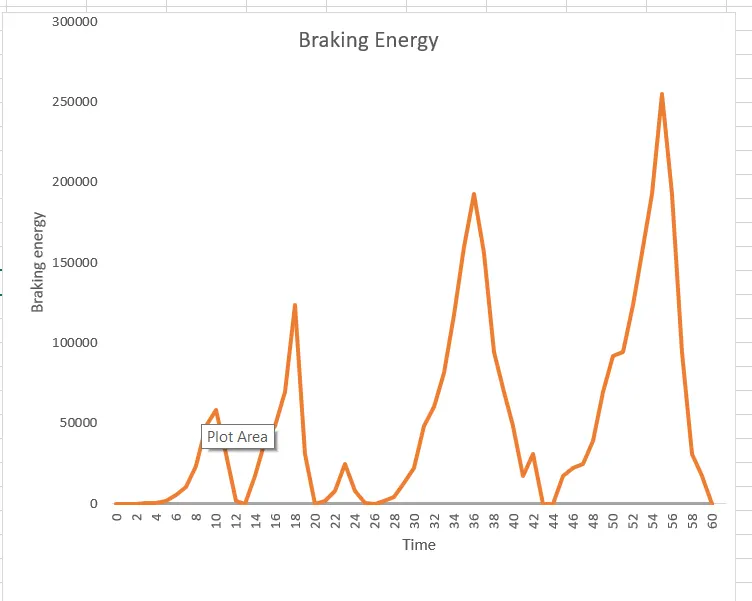
the table represents the values of the drive cycle
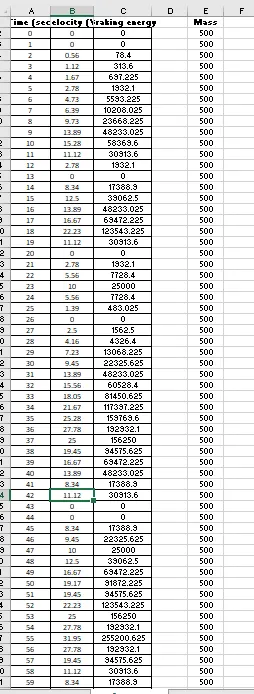
The total braking energy of the drive cycle is 309.52KJ
2.Why electric motor can’t develop braking torque at high speed similar to starting?
Ans-
The purpose of a rotary motor is to provide a desired rotational output speed while overcoming the various rotational loads resisting that rotational output (Torque). Speed and Torque are directly related, and are the two primary performance factors in properly selecting a motor for a specific application or use. To learn how to select the right motor to fit your application, the first step is to understand the relationship between speed, torque and output power of a motor.
Since the rated output power of a motor is a fixed value, speed and torque are inversely related. As output speed increases, the available output torque decreases proportionately. As the output torque increases, the output speed decreases proportionately. This power, speed and torque relationship is commonly illustrated with a motor performance curve which often includes motor current draw (in Amps) and motor efficiency (in %).
When the motor revs increase, however, it also creates what's called "back electromotive force" or "back EMF." The faster the motor spins, the more back EMF is created, reducing the effective voltage it can deliver. The higher the revs, the more back EMF, meaning that instantaneous torque effect diminishes.Since the rated output power of a motor is a fixed value, speed and torque are inversely related. As output speed increases, the available output torque decreases proportionately. As the output torque increases, the output speed decreases proportionately.
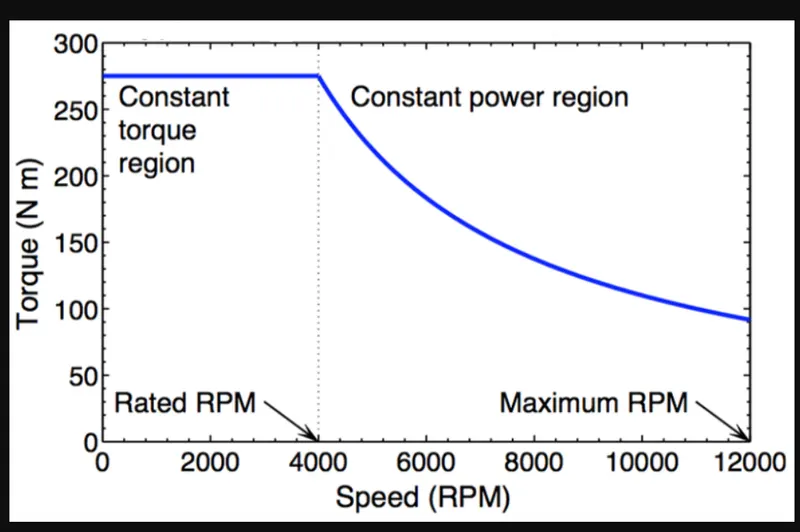
In many cases, application requirements will force the selection of a standard motor that is significantly oversized to insure that all operational points are covered. Applying motors that are oversized for an application results in unnecessary cost, as well as larger and heavier designs of the overall product. Fortunately, custom motor suppliers can develop motors with optimized performance curves to precisely meet application requirements. This is done by changing the electromagnetic characteristics of the motor by altering either the wire size or the number of wire turns in the winding, or both. More turns of smaller wire provides more torque and less speed where fewer turns of larger wire provides higher speed but less torque. In some applications adding gearing to the motor output provides the ideal speed versus torque relationship while keeping the cost and size of the overall solution to a minimum.
2.b)How electric and mechanical brakes are coordinated?
The brake pedal in the vehicle cabin assists us in engaging or disengaging the brakes in mechanical braking, which is typical in all automobiles. Currently, braking technology has performed wonders by designing life-saving braking systems such as ABS, EBD, BA, and a plethora of others. Once the vehicle has achieved a high speed, all of these technologies are crucial in slowing it down and bringing it to a rest. The brake pedals in any of these cars move closer to the disc attached to the driving disc when the driver applies the brakes. Brake pads are commonly utilised to aid in the efficient braking of vehicles.
In the ELECTRIC BRAKES, there are two basic methods for braking the vehicle.
- series
- parallel
Series
The Regenerative Braking and the Mechanical Braking are applied sequentially.
Parallel
Both regenerative and mechanical braking are used in parallel.
When the brake pedal is pushed, hydraulic fluid enters the brake piston and creates braking pressure on the wheels. The same kinetic energy is employed by Regenerative Braking to generate extra power via the Bi-directional motor, which acts as a generator when braking.
The Electric Driven Intelligent Brake, another world’s first system, utilizes the vehicle’s electric motor to directly operate the brake cylinders. When the driver steps on the brake pedal, the necessary braking force is maintained while the hydraulic pressure of the friction brake is controlled to help maximize the energy regeneration of the hybrid motor. Because of its simple structure, in which the motor directly operates the brake cylinders, this new Electric Driven Intelligent Brake system has the potential to be applied to various future hybrid vehicles.
Most of the power brake systems derive vacuum from the engine intake manifold and use this energy to apply brake force which greatly reduces driver’s pedal force and brakes become highly responsive and easy to operate. One major disadvantage of this system is that it puts load on the engine since the braking energy is extracted from the engine. Also the energy lost in stopping the car almost all goes waste in conventional braking systems.
In the Electric Driven Intelligent Braking System, the braking force is provided with the help of a ECU controlled motor and ball screw arrangement. This means that no direct load on the engine while applying brakes. This means that a motor operated the brake for providing the braking energy. A more controlled and uniform braking force is applied since its ECU controlled, this helps to recover braking losses when a regenarative system is is used.
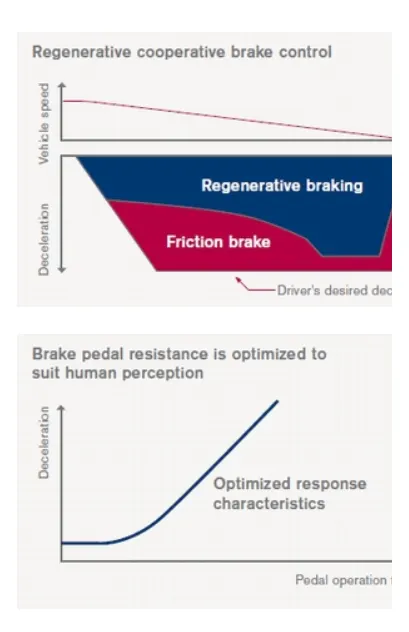
EDIB (Electric Driven Intelligent Brake) controls the regenerative brake and friction brake to support both of these requirements. Further, it also controls the reactive force from the pedal in order to unify the feeling when stepping down on the pedal and the sense of deceleration.
When the driver steps on the brake pedal, the stroke sensor detects operation of the brake. That information is communicated to the ECU and controls the motor. The motor engages the piston and amplifies the friction brake's pressure (hydraulic pressure). Through optimum control of the friction brake's hydraulic pressure, the energy regeneration outcome is maximized.
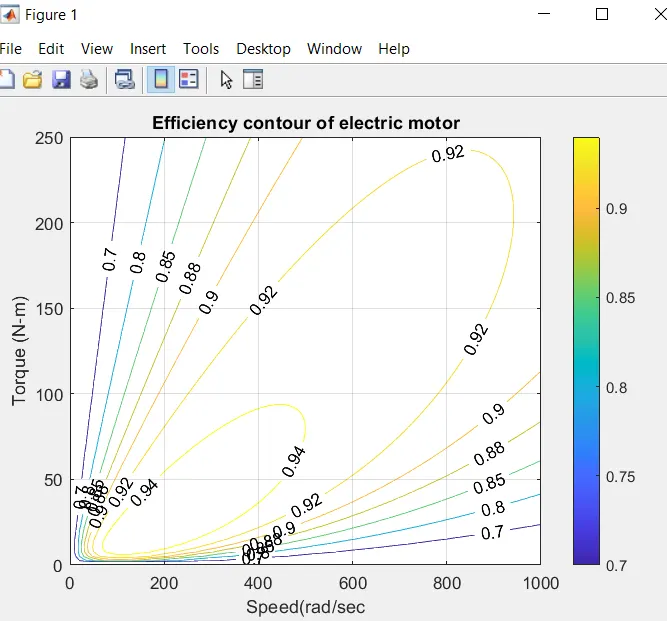
3.Make a MATLAB program which plots contour of given motor speed, torque and efficiency values. Attach the code as a .m file attach a screenshot of all the plots.
Ans-
clear all
close all
clc
%creating speed and torque matrices
Speed=linspace(0,1000);
Torque=linspace(0,250);

%declaring the loss coeff
Kc= 0.2;
Ki= 0.008;
Kw=0.00001;
c=20;

%Creating mesh grid for speed and torque values
[X,Y]=meshgrid(Speed,Torque);
output_power=X.*Y;
A= Kc.*(Y.^2);       %copper loss
B= Ki.*X;            %Iron losses
C= Kw.*(X.^3);       %Windage losses
% Calculating Input power
input_power=output_power + A + B + C + c;
n=output_power./input_power;

%Creating variable for efficiency values for which the contours are to be
%plotted
v=[0.7,0.8,0.85,0.88,0.90,0.92,0.94,0.96,0.98,1];
%plotting
contour(Speed,Torque,n,v,'ShowText','on');
box on
grid on
colorbar
xlabel('Speed(rad/sec');
ylabel('Torque (N-m)');
title('Efficiency contour of electric motor');
Results-
Conclusion
All of the questions are completed with given conditions and all the required files are attached.