Week-11 Challenge: Braking
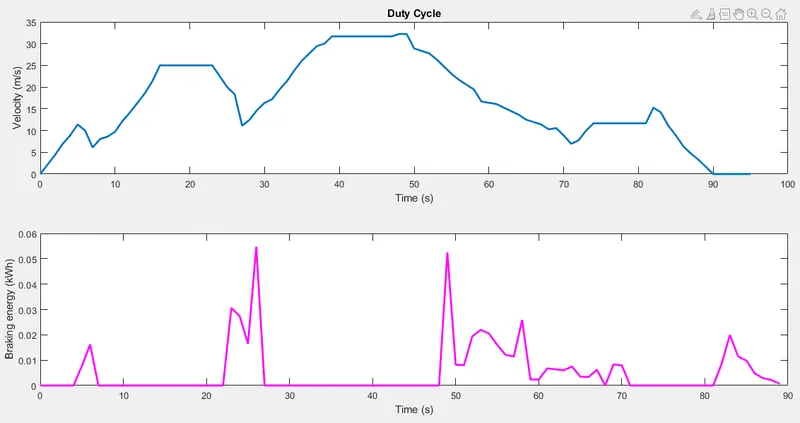
For a defined driving cycle, calculate the energy required for braking.
A driving cycle is a set of values, generally, velocity vs time, which represents how a vehicle travels through a path. In simple words, it would be a velocity vs time graph of a vehicle.
Main uses of driving cycles are
- To assess the performance of a vehicle (fuel economy, emission tests).
- To analyze battery state and energy consumption in EV.
- To simulate vehicle model prior to the actual development.
Braking is the process of controlling the velocity of an object by inhibiting its motion. An object in motion possesses kinetic energyand to bring the object to a stop this kinetic energy must be removed. Removing the kinetic energy can be accomplished by dissipating the energy to the atmosphere through friction or by converting it into another form of energy.
The braking energy is given by,
`E_(br) = 1/2 *m*v^2`
We are going to use Indian driving cycle to calculate the braking energy.
Matlab code:
close all
clear all
clc

%reading Indian drive cycle
d = readmatrix('drive_cycle_data.xlsx');

%mass of vehicle (kg)
m=1600;

%time (sec)
t= d(:,1);

%Velocity (m/s)
v=d(:,3);

%loop to calculate Braking energy.

for j= 1:(length(d)-1)
    if v(j)>v(j+1)
        k(j)=0.58*m*(v(j)^2-v(j+1)^2)/(3.6e+6);
    end
end

fprintf("Total braking power is %f kWh", sum(k));

%plotting
subplot(2,1,1)
plot(t,v,'linewidth',2)
xlabel('Time (s)')
ylabel('Velocity (m/s)')
title('Duty Cycle')
subplot(2,1,2)
plot(t(1:90),k,'linewidth',2,'color','m')
xlabel('Time (s)')
ylabel('Braking energy (kWh)')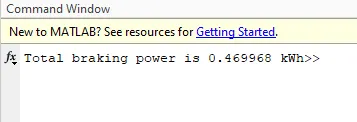
Why electric motor can’t develop braking torque at high speed similar to starting?
This situtation only occurs when the vehicle is at high speeds because the motor will be running in the constnt power region. In the constant power region the torque of the motor decreases and so the motor cannot develop braking torque.
Torque speed characterestics of Vector controlled motor.
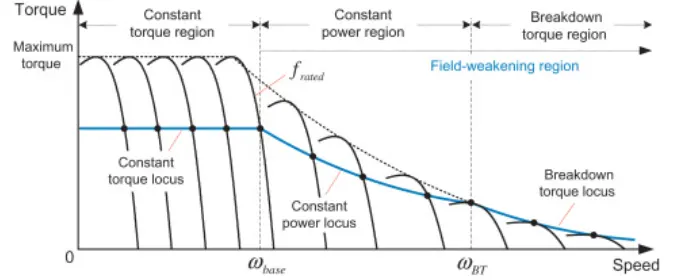
From the above characterestic curves of the motor it is seen that, the torque of the motor remains high at low speeds and reduces as the speed increases.
How electric and mechanical brakes are coordinated?
In electric vehicles batteries are the energy storage means and a huge amount of batteries are required to assure a desired level of performance, which results in the increase of the vehicle weight, cost and the degradation of vehicle performance. A moving vehicle possess a good amount of kinetic energy,and while the brakes are applied to slow down the speed, areasonable amount of kinetic energy is lost in the form of heat to the brake discs. All of this heat energy is lost to the environment. In order to recover this heat energy and use it, regenerative braking uses the motor as a generator to convert the lost kinetic energy into the stored energy in the battery which can be used later. This helps the vehicle to use much of this stored energy from regenerative braking rather than using its own energy reserves.
The regenerative braking is classified on the basis of control strategies into: -
- Serial regenerative braking
- Parallel regenerative braking
Serial regenerative braking
Serial regenerative braking is basically based on the combination of friction-based adjustable braking system that transfers energy to the electric motors and batteries under an integrated control strategy. The overall design of serial regenerative braking is to estimate the deceleration required and distribute the required braking force between the regenerative braking system and mechanical braking system. Serial braking system requires brake by wire system and has more consistent pedal feel due to good torque blending capability. It can increase the efficiency by 15-30%.
Parallel regenerative braking
Parallel braking system is basically based on the combination of friction-based system and the regenerative braking system, operated in tandem without an integrated control. The regenerative braking force is calculated from the brake control unit by comparing the requested brake torque and the motor torque available. Parallel regenerative braking system requires more work in achieving good torque blending. This system can increase the efficiency by 9-18%.
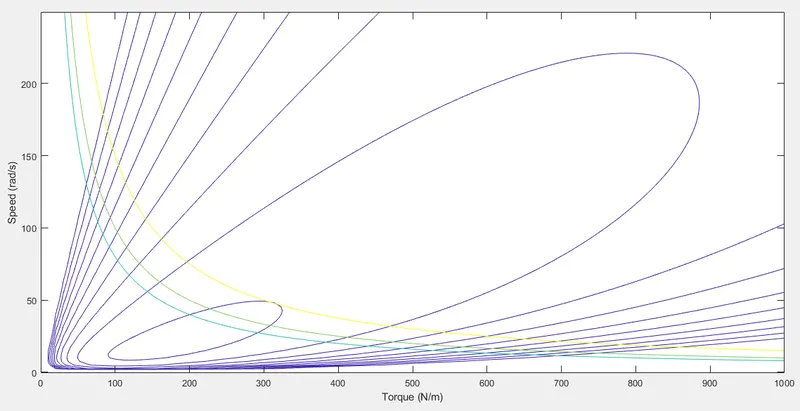
Make a MATLAB program which plots contour of given motor speed, torque and efficiency values. Attach the code as a .m file attach a screenshot of all the plots.
Matlab code:
close all
clear all
clc

%defining torque, speed values
v = linspace (0,1000);
t = linspace (0,250);

%defining constants
k_i = 0.008;     %iron losses constant
k_c = 0.2;       %copper losses constant
k_w = 0.00001;   %widage losses constant
c_1 = 20;        %constant losses

%making meshgrid
[V,T] = meshgrid(v,t);

%calculating losses
l_c = k_c*(T.^2);              %copper losses
l_i = k_i*V;                   %iron losses
l_w = k_w*(V.^3);              %windage losses
t_l = l_c + l_i + l_w+c_1;     %total losses

%power output
p_out = T.*V;

%power input
p_in = p_out + t_l;

%calculating efficency
n_c = p_out./p_in;

%efficiency values
n = linspace(.70, .95, 10);

%plot contour
%plot box
%grid off
contour(V,T,n_c,n);
xlabel('Torque (N/m)');
ylabel('Speed (rad/s)');

%power
p = [8000,10000,15000];
hold on
contour(V,T,p_out,p);
Output: