Week-11 Challenge: Braking
1. The traction force of a vehicle is naturally opposed by various opposing forces like friction offered by the road,air drag force,force of gravity due to upward hill descent & through braking which is externally applied to the wheels by braking mechanism(hydraulic-in case of conventional ICE vehicles) & in case of EV's & HEV's there is inherent regenerative braking mechanism of electric motors.
Here we will only discuss the braking force which opposes the traction force of the moving vehicle.
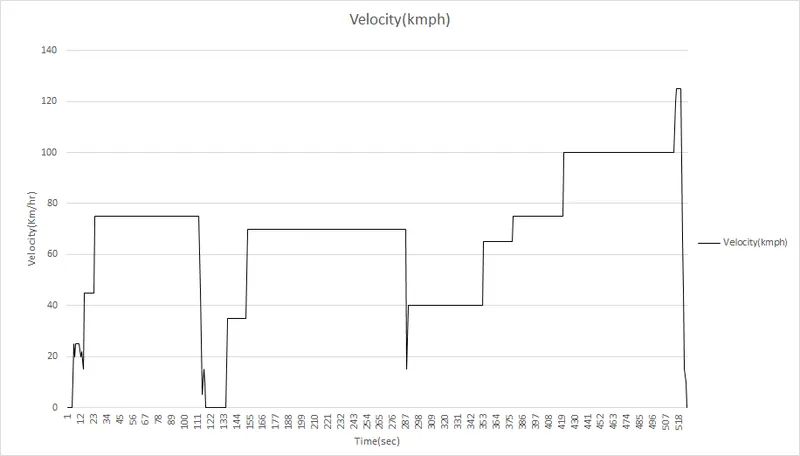
In this challenge,for a given driving cycle the braking energy is calculated only for the duration when the vehicle is decelerating(assuming the deceleration is happening due to braking applied).The external braking energy opposes the positive velocity of the vehicle absorbs the kinetic energy of the vehicle hence reducing the speed.
This braking energy needed is the difference between the kinetic energies(i.e difference of kinetic energy at speed v1-point at which vehicle starts to decelerate & kinetic energy at speed v2-point at which vehicle again starts to accelerate or simply to say the part the drive cycle plot with negative slope or downward slope).This change in kinetic energies is calculated for period of deceleration in the driving cycle & summed to calculate total braking energy needed for a given driving cycle.The braking energy applied reduces the kinetic energy of a vehicle from KE1 to KE2.
In terms of kinetic energy = 0.5 x(Total Mass of the vehicle) x(velocity)^2 (units-> kg m^2/sec^2)
1 kg m^2/sec^2 = 1 Joules of energy is the standard considered for calculation of energy consumed in Joules.
Power is energy consumed/delivered per unit of time P = E/t , 1 J/sec = 1 watt is the standard considered for power consumed in Watts
Please find the braking energy calculation along with the considered Drive cycle in the attached excel sheet.
| Velocity(v1) | Velocity(v2) | Time duration for fall in velocity(in sec) | Braking energy needed(in Joules)= Difference in KE between velocities v1 & v2(0.5*M*[v1^2-v2^2]) | Braking power needed(in watts) = Energy consumed per unit time | |
| 6.944 | 5.555 | 1 | 8680.5555 | 8680.5555 | |
| 6.944 | 5.555 | 1 | 8680.5555 | 8680.5555 | |
| 6.111 | 4.166 | 1 | 9994.3825 | 9994.3825 | |
| 20.83 | 1.388 | 5 | 215981.178 | 43196.2356 | |
| 4.166 | 0 | 1 | 8677.778 | 8677.778 | |
| 19.44 | 4.166 | 1 | 180279.022 | 180279.022 | |
| 34.722 | 0 | 5 | 602808.642 | 120561.7284 | |
| The value in Cell A1 of attached excel sheet is the total mass of the vehicle considered in this driving cycle | Total energy consumed for braking during the whole driving cycle(8 hr journey) considered(in Joules) = | 1035102.114 J | Total power consumed for braking during the whole driving cycle(8 hr journey) considered(in Watts) = | 380070.2575 W |
2. Why electric motor can’t develop braking torque at high speed similar to starting? How electric and mechanical brakes are coordinated?
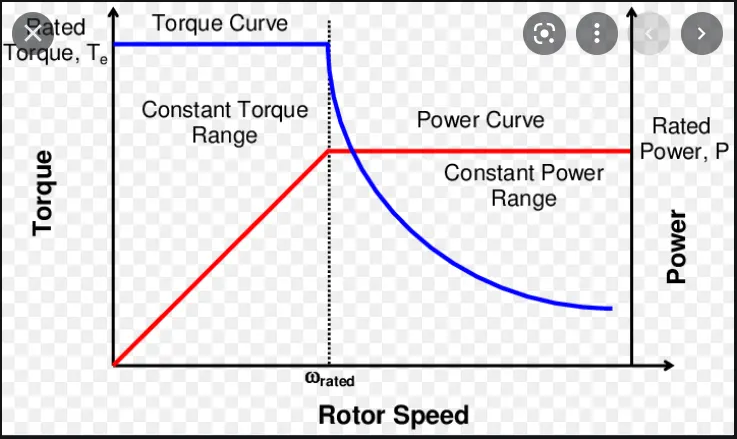
The difficulty to develop braking torque at high speed occurs in constant power region of speed-torque characteristics when the speed of motor is higher than when it is in constant torque region.
In constant power region, the motor speed is high but torque is low and decreases with increase in motor speed & in constant torque region the motor torque is high but speed is low.
When the motor starts it operates in constant torque mode & as the drive load requirement is high during the start the torque supplied by the motor is high but as the motor develops speed & accelerates,the torque required by the load reduces hence motor has minimum torque to supply , so motor refuses or finds it difficult to supply braking torque in constant power region.
The braking torque is very effective as long as the motor is in constant torque region as the motor already has torque to accelerate or decelerate the motor.
Coordination of electrical & mechanical brakes in EV's & HEV's:
There are 2 strategies for coordination of electrical & mechanical brakes -
1. Series control strategy: In this strategy according to the brake pedal input the front wheel friction brake,rear wheel friction brake & regenerative brakes are applied one after the other.If we want to save more battery energy the sequence of braking can be regenerative braking->front wheel friction brakes -> rear wheel friction brakes.In case gradual & non urgent braking there is more time for regenerative power to flow from motor to battery.
If strong & emergency braking is needed the the sequence can be front wheel friction brakes -> rear wheel friction brakes -> regenerative braking .
2. Parallel control strategy:
In this strategy according to the brake pedal input the front wheel friction brake,rear wheel friction brake & regenerative brakes are applied simultaneously.The more strong the brake pedal input the more strong is the effect of these three parallel brakes. Depending upon whether the braking is strong/sudden or gradual the effect of these parallel brakes can be prioritised so that vehicle comes to rest within desired time limit.
In case of gradual/non urgent braking all 3 brakes will be applied together but the maginitude of brakes can be prioritised as follows:
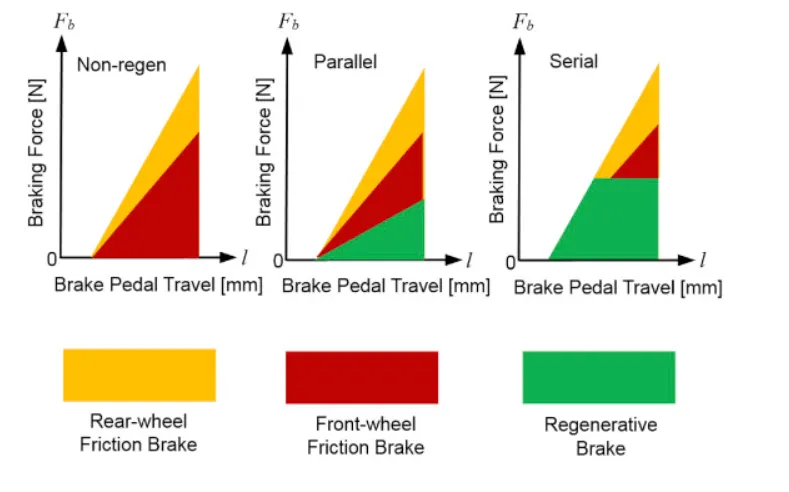
Fig:arrangement of 3 brakes for series & parallel braking strategy for a given brake pedal input
In addition to this different OEM's deploy different braking control algorithms like Nissan Leaf EV uses electric driven intelligent braking:
In this technology of theirs the braking of vehicle is combination of regenerative braking & friction braking as I discussed previously.For braking at higher speed the braking will be combination of regenerative braking & frictional braking.
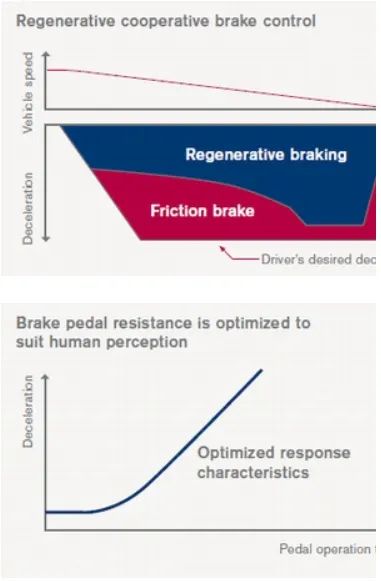
how the EDIB technology works ?
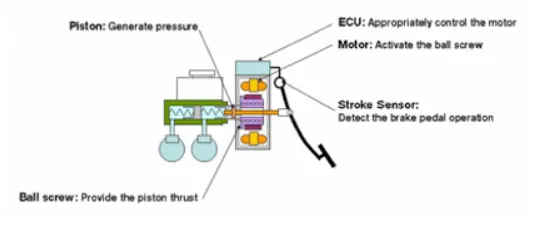
Fig: Schematic of EDIB system
When the driver steps on the brake pedal, the stroke sensor detects operation of the brake. That information is communicated to the ECU and controls the motor. The motor engages the piston and amplifies the friction brake's pressure (hydraulic pressure). Through optimum control of the friction brake's hydraulic pressure, the energy regeneration outcome is maximized.
3. MATLAB program to plot contour of given motor speed, torque and efficiency values :
A contour plot is a 2D projection of a 3D plot(here the 3D plot has speed,torque & efficiency as 3 dimensions). efficiency is the third dimension as a height.The curves in the below plot are nothing but the 3rd dimension(efficiency) projected to the XY axis into a 2D diagram.By clicking on different points of the curves we can get the efficiency at different speed-torque of motor
The explanation of the below code is available as comments in the .m file attached
clear all
close all
clc
W=linspace(0,3000,200); %defining an array for motor speed values ranging 0-3000rpm
T=linspace(0,300,50); %defining an array for motor torque values ranging 0-300N-m
[X,Y]= meshgrid(W,T); %to create a 2D grid plot for speed-torque characteristics using the speed-torque coordinates
cu= 0.15; %copper loss coefficient
fe=0.005; %iron loss coefficient
wi= 0.00016; %windage loss coefficient
% power losses in watts
loss1 = cu*(Y.^2); %copper loss
loss2 = fe*(X); %iron loss
loss3 = wi*(X.^3); %windage loss
loss4 = 16; %conduction loss
Pout = X.*Y;
Pin = Pout + loss1 + loss2 + loss3 + loss4 ; %input power equals the power delivered at output in addition to the losses
efficiency = (Pout./Pin); %efficiency of the motor
N = linspace(0.30,0.10,1);% array of motor efficiencies ranging from 30 percent to 100 percent
contour(X,Y,N,efficiency); %plotting contour for motor's speed-torque-efficiency characteristics
title("contour plot for motor speed-torque-efficiency characteristics"); %title of the plot
xlabel("speed in rpm"); % x-axis labelling
ylabel("torque in N-m"); %y-axis labelling
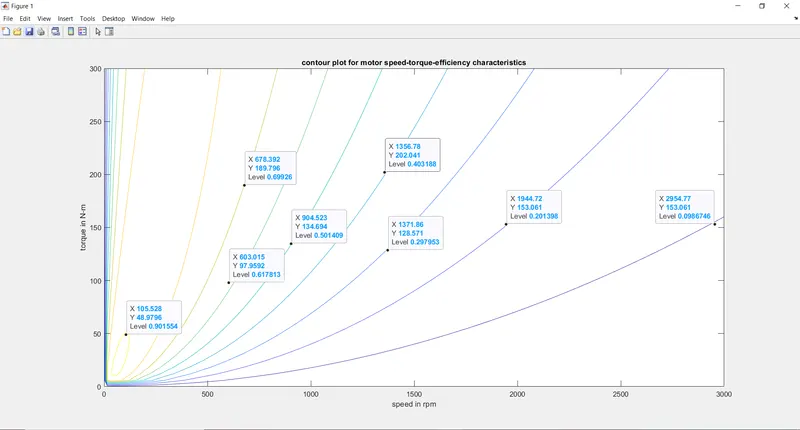
Fig:Contour plot showing the efficiency(labelled as Level) of motor at different values of speed(labelled as X) & torque(labelled as Y)