Week-11 Challenge: Braking
Aim:
- For a defined driving cycle, calculate the energy required for braking.
- Why electric motor can’t develop braking torque at high speed similar to starting? How electric and mechanical brakes are coordinated?
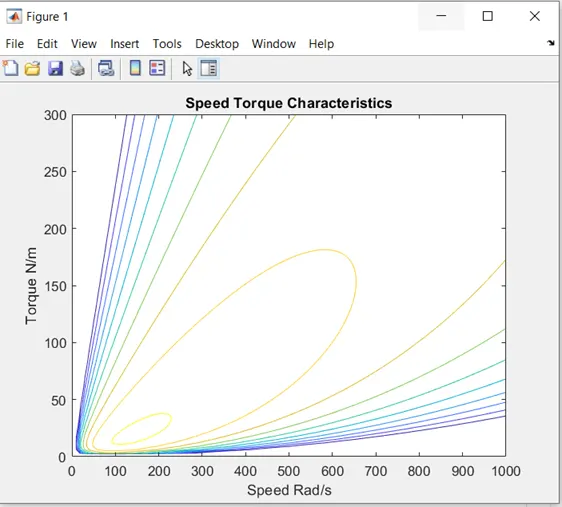
- Make a MATLAB program which plots contour of given motor speed, torque and efficiency values. Attach the code as a .m file attach a screenshot of all the plots.
Solution
- For a defined driving cycle, calculate the energy required for braking.
Let us consider arbitrary driving cycle
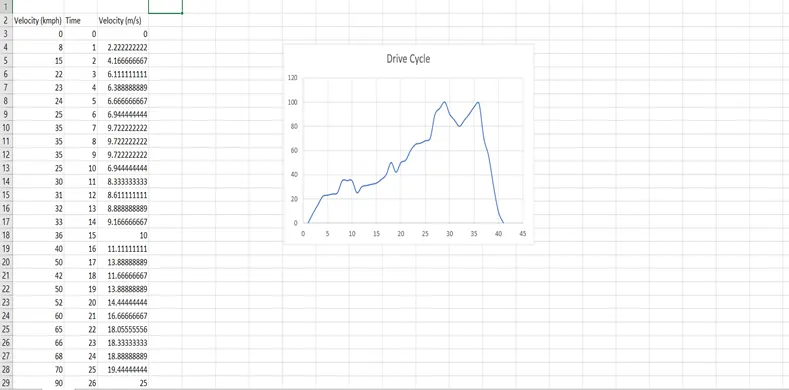
From the graph let us analyze the few instants of energy to find the braking energy.
- 35km/hr to 25km/hr in 1sec
- 50km/hr to 42km/hr in 1sec
- 100km/hr to 80km/hr in 3sec
- 99km/hr to 0km/hr in 4sec
Braking energy is given by the expression
Eb = 0.5*M (Vi^2 – Vf^2)
Where,
Eb is braking energy
M is the mass of the vehicle
Vi is the initial velocity
Vf is the final velocity
Calculation is shown as below:
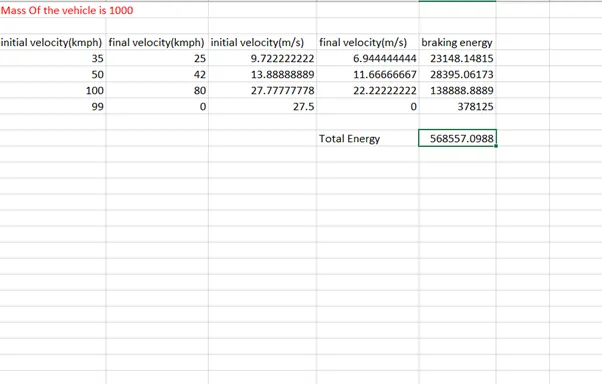
Total braking energy is obtained 568.557 K for the corresponding driving cycle.
2) Why electric motor can’t develop braking torque at high speed similar to starting? How electric and mechanical brakes are coordinated?
When the motor is at rest and it has to operate from standstill position to the reach the moderate speed the higher torque is required to bring the motor in operation. Whereas when the vehicle is already at high speed the capping or the limit is reached by the motor operation and thus any further higher torque could not be obtained while braking. The braking operation happens in the motion which is been distributed as per proportion in the Brake Energy and the Regenerative Braking.
In a vehicle, the brake is the most important device to control the vehicle. It reduces the speed of any rotating parts of electrical and mechanical equipment. It is a crucial part of the safe operation of systems. It uses friction on the two surfaces of a vehicle. This converts kinetic energy into heat. Almost all the vehicle wheels have a braking system. Even shopping cars and aircraft have braking systems. It has several characteristics like peak force, fade, continuous part dissipation, power, smoothness, noise, weight, durability, drag, pedal feel.
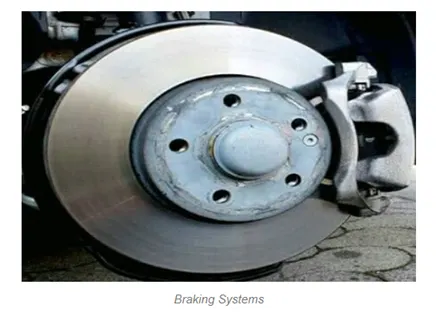
Brake is a mechanical device. From a moving system, it absorbs energy and inhibits motion. It is used for reducing the speed of a wheel or axle. It works by means of friction. The maximum decelerating effect obtained is called peak force, which is the main characteristic of the braking system. The temperature of brakes gets high when they are typically used and this may lead to failure of the system.
Types of Braking Systems
There are three types of braking systems which include the following.
Mechanical Braking System.
Drum braking
Disk braking
Band braking
Pawl and Ratchet braking
Electrical braking system
Plugging type braking
DC injection type braking
Eddy current braking
Dynamic resistor type braking
Regenerative braking
Sharing DC bus type braking
Other Types of Braking Systems
Hydraulic braking system
Power brakes
Air braking system
Air hydraulic braking system
Vacuum brakes/ servo braking system
Mechanical Braking System
Mechanical braking mostly used in scooters, motor vehicles, and motorcycles where small power is required. It is essential in manufacturing power transmission applications, material handling, etc. It delivers forces to the axle or a wheel in order to stop motion. It helps to reduce the speed of the system slowly by the mechanical process when compared to electrical braking.
The working of a mechanical brake depends on the pedal. When the pedal is pressed, the brake shoes are pushed outwards and rotates against the drum which is connected to the wheels. Hence the machine or vehicle gets slow down and stopped. And when the pedal is released, it goes to normal position due to the pullback action of spring shoes.
Electrical Braking System
Electrical braking is used to reduce the speed of the machine depending on flux and torque. This type of braking is mainly used for functional braking to control the speed of the machine. It is easy to handle and comfortable. But it cannot be used for emergency braking and parking braking.
The working of electrical braking depends on the electromagnetic force (EMF) acting on the brake shoes. The battery is used to generate an electric current which helps to energize the electromagnet mounted on the backplate. This results in activating the cam and expanding the brake shoes. Hence the vehicle or machine is stopped by braking the wheel.
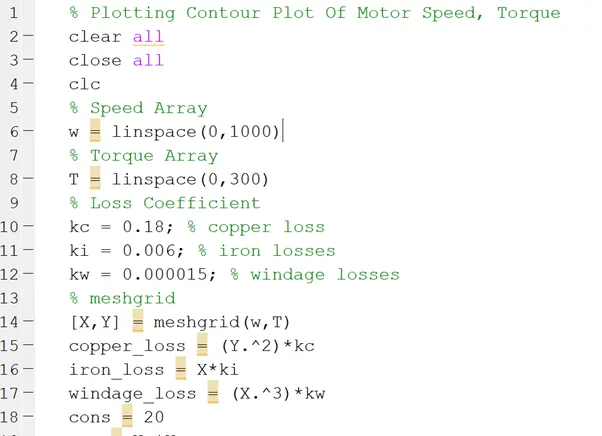
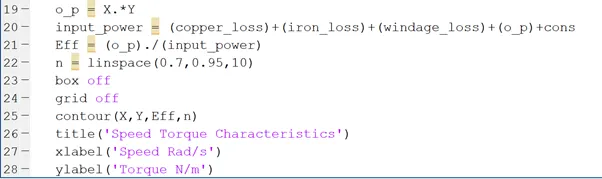
3) Make a MATLAB program which plots contour of given motor speed, torque and efficiency values. Attach the code as a .m file attach a screenshot of all the plots.
The plots contour of given motor speed, torque and efficiency are given below:

Output: