Week-11 Challenge: Braking
1. For a defined driving cycle, calculate the energy required for braking.
A driving cycle is a series of data points representing the speed of a vehicle versus time.Driving cycles are produced by different countries and organizations to assess the performance of vehicles in various ways, as for instance fuel consumption, electric vehicle autonomy and polluting emissions.Below is the drive cycle graph.
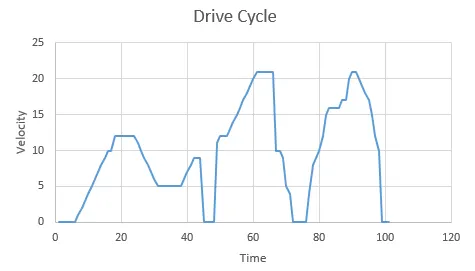
Inorder to calculate the braking energy, we have the formula
Braking Energy= 1/2*(m*v^2)
where m is mass of vehicle in kg
and v is diffrence of initial and final velocities in m/s
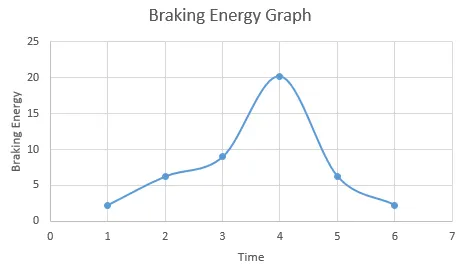
Below is the braking energy calculation for six different data values.
| Sl. No | Time in sec | Mass of the vehicle in kg | Final Velocity in m/s | Initial velocity in m/s | Difference Velocity | Braking Energy in kJ |
| 1 | 3 | 500 | 7 | 10 | 3 | 2.25 |
| 2 | 2 | 500 | 10 | 15 | 5 | 6.25 |
| 3 | 11 | 500 | 6 | 12 | 6 | 9 |
| 4 | 6 | 500 | 0 | 9 | 9 | 20.25 |
| 5 | 5 | 500 | 3 | 8 | 5 | 6.25 |
| 6 | 7 | 500 | 13 | 16 | 3 | 2.25 |
for first calculation
Braking Energy= 1/2*(m*v^2)
= 0.5*(500*(10-7)^2)
= 0.5*500*9
= 2.25kJ.
in the similar way the braking energy is calculated for other data values.
For the calculated braking energy we can plot the graph.The graph of the braking energy versus time is as shown in the below figure.
2. Why electric motor can’t develop braking torque at high speed similar to starting? How electric and mechanical brakes are coordinated?
Answer for Why electric motor can’t develop braking torque at high speed similar to starting?...In case of ac or dc motor there is no torque at maximum speed,gradually the torque decreases at high speed as the speed tends to be maximum speed.This situation does not occur at the statrting or the begining of the acceleration beacause most of the torque is used to increase the kinetic energy of the load.But when the speed is already high and no extra load is supplied it is not possible to increase the torque as well as to develop the braking torque.The braking operation happen in the motion.
How electric and mechanical brakes are coordinated?
Braking is the process of controlling the velocity of an object by inhibiting its motion. An object in motion possesses kinetic energy and to bring the object to a stop this kinetic energy must be removed. Removing the kinetic energy can be accomplished by dissipating the energy to the atmosphere through friction or by converting it into another form of energy.
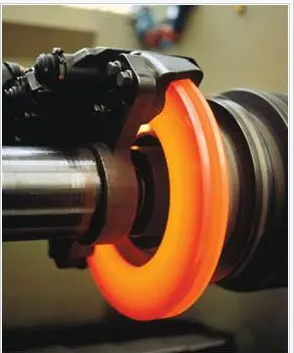
Mechanical brake which inhibits motion through friction brake pads. A mechanical brake applies a friction force to convert the kinetic energy of the vehicle into thermal energy which then dissipates into the atmosphere.The most common method of braking in motor vehicles is friction braking(Below figure) . In this method, some or all of the vehicles wheels are fitted with brake pads which apply a friction force that inhibits the motion of the wheels. Frictional braking results in a conversion of the kinetic energy gained from fuel consumption to thermal energy. This thermal energy then dissipates to the atmosphere in the form of waste heat.Large friction forces can be needed to inhibit a vehicle's motion, particularly in large machines and trucks which have a high mass and therefore high kinetic energy. The brake pads, which are responsible for applying the friction force, experience wear over the course of their life due to this friction force. The brake pad wear causes the brakes to become less effective over the course of their life and need regular replacement.Classification of mechanical braking
- Drum braking
- Disk braking
- Band braking
Electrical braking is used to reduce the speed of the machine depending on flux and torque. This type of braking is mainly used for functional braking to control the speed of the machine. It is easy to handle and comfortable.The working of electrical braking depends on the electromagnetic force (EMF) acting on the brake shoes. The battery is used to generate an electric current which helps to energize the electromagnet mounted on the backplate. This results in activating the cam and expanding the brake shoes. Hence the vehicle or machine is stopped by braking the wheel. Usually three types of braking are classified namely,
- Plugging type braking
- Dynamic resistor type braking
- Regenerative braking
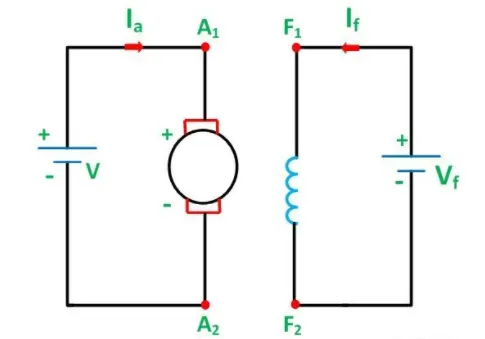
Below is the diagram for dynamic braking of a seperately excited dc motor
Electrical and Mechanical brake cordination:
There are two ways in which the EVs can be braked
1. Series-regenerative braking and mechnical braking both applied one after another
2. Parallel-Electrical braking and mechanical braking both applied together simultaneouly.
When brake is applied hydraulic fluid reaches the brake pistons and created the braking pressure on the wheels and the same KE is used by the regenerative braking which is supplied back to source using the bidirectional converter.
3. Make a MATLAB program which plots contour of given motor speed, torque and efficiency values. Attach the code as a .m file attach a screenshot of all the plots.
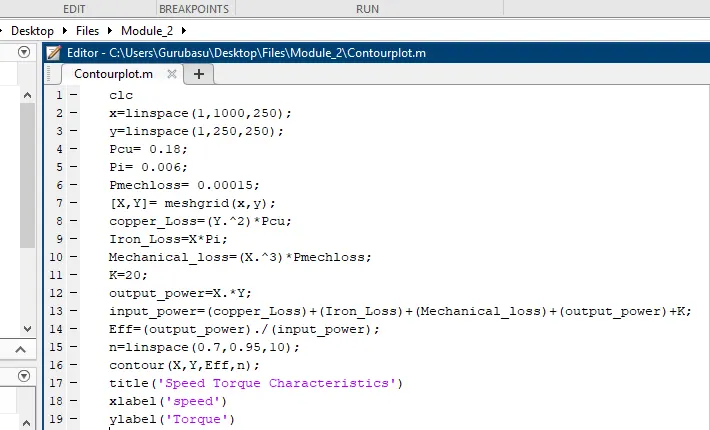
Below is matlab code to plot the contour of given speed torque and efficiency.
Below is the contour plot of the speed, torque and the efficiency.
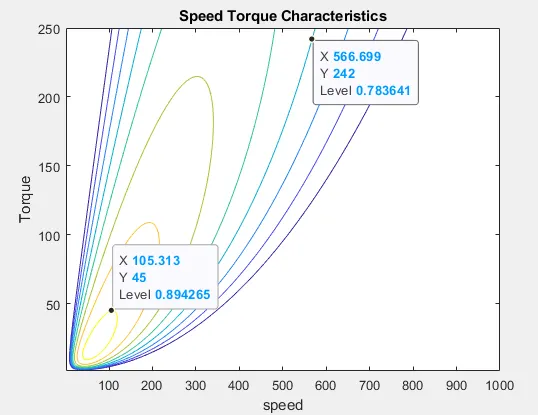
From the graph we can know that only at a particular speed and torque the maximum efficiency is obtained that is at speed of 105.313 rad/sec and 45N-m torque the efficiency is 89.4%.As the speed increases the efficiency of the motor reduces.