Week-11 Challenge: Braking
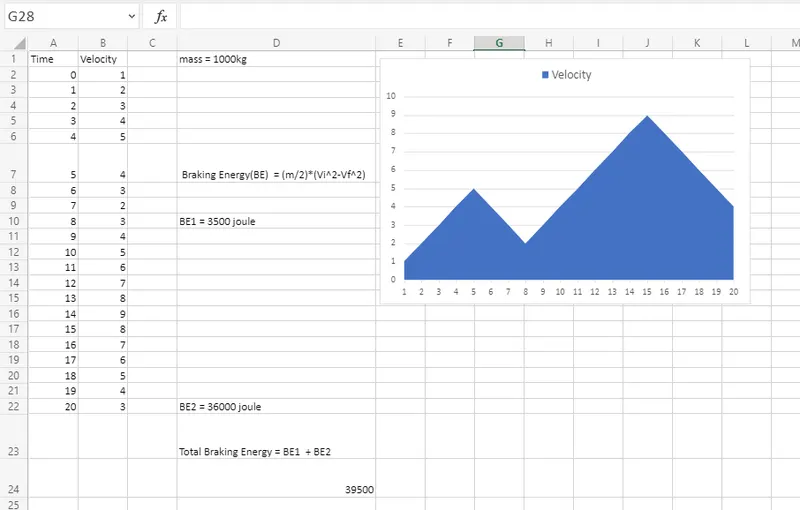
Q-1) For a defined driving cycle, calculate the energy required for braking.
Here e first have to define a drive cycle, for which I had used an Excel sheet, then we have to calculate Braking energy by using change in Kinetic energy of the vehicle in a given time,
Braking energy = (m*(Vf^2 - Vi^2)) / 2
where, m - a mass of the vehicle
Vf - final velocity of vehicle i.e after braking
Vi - initial velocity of vehicle i.e before braking
Q-2) Why electric motor can’t develop braking torque at a high speed similar to starting? How electric and mechanical brakes are coordinated?
The electric motor cant develops braking torque similar to starting torque at high speed because :
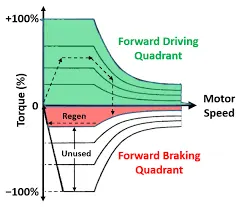
- As one can see from the graph that a high-speed motor is in constant power region not in constant torque region, there on applying brake there is a transition from the first quadrant to the second quadrant in which a small amount of torque is recovered i.e Regeneration.
- Battery discharge at a very fast rate in comparison to charging rate for example a good design battery charges at 1C but due to ist chemistry, it discharges with a minimum rate of 2C.
- Due Complex working of the Power converter there is some power loss in braking.
Electric and mechanical brakes are coordinated in Parallel type Brake Control Strategies, for example, Electrical Driven Intelligent Brake strategies developed by NISSAN Leaf. Intelligent Emergency Braking monitors the surrounding area in front of the car for vehicles and pedestrians, helping to avoid or reduce damage caused by collisions.
How the technology works
If the system determines that there is a risk of colliding with a vehicle or pedestrian in front of the vehicle, it will alert the driver through visual and audio alerts and apply light, automatic braking. This is to prompt the driver to take action to avoid a collision and If the driver does not take action to decelerate and the risk of a collision increases, the system will apply automatic emergency braking immediately before the collision. This will help to avoid or reduce the damage caused by the collision.
The EDIB allows and controls optimization of the regenerative brake and regular friction brake.
EDIB controls the regenerative brake and friction brake to support both of these requirements. Further, it also controls the reactive force from the pedal in order to unify the feeling when stepping down on the pedal and the sense of deceleration.
clc
clear all
close all


W = linspace(1,2500);   % speed in rad/sec
T = linspace(1,500);    % Torque in Nm

Kc = 0.18;     % copper loss coefficeint
Ki = 0.0075;   % iron loss coefficeint
Kw = 0.00001; % windage loss coefficeint
Cl = 25;      % motor loss constant

[x,y] = meshgrid(W,T);
Po = (W.*T);  % power output

Cl = (y.^2)*Kc;   % copper loss
Il = x.*Ki;       % iron loss
Wl = (x.^3)*Kw;   % windage loss

% power input = power output + copper loss + iron loss + windage loss +
% motor loss
Pi = Po + Cl + Il + Wl + Cl;
n = Po./Pi;  % efficiency

V = [0.7,0.725,0.750,0.750,0.8,0.825,0.850,0.875,0.90,0.925];  % efficiency curve

box off
grid off
contourf(x,y,n,V);
colorbar
xlabel('Speed(rad/sec)')
ylabel('Torque(Nm)')
zlabel('Efficiency')
title('Speed-Torque characterstic of Induction Motor with different efficiency value')
RESULT :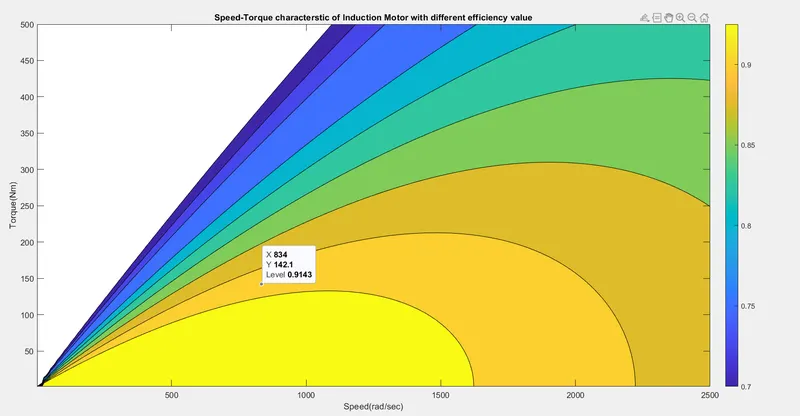
REFERENCE :