Different Methods Of Regenerative Braking
AIM : To Study about the different methods of regenerative braking and Calculate the Energy required for Braking.
OBJECTIVES :
-
For a defined driving cycle, calculate the energy required for braking.
-
Why electric motor can’t develop braking torque at high speed similar to starting ? How electric and mechanical brakes are coordinated ?
-
Make a MATLAB program which plots contour of given motor speed, torque and efficiency values. Attach the code as a .m file attach a screenshot of all the plots.
STUDY - 1 :
Energy Required For Braking :
- As we know that the energy can never be created or niether destroyed with the today's development. we have been able to utilize the energy which is been wasted at the time of braking.
- The kinetic energy which assist the vehicle to move also gets dissipated while the braking is done. Though it depends on multiple parameters on how efficient the braking would be it can be depended upon.
-
Number of Brake Pistons
-
Duration and Degree of Brake Pedal been Pressed
-
Road Condition
-
Temprature
-
Brake Pad and Disc Condition
-
Mass of the Vehicle
- Still with a basic operation where the vehicle in motion and the brakes are applied the same efficiency could be calculated by the given equations.
' BE = 1 / 2 [ M*(V^2)] '
-
BE = Braking Energy
-
M = Mass of the vehicle
-
V = Velocity
- In this manner the same calculation is been carried out for calculating the brake efficiency that would be required at the peak point.
- It bieng a drive cycle with speed variations the braking power required would vary but still the highest braking power required is mentioned below -
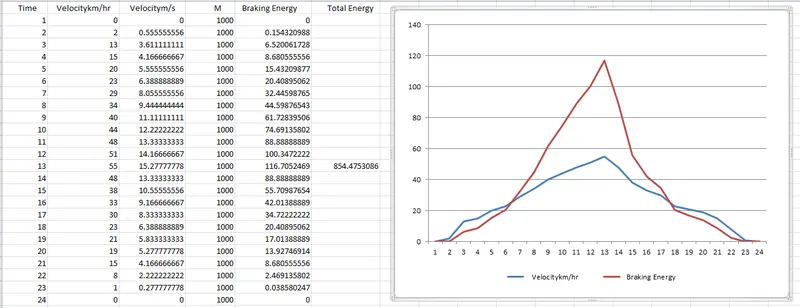
Braking Energy Required for the Speed of 55 KMPH is 116.7052469 KJ.
Excel File Link - https://drive.google.com/file/d/1Y3r2ErU04XTUghNeG-972wd8jUI-YAhP/view?usp=sharing
STUDY - 2 :
Electric motor can't develop braking torque at high speed - Reason
Speed torque characteristics of motor is shown below :
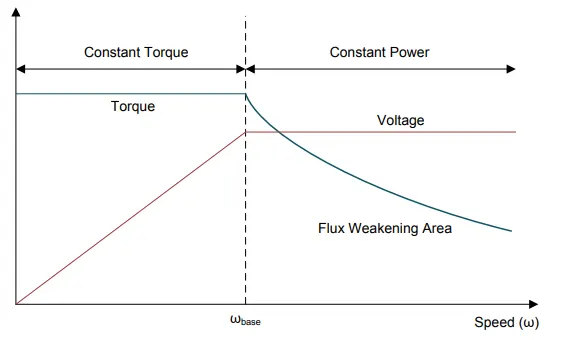
- Here it is clearly shown in the graph that till the motor reaches the critical speed it has constant torque and once it reaches the critical speed, the curve is having a down slope which is a constant power region And this graph denotes the accelerating operation of the motor.
- For the deceleration or braking operation of the motor, this graph is mirrored down which will be having the speed (+ve) and torque (-ve).
For example,
- we can say that an EV can achieve 0-100 kmph in 10sec. Acceleration operation goes this way, with low speed and high torque Constant torque region is achieved which has accelerating power and by reaching the critical speed it shifts to constant power region and thus it easy for an EV to reach 0-100 kmph.
- As said that the breaking operation graph will be the mirrored image of above plot. So we cannot say that the motor producing -7Nm torque for acceleration can also produce -7Nm for breaking. Because we are operating in the field weakening region and operating above the base speed.
- Thus Peak Acceleration torque is greater than the Peak Deceleraion.
Electric and Mechanical brakes coordination :
- Generally Electric motor dont have high torque capacity to handle all of the vehicle braking.
- Hence during the initial braking time, mechanical brakes are used in larger proportion than regenerative braking.
- Once the braking torque value starts to decrease the regenerative braking is increased in proportion.
Basically, there are three different brake control strategies :
- Serial Braking Strategy
- Parallel Braking Strategy
Series Braking Strategy :
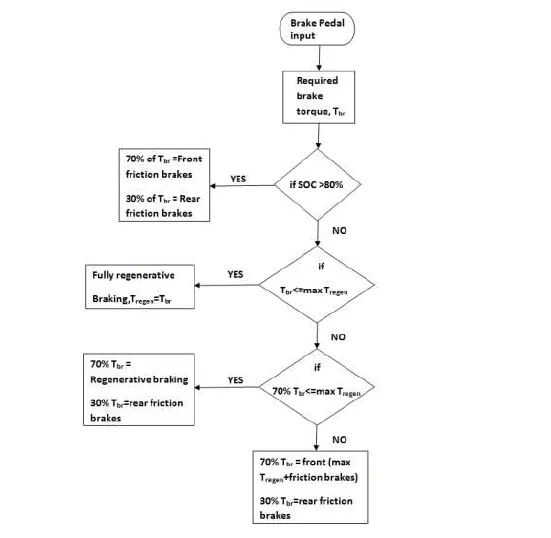
- Once the brake pedal is pressed and depending on the level of depression, a brake torque is sent. Now this brake torque passes into the brake control strategy block.
- Here, firstly it is checked if battery state-of-charge is below 80% which is set as the maximum permissible level of charge. If that condition is satisfied, then the battery is recharged.
- The brake torque requested is compared to the maximum regenerative torque limit of the motor-generator. If the overall brake torque requested is less than or equal to the maximum regenerative torque, then the vehicle brakes purely on regenerative torque and the battery is charged.
- The amount of charge ultimately put in depends also on the motor-generator operation efficiency and the battery charging efficiency. If the overall brake torque requested is greater than what the motor-generator can provide, then the friction brakes kick-in.
- Now since the vehicle is front driven, it is checked if the total brake torque requested from front is less than or equal to maximum regenerative torque capability of motor-generator. If yes, then front braking is provided purely by regeneration and rear (non-driven axle) by friction.
- Once the total brake torque request increases further, then front friction brakes (driven axle) comes into play in combination with rear friction brakes and front regenerative braking, to satisfy the overall brake torque demand. This has been represented in a chart manner
Parallel Braking Strategy :
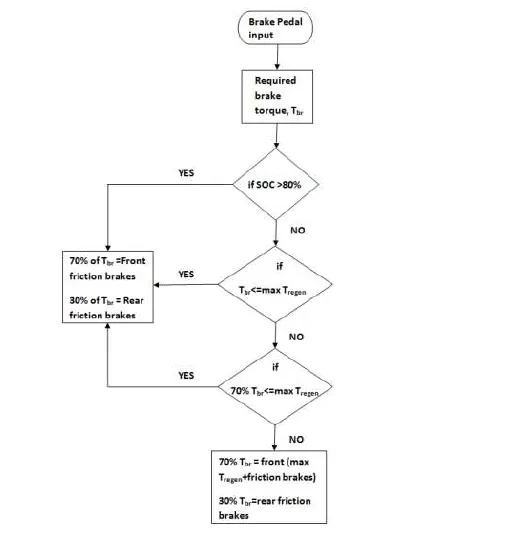
- Once the brake pedal is applied and a desired overall brake torque request is sent from the driver block. This brake torque on passing through the brake control strategy gets divided between regeneration and friction braking at all times.
- The strategy is so modeled with the comfort and brake pedal feel in mind. As a parallel regenerative braking is an add-on to the conventional systems, it is devoid of any integrated control. So to make the transition and co-performance of regenerative braking with friction smooth, it is assigned in such a way that, there is a clear division between the amount of brake torque that will be achieved from regeneration and friction braking.
- On application of brakes and in keeping with the design of the motorgenerator, it is designed to operate generator in a constant generator torque region. Motor-generator can provide a maximum of 322 Nm of generator torque at or under the base speed.
- The generator is scaled such that the base speed of the generator corresponds to a velocity of 124 [kmph], which is the maximum speed limit on most highways. Hence regeneration works, as long as the vehicle is braking from a speed of under 124 [kmph] and the requested brake torque on the front driven wheels, after the front-rear brake split is greater than or equal to maximum generator torque.
- If that condition is satised, then regenerative and friction braking operates in tandem else it’s just the friction brakes at the driven and non-driven axle.
NISSAN LEAD - EDIB (ELECTRONIC DRIVEN INTELLEGENT BRAKING) :
EDIB (Electric Driven Intelligent Brake) controls the regenerative brake and friction brake to support both of these requirements. Further, it also controls the reactive force from the pedal in order to unify the feeling when stepping down on the pedal and the sense of deceleration.
Technology Functionality :
- After stepping on the brake pedal, the system produces natural and adequate braking force that corresponds to the operation.
- The amount of energy regeneration also needs to be increased as much as possible. EDIB (Electric Driven Intelligent Brake) controls the regenerative brake and friction brake to support both of these requirements.
- Further, it also controls the reactive force from the pedal in order to unify the feeling when stepping down on the pedal and the sense of deceleration.
STUDY - 3 :
Steps to Make a MATLAB program which plots contour of given motor speed, torque and efficiency values.
- The output power values are calculated by multiplying given speed and torque values.
- All three losses are added with output power to get total input power provided.
- From input and output power the efficiency values are calculated.
- Then a contour plot is drawn for particular efficiency values alone.
Matlab Code :
clear all
close all
clc
x=linspace(1,1000); %Speed in rad/sec
y=linspace(1,250); %Torque in Nm
%Motor loss constants
kc=0.2; %Copper loss constant
ki=0.008; %Iron loss constant
kw=0.00001; %Windage loss constant
Const_Loss=20; %Constant motor loss
[X,Y]=meshgrid(x,y); %Converting to 2D
Output_power=(X.*Y); %Power = Torque x Speed
B= (Y.^2)*kc; %Copper loss
C= X.*ki; %Iron loss
D= (X.^3)*kw; %Windage loss
Input_power = Output_power + B + C + D + Const_Loss;
Efficiency= Output_power./Input_power; %Eff of the motor
V = [0.70,0.80,0.90,0.91,0.92,0.925,0.93]; %Efficiencies to be plotted
box off
grid off
contourf(X,Y,Efficiency,V);
contourcbar
title('Speed - Torque Efficiency Characteristics of Motor');
xlabel('Speed (rad/sec)');
ylabel('Torque (Nm)');
Code Explaination :
- Here in this program first two inputs were given. They are Speed & Torque using linspace command.
- The motor constant values are assigned namely Copper loss, Iron loss, Windage loss and Constant motor.
- Then meshgrid is used to evaluate functions of two variables and three-dimensional mesh/surface plots. The Output Power is calculated by multiplying speed and torque.
- Then all the loss and input powers are calculated.
- Then comes the efficiency were calculated and Contour graph is plotted between Speed, Torque and Efficiency. Title and labels were given.
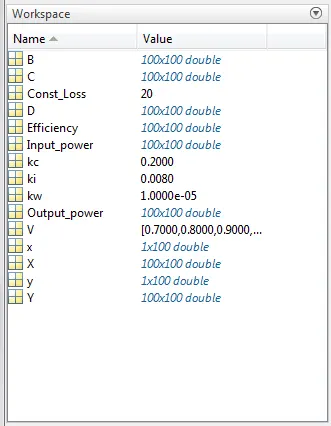
Workspace Window :
Output Plot :
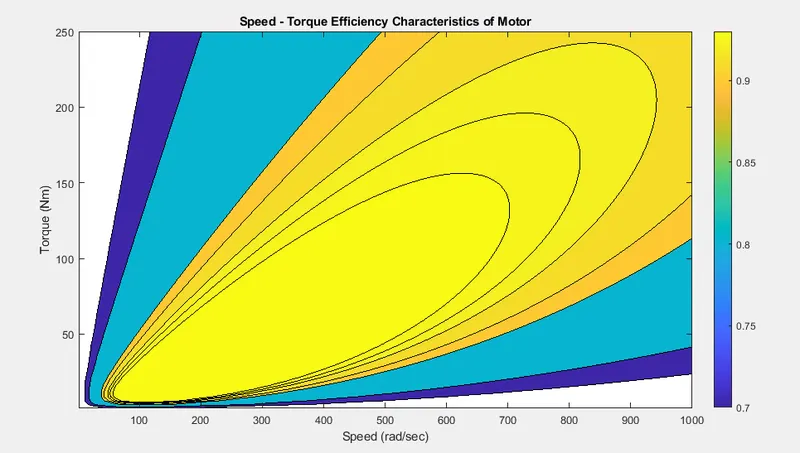
- This clearly shows that maximum efficiency of 93% is achieved by 691.1rad/sec and at 147Nm.
- The lowest Efficiency is achieved at 223 rad/sec at torque of 105.3Nm and this Contour plot clearly gives the idea on Speed, Torque and Efficiency relationship of the motor.
- The color indicates the efficiency denoted in the right side with the colorbar.
CONCLUSION :
- Successfully calculated the energy required for braking.
- Discussed about electric motor braking torque and electric and mechanical brakes are coordinated.
- Maked a MATLAB program that plots the contour of given motor speed, torque and efficiency values.
REFERENCES :
https://www.nissan-global.com/EN/TECHNOLOGY/OVERVIEW/edib.html