Week-11 Challenge: Braking
Q1:For a defined driving cycle, calculate the energy required for braking.
ANSWER:
Braking is a condition to slow down or stop amoving vehicle as required.There are several techniques to apply brakes,which can be mechanical or electrical.The most commonly used technique is by applying friction.The consumed kinetic energy can be derived as the following equation :
Braking Energy = (1/2)*m*v^2
Where m - total mass of the vehicle (vehicle mass+pay load) in unit of Kg
v = (initial velocity -final velocity) in m/s
For example if initial speed of a vehicle is 20m/s and final is 10m/s,The mass of the vehicle is 500kg,then the required kinetic energy for braking = 1/2 *500*(20-10) = 25KJ
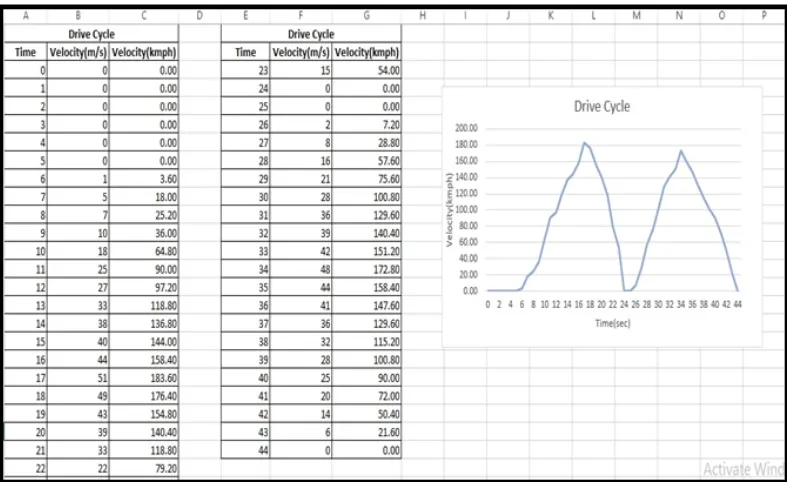
Here for a driving cycle the required braking energy is calculated for each second of time to slow down or stop the vehicle-Braking energy calculation for UDDS Driving cycle.
Q2:Why electric motor can’t develop braking torque at high speed similar to starting? How electric and mechanical brakes are coordinated?
Explanation :
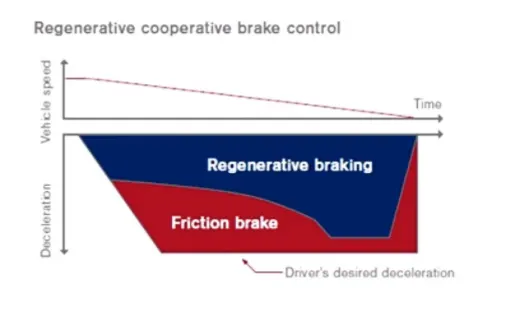
When the motor is at rest and it has to operate from the standstill position to the reach the moderate speed the higher torque is required to bring the motor in operation.whereas when the vehicle is already at high speed the capping or the limit is reached by the motor operationand thus any further higher torque could not be obtained while braking .The braking operation happens in the motion is been distributed as per proportion in the Brake Energy and the Regenerative Braking.
Electrical Braking and Mechanical Braking:
In mechanical braking which we usually see and experience in all vehicles the brake in the vehicle cabin helps us to engage or disengage the brakes.Currently the braking technology have done wonders by inventing life saving braking technologies such as ABS,EBD,BA and many others.All these technologies play a vital role in stopping the vehicle and coming back to rest from a high speed.In all these vehicles when the driver applies the brakes the brake pads come closer to the discconnected with the driving disc.The brake pads usually helps in efficient braking.
There are 2 generic methods by which the vehicle could be braked in the Electric brakes:
Series - The regenerative braking or the mechanical braking both are applied one after another.
Parallel - The regenerative braking or the mechanical braking both are applied parallely.
When the brake pedal is applied the hydraulic fluid reaches the brake pistons and creates the braking pressure on the wheelsand the same kinetic energy is been used by the regenerative braking for generating more power using the bi-directional motor which operatesas a generator while braking.
An example of the proposition of Regenerative brakingand the mechanical braking is as follows:
Nissan Leaf - EDIB(Electronic Driven Intelligent Braking)
Q3:Make a MATLAB program which plots contour of given motor speed, torque and efficiency values. Attach the code as a .m file attach a screenshot of all the plots.
ANSWER:
Matlab code:
clear all
close all
clc

%Speed Array
omega = linspace(0,300,100);

%torque array
T = linspace(0,2000,100);

%meshgrid
[X,Y] = meshgrid(T,omega);

%loss coefficients
cu = 0.17;         %copper coefficient
fe = 0.006;        %iron coefficient
win = 0.000015;    %windage coefficient

%losses
cu_losses = cu*(Y.^2);     %copper losses
fe_losses = fe*(X.^2);     %iron losses
win_losses = win*(X.^3);   %windage losses
cond_loss = 18:            %conduction losses

%output power
P_out = (X.*Y);

%input power
P_in = P_out + (cu_loss) + (fe_loss) + (win_loss) + (cond_loss);

%Efficiency
n = ((P_out)./(P_in));

%Efficiency values for contour
W = linspace(0.75,0.95,10);

%contour Plot
contour(X,Y,n,W)
xlabel('Angular Speed,rad/s')
ylable('Torque,Nm')
title('Speed,Torque and Efficiency characteristics of Motor')
In this Matlab script we create arraysfor the speed and torqueof the motor using the linspace command.For the speed consider a range of values from 0 to 2000 radians per second whereas for the torque ,consider a range of values from 0 to 300Nm. These arrays are then used to create 2D grid coordinates using the meshgrid command.These coordinates will help in the creationof the contour plot.In order to find the efficiency of the motor , we need to consider the various losses that occurin the motors operation.These are :
Copper losses,Iron losses,Windage losses,Conduction losses
These various losses are dependant on the speed and the torque of the motor.They also have a characteristics constant of proportionality which are all assumed for the following calculations and representedas 'K'.In each calculation,the speed and torque are representedrespectively as ω and T
Copper losses = KCu*ω2
Iron losses = KFe*T2
Windage losses = Kw*T3
The values of coefficients are taken as general values.Conduction losses are assumed to be 18Joules.
Finally we plot the contour with the contour command. In addition,an array for the efficiency values we want to plot for is created called 'W' and is assigned for values ranging from an efficiency levelof 0.75 to 0.95. This array is used in the creation of the contour.Axis labels and a title is also made for better readibility.
Output:
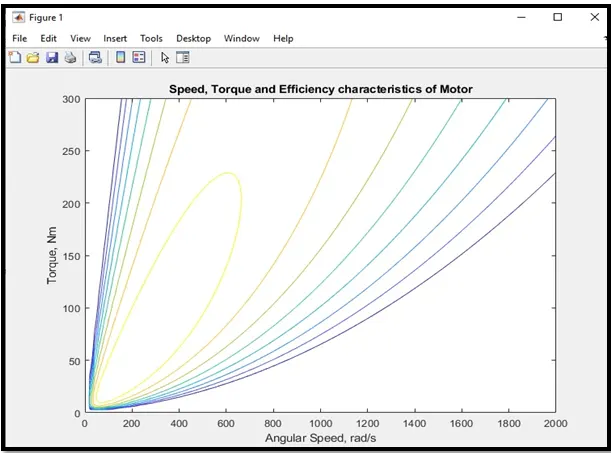
From this contour plot we can see that the highest level of efficiency arises in the innermost contour plot and this efficiency decreases as the contour increase in size from the innermost contour.