Week-11 Challenge: Braking
AIM:-
- For a defined driving cycle, calculate the energy required for braking.
- Why can't electric motors develop braking torque at high speed similar to starting? How electric and mechanical brakes are coordinated?
- Make a MATLAB program which plots contour of given motor speed, torque and efficiency values. Attach the code as a .m file attach a screenshot of all the plots.
Study1:-For a defined driving cycle, calculate the energy required for braking.
Braking:-Braking is the process of slowing down or stopping a vehicle as required.Basically they are several techniques to apply brakes,Which can be mechanical or electrical brakes.The most commonly technique used is friction because it consumes energy.
Braking energy =`1/2*m*v^2`
Breaking is the kinetic energy with units Joule
Where
M=Total mass of the vehicle(vehicle mass+payload)units in kg
V=(final Velocity - initial Velocity)units in m/s
For given drive cycle the intial value is 0 and final value is 50 now we can calculate the energy required for braking
calculation of energy required for braking as shown below:-
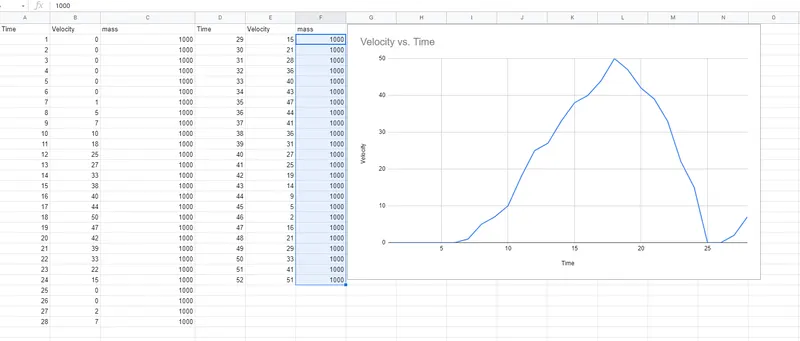
Therefore the braking value can be calculated below
E = `1/2*M*(V_f-V_i)^2`
`E=1/2*1000*(50-0)^2`
`E=1/2*1000*2500`
`E=1/2*2,500,000`
`E=frac{1,250,000}{1000}`[Kw=1000]
`E=1250KJ`
The Energy Required for drive cycle is 1250Kj
-----------------------------------------------------------------------------------------------------------------------------------------------------
Study2:-Why electric motor can’t develop braking torque at high speed similar to starting? How electric and mechanical brakes are coordinated?
Electric motors cannot develop braking torque at high speed.
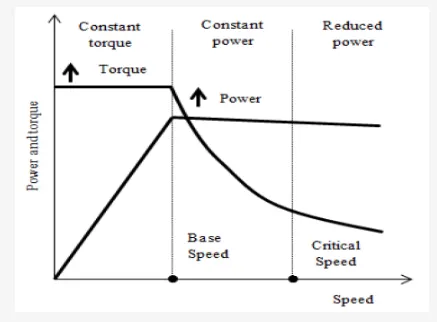
The above figure shows the Speed and Torque Characteristics
- The above model it is seen that the when the motor reaches to the critical speed,it has constant torque and once it reaches the critical speed,then the curve is having the down slope which is constant power region.
- The graph above shows the accelerating operation of motor
- For braking operation the graph is mirrored down,having the speed(+ve) and torque(-ve).
They are two types of braking operations.they are
- mechanical braking
- Electrical braking
Mechanical Braking:-Mechanical braking mostly used in scooters, motor vehicles, and motorcycles where small power is required. It is essential in manufacturing power transmission applications, material handling, etc. It delivers forces to the axle or a wheel in order to stop motion. It helps to reduce the speed of the system slowly by the mechanical process when compared to electrical braking.
Working of Mechanical braking:-
The working of a mechanical brake depends on the pedal. When the pedal is pressed, the brake shoes are pushed outwards and rotates against the drum which is connected to the wheels. Hence the machine or vehicle gets slow down and stopped. And when the pedal is released, it goes to normal position due to the pullback action of spring shoes.
They are 4 types of Mechanical braking:-
- Drum braking
- Disk braking
- Band braking
- Pawl and Ratchet braking
Electrical Braking:-Electrical braking is used to reduce the speed of the machine depending on flux and torque. This type of braking is mainly used for functional braking to control the speed of the machine. It is easy to handle and comfortable. But it cannot be used for emergency braking and parking braking.
Working of Electrical Braking:-
The working of electrical braking depends on the electromagnetic force (EMF) acting on the brake shoes. The battery is used to generate an electric current which helps to energize the electromagnet mounted on the backplate. This results in activating the cam and expanding the brake shoes. Hence the vehicle or machine is stopped by braking the wheel.
They are 6 types of Electrical Braking.They are
- Plugging type braking
- DC injection type braking
- Eddy current braking
- Dynamic resistor type braking
- Regenerative braking
- Sharing DC bus type braking
They are two brake control strategies for Mechanical brake and electrical brakes are
- Series
- Parallel
Series Braking:-Brake will be applied one after another so they are connected in series.It can be either Regenerative or Mechanical brake
Parallel Braking:-In parallel Braking,brakes are appilied on both at a time simultaneously.
------------------------------------------------------------------------------------------------------------------------------------------------------
Study3:-Make a MATLAB program which plots contour of given motor speed, torque and efficiency values. Attach the code as a .m file attach a screenshot of all the plots.
To plot the Contour graph we need 4 types of losses.They are
- Copper Losses
- Iron Losses
- Windage Losses
- Constant Losses
Copper Losses:-These are the losses which are taken in the winding of the machine due to current flowing through it.
Formulae:-`Cu=K_cT^2`
Iron Losses:-Iron losses in electrical machines are defined by the loss happening due to reversal of the magnetic field.
Formuale:- `Fe=K_iw`
Windage Losses:-Windage Losses occur in electric rotating machines such as motors and generators. Windage losses also occur in machines such as turbines and gearboxes.
Formulae:- `W=K_wW^3`
Constant Losses:-This is denoted by C
Formulae:- C
Total Losses= `K_cT^2+K_iW+K_wW^3+C`
Matlab Code:-
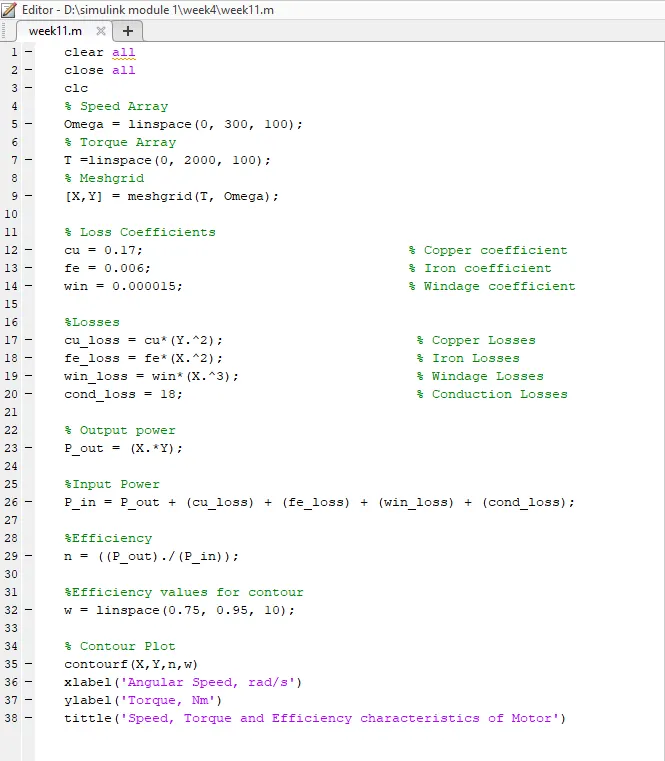
Output:-
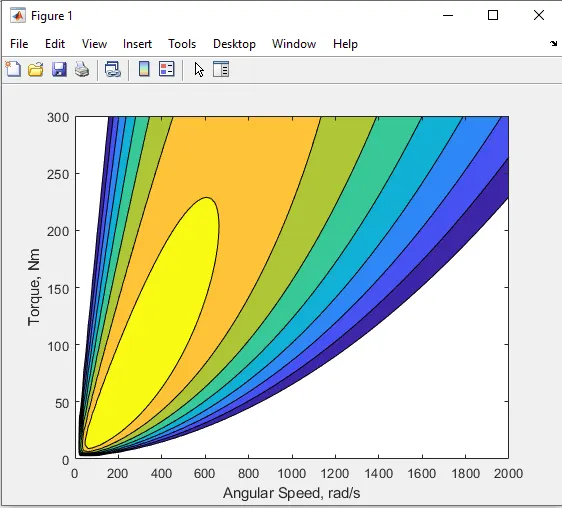
From the above output,we can see the highest level of efficiency arises in innermost contour plot and the efficiency decreases the contour increases size from innermost contour.