Braking for motors
AIM: To understand the concept of braking for motors.
OBJECTIVE:
- To calculate the braking energy required from the defined driving cycle.
- Explain about why electric motor can’t develop braking torque at high speed similar to starting. How electric and mechanical brakes are coordinated.
- Simulate a MATLAB program which plots contour of given motor speed, torque and efficiency values.
STUDY 1:
Braking is the process by which it prevent the motion of vehicle by absorbing the energy from moving parts. It helps to slow down or control the motion of vehicle by means of friction.
The drive cycle data is shown in excel sheet given below.The duration of drive cycle is 30sec.
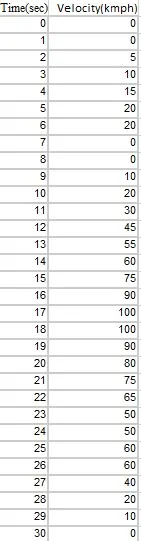
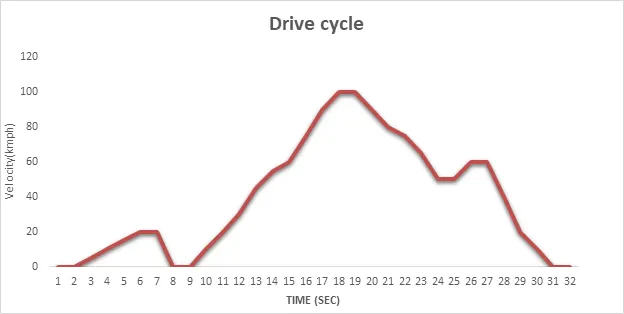
The braking energy is nothing but the kinetic energy for given drive cycle is
E = ½ m[vi – vf]^2
As the speed decreases from 20 kmph to 0 kmph.Assuming mass of 500kg is constant throughout the drive cycle.The braking power required is
E = 0.5*500[20 – 0 ]^2
= 0.5*500*400
= 100 KW
The speed decreases from 100 kmph to 50 kmph.The braking power required is
E = 0.5*500[100 – 50 ]^2
= 0.5*500*(50)^2
= 0.5*500*2500
= 625 KW
The speed decreases from 60 kmph to 0 kmph.The power required for braking is
E = 0.5*500*[60 – 0 ]^2
= 0.5*500*(60)^2
= 0.5*500*3600
= 900 KW
RESULT:
Thus the braking energy for driving cycle has been calculated successfully.
STUDY 2:
REGENERATIVE BRAKING
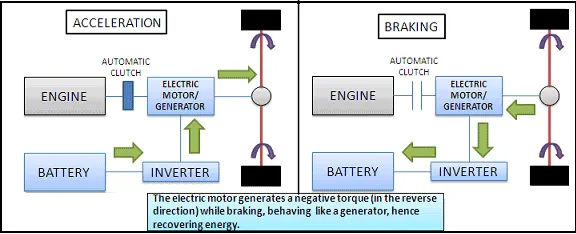
The motor moving with high speed then brakes are applied the motor cut down the battery source but the motor continue to run because of moment of inertia.As the motor runs in magnetic field, the back emf is developed which produce negative torque.This negative torque results in braking.
During braking the motor act as a generator which recharges the battery.The kinetic energy of vehicle is converted into electrical energy and stores in the battery.In conventional IC engine vehicle the kinetic energy is dissipated only in the form of heat.
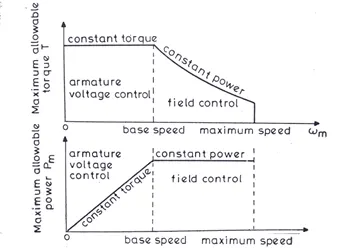
Speed Torque Characteristics of DC Motor
MOTOR LIMITATION:
In above speed torque characteristics shows the speed is low torque produces is high.When the motor get started the speed of the motor is low ,the torque developed is higher so that acceleration power will be high and vehicle drive easily. During braking the speed of the motor is high but the torque developed is low as the motor operates in field weaking region.
BATTERY LIMITATION:
The battery discharge rate is more than the charging rate.The discharge rate will be higher once it reaches the threshold value of battery.Hence it affects the braking torque to be high.
POWER CONVERTERS:
The power converters are bi-directional as they use the regenerative braking to charge the battery and if the power converters are complex or less efficient at high speed then braking torque gets affected.
The electric and mechanical braking are coordinated in two ways:
- Series braking
- Parallel braking
Series braking:
In this braking the brakes are applied one followed by other.The electric brakes are applied first folllowed by mechanical brake.The vehicle is moving and we are approaching the signal before reaching the signal take acceleration paddle so that the vehicle speed reduced and regenerative braking takes place.When the vehicle reaches the signal apply brake padel so that mechanical braking takes place.
Parallel braking:
In this braking both electrical and mechanical brakes are applied.When the brakes are applied the brake fluid move to the brake piston which cause the motion of wheel to retard so that kinetic energy is lost.The lost kinetic energy can be reused at the same time by regenerative braking with the help of power converters to charge the power to the battery.
RESULT:
Thus the electric motor produce low torque during braking and electrical and mechanical braking are coordinated are explained clearly.
STUDY 3:
The Matlab code for speed,torque and efficiency are shown below
clc
speed = linspace(1,1000);
Torque = linspace(1,250);
kc = 0.2;
ki = 0.008;
kw = 0.00001;
Cons = 20;
[x,y]= meshgrid(speed,Torque);
%calculating copper loss
C = kc*(y.^2);
%calculating iron loss
I = ki*x;
%calculating windage loss
w = kw*(x.^3);
%outputpower = torque*speed
outputpower = (x.*y);
%input power = outputpower+losses
inputpower = outputpower+C+I+w+Cons;
%calculating efficiency
Z = outputpower./inputpower;
%the efficiency for which the output is plotted
v = [0.70,0.80,0.85,0.90,0.91,0.92,0.925,0.923];
box off;
grid off;
contour(speed,Torque,Z,v);
xlabel('speed in rad/s');
ylabel('Torque in N.m');
hold on
OUTPUT:
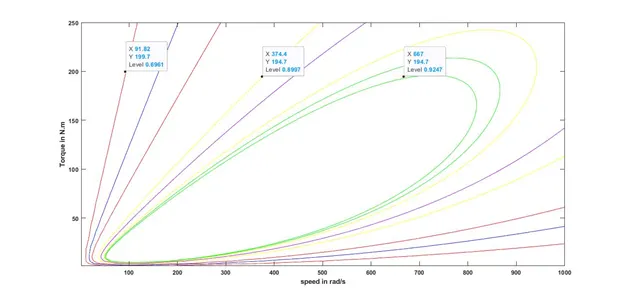
The above plot shows that inner circle provides a highest effciency of 92%.As the efficiency decreases with moving away from inner circle.
RESULT:
Thus the contour plot for the motor speed,torque and efficiency are successfully done.