Braking
Q1. For a defined driving cycle, calculate the energy required for braking.
Ans.
The braking performance is one of the most important concerns in vehicle safety. In urban area driving, a significant amount of energy is consumed in braking. Electrification of vehicles makes it feasible to recover some of the energy lost in braking. A hybrid braking system was developed to ensure the efficient braking of vehicles and recovering the braking energy. The design and control objectives of such a hybrid braking system are to ensure sufficient braking force to quickly reduce the vehicle speed, properly distribution the brake force to the front and rear axle, and also recover as much braking energy as possible. So understanding of braking energy of a driving cycle is important.
Governing equation:-
Braking energy = `1/2*M*V^2` Joules
Where M--> Mass of the vehicle in kg
V--> Velocity in m/s
The following driving cycle is designed for the calculation of braking energy required
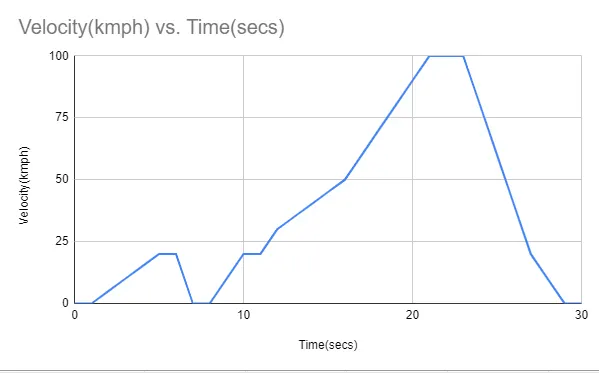
Refer to the following link for accessing the excel file for the driving cycle and all the calculations performed
https://docs.google.com/spreadsheets/d/1KNw3a7l0GCQBo8l3f0P83etoabWOiVbvDWKFZOZ7JVo/edit#gid=0
Results: The braking energy required for the taken driving cycle is 5.062 KJ.
Q2. Why electric motor can’t develop braking torque at a high speed similar to starting? How electric and mechanical brakes are coordinated?
Ans.
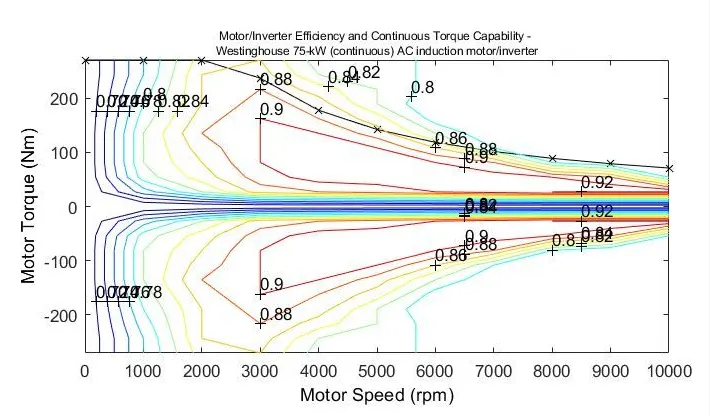
The figure represents forward motoring (positive torque and speed) and forward braking (negative torque and positive speed).
Sometimes after accelerating you can't reach the maximum torque. The reason is that no matter how much the current loop wants to increase the current by increasing the PWM duty cycle of the power stage, the Vmotor is too close to Vbemf, and therefore current cant increase more.
Whenever Friction Torque + Additional loads = Motor Torque, the load remain in equilibrium.
Whenever Friction Torque + Additional loads < Motor torque, the load accelerates.
Al high speeds, the BEMF is so close to Vbus that the applicable motor torque gets limited. Then, the bigger the friction torque + Additional load is, the smaller the acceleration torque becomes.
This can also occur if acceleration or speed is limited by some reason.
This situation does not occur at the beginning of an acceleration because most of the torque is used to increase the kinetical energy of the load. But when the speed is already high and no extra load is applied it is not possible to increase the torque.
And also we know the torque of the induction motor is inversely proportional to the square of the rotor speed. So at higher speed the torque will be less. Thats's why at high speed electric motor cannot produce braking torque similar to the starting torque.
Coordination of Electrical and Mechanical brakes:
In a electric Motor the Total Brake distribution is in two aspects which are Electrical Brake known as Regenerative Brake and Mechanical Brake or Classical Brake with hydraulic cylindrical system. Brake force distribution must be uniform, if the Regenerative Brake power requirement is more than the charging limit of the battery or more than regenerative capacity of the machine we must apply Mechanical brakes as well. In practical case the combination of these two is applied. So usually it is combined response of Mechanical brake and Regenerative brake. The reason for how these brake force are combined, that particular phenomenon is called Brake Control Strategies.
There are two Brake Control Strategies:
- Series- In case of series we apply Mechanical brake and Regenerative electric brake one after another. We can apply only one brake strategy at a time either apply Regenerative or Mechanical brake. The Series Brake Control Strategy has further classification, that is based on whether we want comfort of driver or brake behaviour compared to energy efficiency.
- Parallel- In case of parallel we apply both brakes simultaneously. This particular Parallel braking is going to happen both at a time.
Comparison:
| Electrical Braking System | Mechanical Braking System |
| This system is used for functional braking like controlling speed or bringing the load to standstill. | This system is used for emergency stopping or while parking. |
| It is usually very smooth and comfortable. | It is rough and uncomfortable. |
| No wear results from this braking. | Causes wear in the braking components and requires regular maintenance. |
| It is possible to return the regenerated energy back to the main supply. | It is not possible in this braking system to supply the energy back to the supply and the energy is always lost as heat, noise and wear. |
| Cannot be used as a safety device. | Mostly used as a backup safety device. |
Q3. Make a MATLAB program that plots the contour of given motor speed, torque, and efficiency values. Attach the code as a .m file attach a screenshot of all the plots.
Ans.
MATLAB program for plotting the contour of given motor speed, torque, and efficiency values is as below
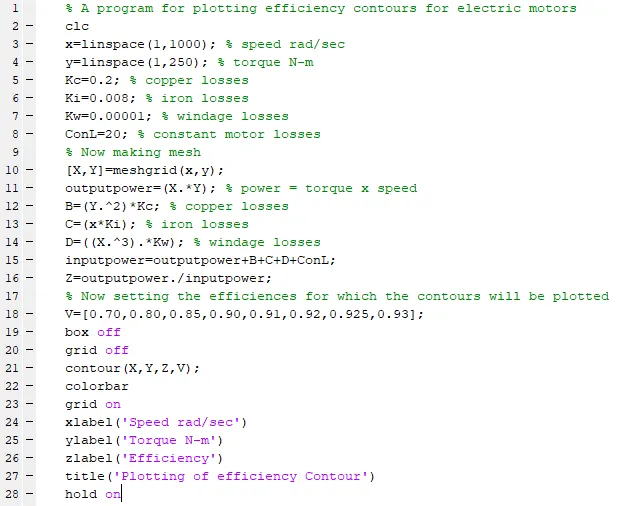
The following results are obtained after running the above code
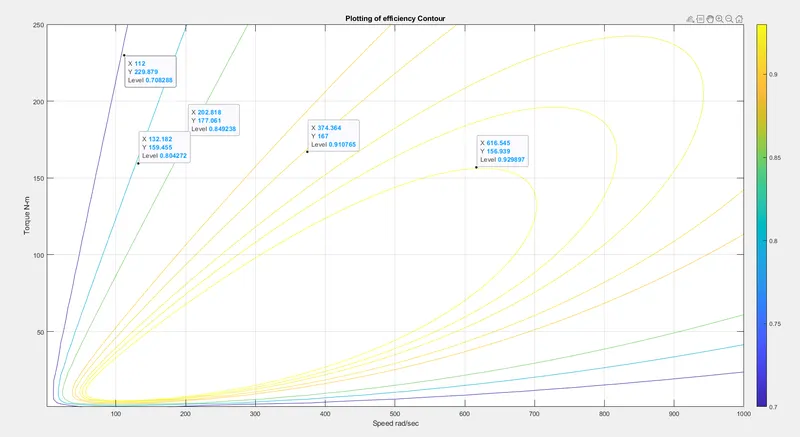
Conclusion: After observing the plot we can conclude that the inner contours have higher efficiency than the outer contours.