Week 11 Car Crash simulation
Objective:
To perform a parametric study using 3 different values of thickness for the car body. Also to compare the total deformation and Equivalent Stress of the models.
Setup:
Since no new materials are added we directly import the geometry and load it into spaceclaim. Once loaded in spaceclaim and checking for any abnormalities we load the geometry in the mechanical module. Once loaded in the mechanical module rename the part as Wall and Carbody. The two geometry which does not correspond to anything are suppressed. A thickness of 0.3 is given initially. A symmetry is added. A symmetry region is added by selecting the surface of the wall which extends to the front of the car. Another symmetry region is added by selecting the edges of the car . In connections we make the body interaction as frictionless and delete the default contacts. Once that is done we onto meesh and give an overall mesh size of 70mm. A patch conforming method is used to for the car body and method is changed to triangles. A face sizing is given to the surfaces of the car body at the back which wont deform due to the impact the size being 150mm. Going into analysis settings we give an end time of 4e-2 leaving all the systems default. Then we give a fixed support to the back surfaces of the carbody and a displacement of 500mm in the z direction to the wall. While giving the thickness of the carbody under geometry we also seect the parameter option. Then for the solution we add Total Deformation and Equivalent Stress to which we also add the parameter option. Solve the proble and then once it is solved going into the analysis system selecting the parameter option we give different values of thickness as input of 0.6 and 0.9 then proceed to solve.
Case 1 (0.3):
Total Deformation:
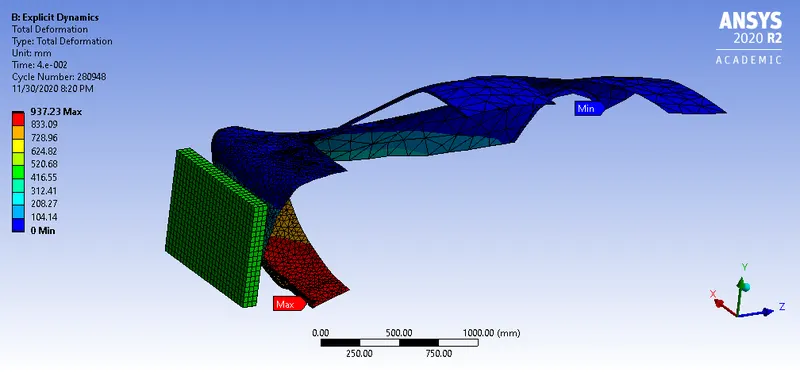
The maximum deformation occured at the front of the car at 937.23mm.
Equivalent Stress:
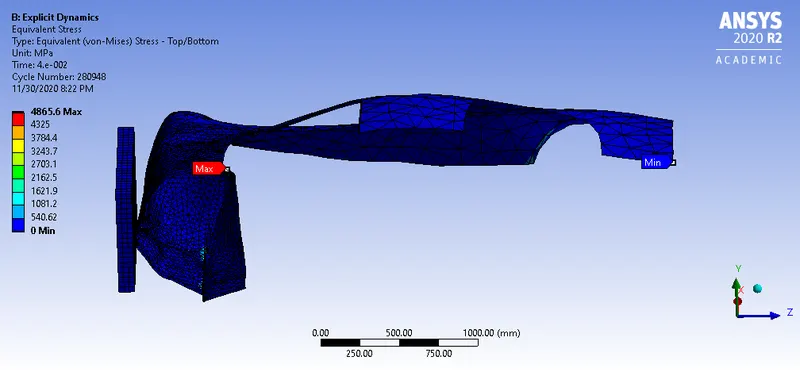
The maximum stress occured at the leading edge of the car at 4865.6 MPa.
Case 2 (0.6):
Total Deformation:
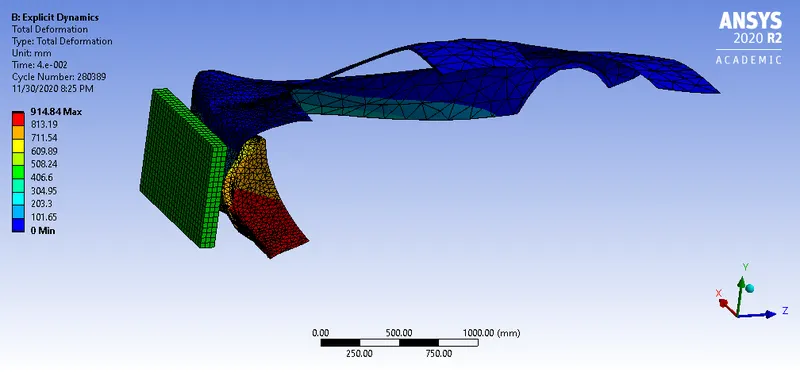
The maximum deormation occured at the front of the car at 914.84mm.
Equivalent Stress:
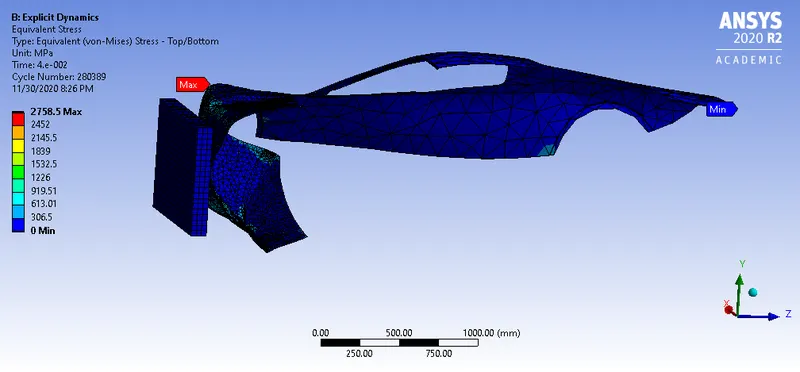
The maximum stress occured at the front of the car at 2758.5 MPa.
Case 3 (0.9):
Total Deformation:
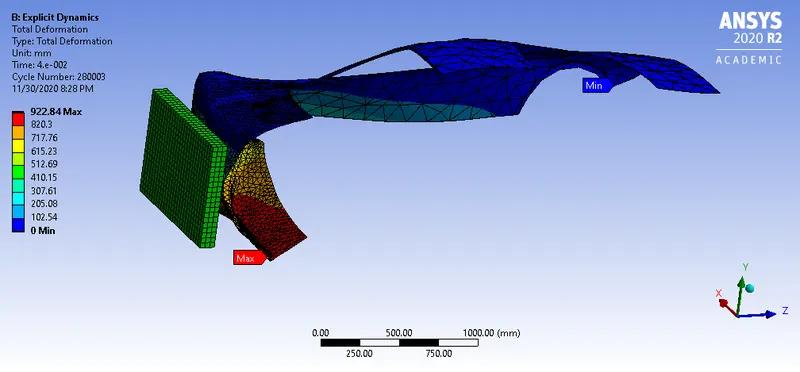
The maximum deformation occured at the leading edge of the car at 922.84mm.
Equivalent Stress:
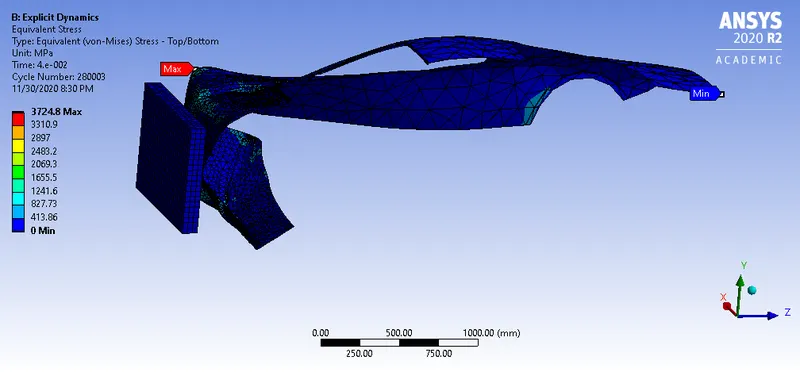
Maximum stress occured at the front of the car at 3724.8 MPa.
Conclusion:
| Thickness(mm) | 0.3 | 0.6 | 0.9 |
| Total Deformation (mm) | 937.23 | 914.84 | 922.84 |
| Equivalent Stress (MPa) | 4865.6 | 2758.5 | 3724.8 |
Out of the following results a thickness of 0.6mm seems to be the better candidate as it has the least deformation and the least amount of stress developed as well. In all cases the maximum stress and deformation occured at the same points.