Hyperelastic Material Study using Mooney-Rivlin and Odgen Models
Objective: To model hyperelastic material by conducting uniaxial tensile test for a dogbone specimen and to determine the material constants for Mooney-Rivlin, and Odgen type of hyperelastic materials.
Introduction:
Hyperelastic or Green elastic material is a type of constitutive model for elastic material for which the stress–strain relationship derives from a strain energy density function.
Hyperelastic material models are regularly used to represent the large deformation behavior of materials.
They are commonly used to model mechanical behaviors of unfilled/filled elastomers.
In addition to elastomers, hyperelastic material models are also used to approximate the material behavior of biological tissues, polymeric foams, etc.
The most common type of example for this kind of material is rubber, whose stress - strain relationship can be defined as non-linea, isotropic, incompressible, and independent of strain rate. This challenge is focused on modeling of hyperelastic material.
The first type of hyperelastic models were developed by Ronald Rivlin and Melvin Money which were the Neo-hookean and Mooney-Rivlin solids.
Hyperelastic constants:
To find the material constants, it is necessary to select the constitutive model. For calibration of material parameters to the experimental data for the stress-strain curve determination, a set of equations involving strain energy density and the invariants need to be solved.
In this case, essentially, the equations for Mooney-Rivlin and Odgen constitutive models will be solved with the help of a uniaxial test in LS-DYNA.
Material Modeling:
Engineering stress-strain data has been provided to us in the form of an image file that defines the behavior of the material.
There is no conversion needed to true stress - true strain from the engineering stress -strain as in the elasto-plastic model.
Using the *Define_Curve option in LS-DYNA, we define the stress-strain curve by inserting the values.
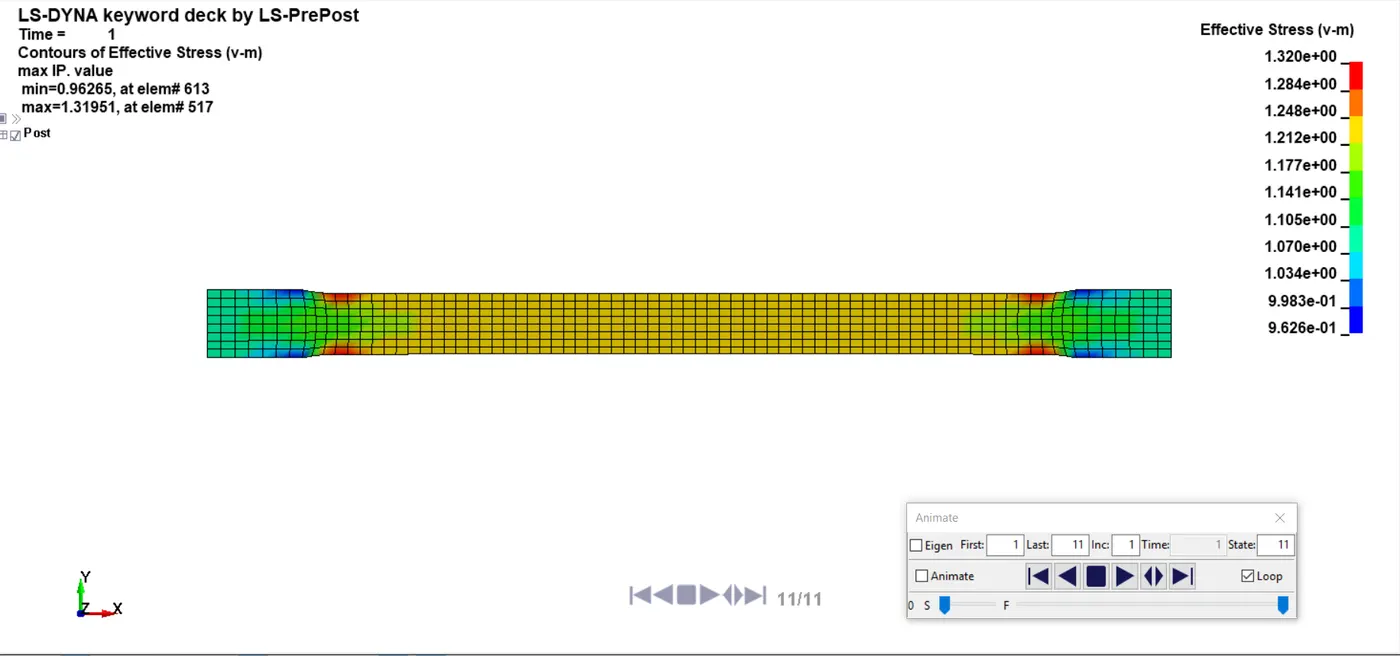
The dogbone specimen is constrained in one direction and a certain amount of displacement is given the other direction.
LS-DYNA gives the output in form of true stress-strain values. The amount of displacement depends on the following calculation for 100%w strain:
Engineering strain = `e^(True epsilon)-1`
For 100% engineering strain for a length of 145 mm,
100% engineering strain = 69% true strain.
Displacement = 0.69xinitial dimension
Displacement = 100 mm.
Hence, to produce 100% engineering strain, a displacement of 100 mm is needed.
Implicit analysis is carried out for this challenge with *Control_Implicit_Auto and *Control_Implicit_General cards.
Determination of Mooney Rivlin Constants:
For this type of model, MAT77_H card is utilized. The N parameter in the card is set to N1, N2 and N3 for the constants needed for polynomial order of 1,2 and 3.
The SW, SGL, ST parameters are as unity for the card as the data is in the form of stress-strain.
The output d3hsp file for each order contains the Mooney-Rivlin constants and the stretch ratio to true stress values.
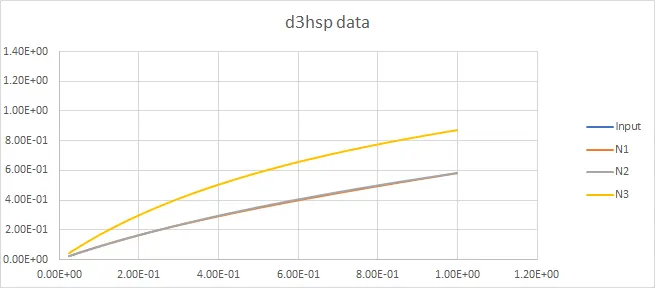
The MOONEY-RIVLIN constants for each case are as follows:
For N1: C1 = 0.1768, C2 = 0.1474
For N2: C10 = 0.2595, C01 = 0.04594, C11 = -0.02092, C20 = 0.002914, C02 = 0.001016
For N3: C10 = 0.2611, C01 = 0.04420, C11 = -0.006074, C20 = -0.002667, C02 = -0.00996,
C30 = 0.0001565
The model is run with different N values and the conversions to engineering stress-strain is carried out.
Later, the constant values from N1, N2 and N3 are input one by one and the data is extracted from the d3plot files in form of true stress-true strain.
This data is converted to engineering stress-strain and the three curves are presented below for N1 constants, N2 constant, and N3 constants.
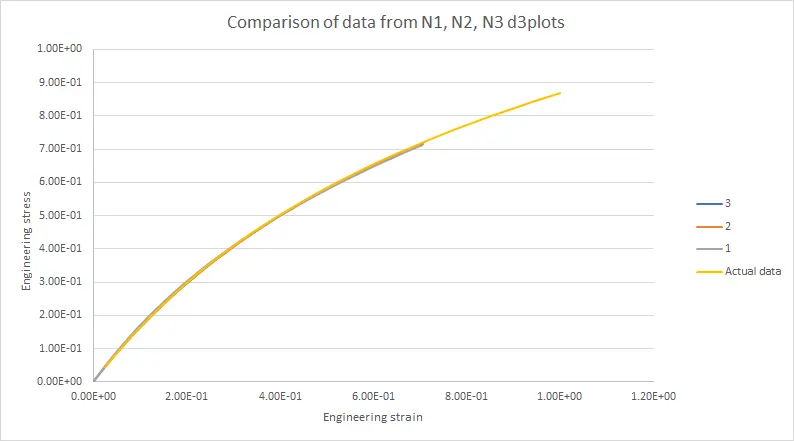
From the above image, all the Mooney Rivlin constants fit the actual data.
Odgen material model:
The ODGEN material constants are determined in a similar manner from the MAT77_O material card.
Even though this card allows for N order 8, for our case, we will be limiting it upto N = 3.
Again the SW, SGL, ST parameters are set to unity.
The solved constants are given as follows:
For N1,
`mu(1) = 0.9107602, alpha(1) = 1.34272388`
For N2,
`mu(1) = 0.9156473, alpha(1) = 1.339909`
`mu(2) = 2.225955, alpha(2) = -1.84347025E-3`
For N3,
`mu(1) = 0.03184257, alpha(1) = 1.9263321`
`mu(2) = 0.2613755, alpha(2) = 1.5503405`
`mu(3) = 0.6819919235, apha(3) = 1.288782095`
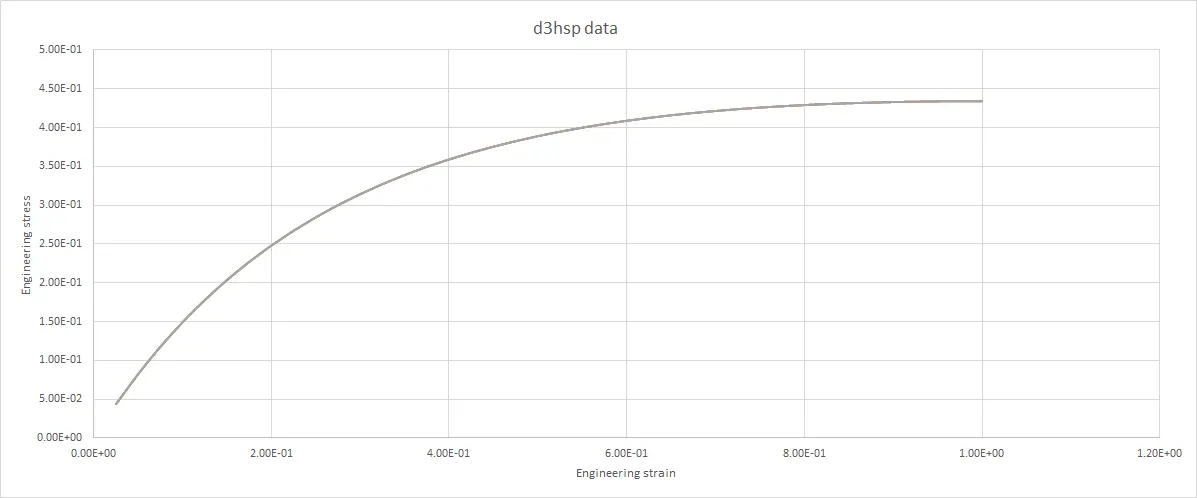
The model is run with different N values and the conversions to engineering stress-strain is carried out.
Later, the constant values from N1, N2 and N3 are input one by one and the data is extracted from the d3plot files in form of true stress-true strain.
This data is converted to engineering stress-strain and the three curves are presented below for N1 constants, N2 constant, and N3 constants.
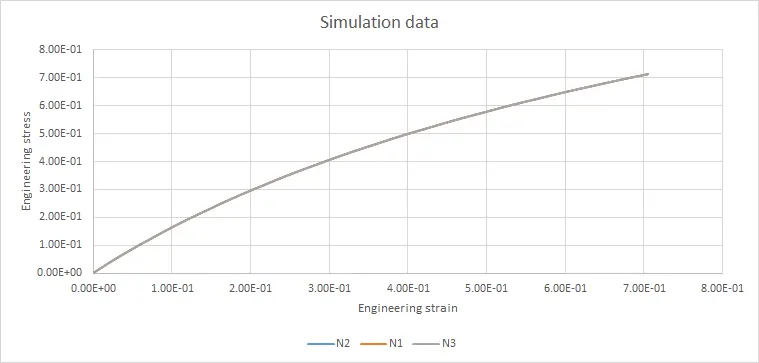
Again, from the above plot, all Odgen material constants fit the actual data.
The excel sheets for Odgen material and Mooney Rivlin are attached with this assignment.
Conclusion:
Many hyperelastic material models and cards exist in LS-DYNA out of which MAT77_H and MAT77_O are put into practice for this challenge. Ultimately, the type of hyperelastic material to be used depends on the application and its complexity. For every material, the model parameters should be validated for different kinds of test like tension, compression, shear, bending etc. The quality of the model data is highly important for any test result.