Week - 10 Hyperelastic Material Models
Aim: To calculate the Mooney Rivlin and ogden material constants.
Given:
1. Engineering stress-strain data .
2. Dogbone specimen
Unit system used: g-mm-ms
Theory:
A hyperelastic or Green elastic material is a type of constitutive model for ideally elastic material for which the stress–strain relationship derives from a strain energy density function. For many materials, linear elastic models do not accurately describe the observed material behaviour. The most common example of this kind of material is rubber, whose stress-strain relationship can be defined as non-linearly elastic, isotropic, incompressible and generally independent of strain rate. Hyperelasticity provides a means of modeling the stress–strain behavior of such materials.
Ronald Rivlin and Melvin Mooney developed the first hyperelastic models, the Neo-Hookean and Mooney–Rivlin solids. Many other hyperelastic models have since been developed. Other widely used hyperelastic material models include the Ogden model and the Arruda–Boyce model.
The strain energy density function for an incompressible Mooney–Rivlin material is

where C1 and C2 are emperically determined material constants and I1 and I2 are the first and the second invariant.
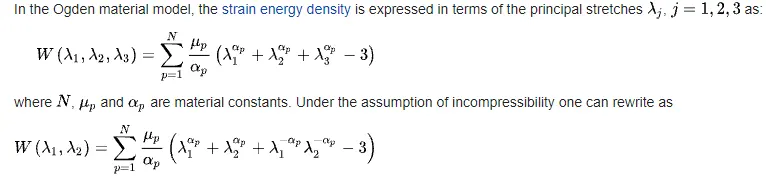
The Ogden material model is a hyperelastic material model used to describe the non-linear stress-strain behaviour of complex materials such as rubbers, polymer, and biological tissue.
Procedure:
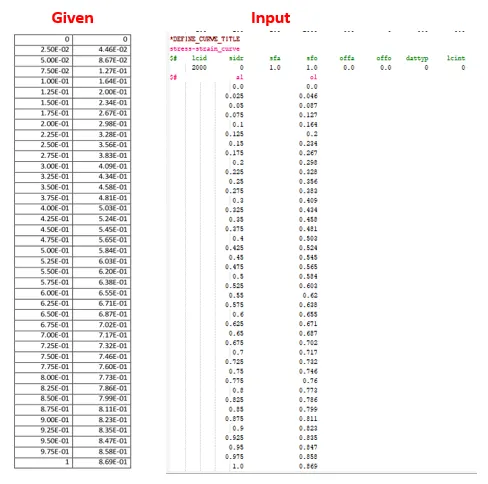
1. As input in hyperelastic material model is engineering stress-strain. And given data is also in engg. stress-strain. So MAT 077-H is selected and stress- strain curve is defined.
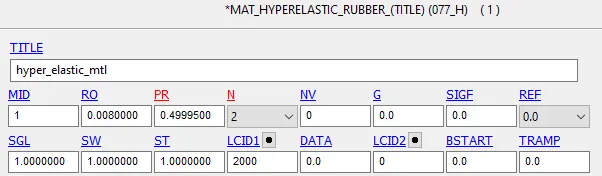
SGL, SW, ST are kept 1 as input data is in stress-strain form. N=2 , as we don't know constant values yet.
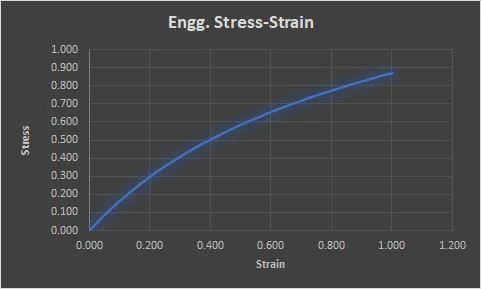
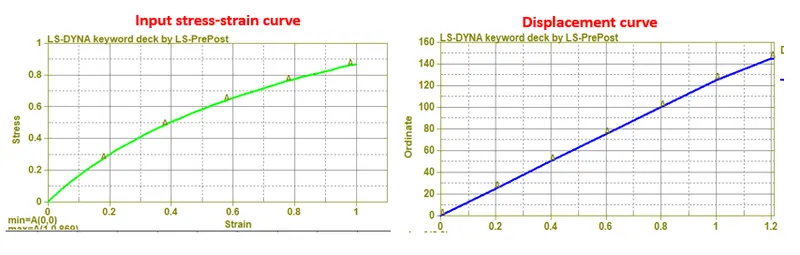
From the stress-strain curve we can see that for 100% strain, Stress generated is only 0.87 MPa, which is typically hyperelastic material behavior.
Part is defined.

2. Input and displacement curve are presented below. for 100% strain displacement is given equal to original length of specimen.
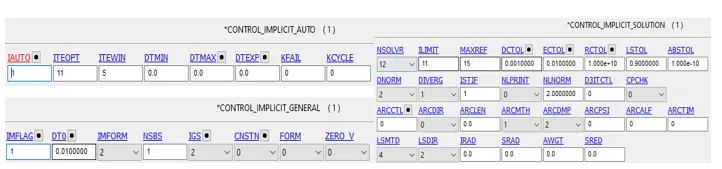
3. As this is static simulation implicit solver is used. And necessary boundary condition are given.
As this is non-linear problem, Control_implicit_solution card is used along with impicit general, implicit auto.
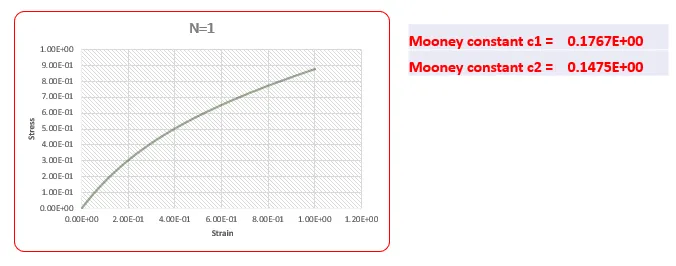
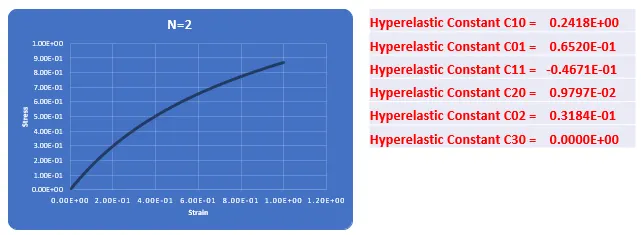
4. Calculation of constants and stress-strain
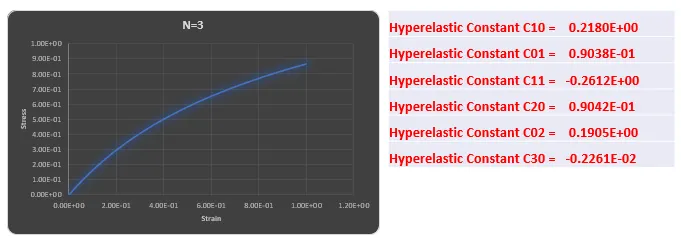
|
Stress (MPa) |
Strain (mm) |
Young's Modulas |
|
|
N = 0 |
1.828 |
0.3887 |
4.702855673 |
|
N = 1 |
1.827 |
0.3886 |
4.701492537 |
|
N = 2 |
1.811 |
0.389 |
4.655526992 |
|
N = 3 |
1.813 |
0.3889 |
4.661866804 |
---------------------------------------------------------------------------------------------------------------
4. Similarly odgen material model is modelled.
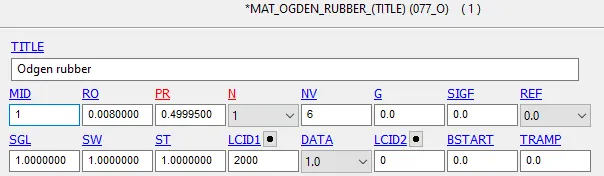
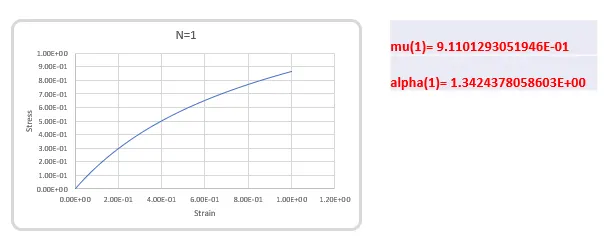
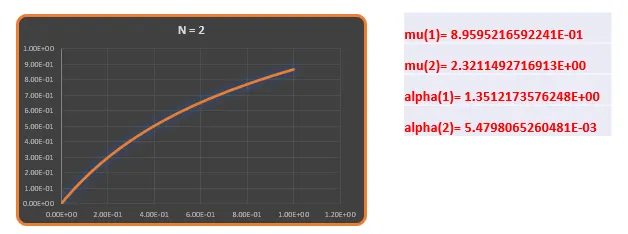
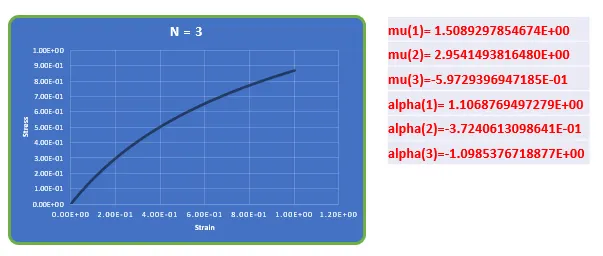
| Stress (MPa) | Strain | Young's Modulas | |
| N = 0 | 1.81 | 0.3889 | 4.654152738 |
| N = 1 | 1.81 | 0.3889 | 4.654152738 |
| N = 2 | 1.81 | 0.3889 | 4.654152738 |
| N = 3 | 1.81 | 0.389 | 4.652956298 |
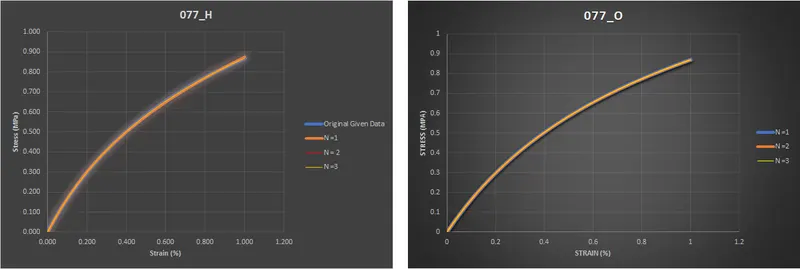
Model verification for 077_H and 077_O
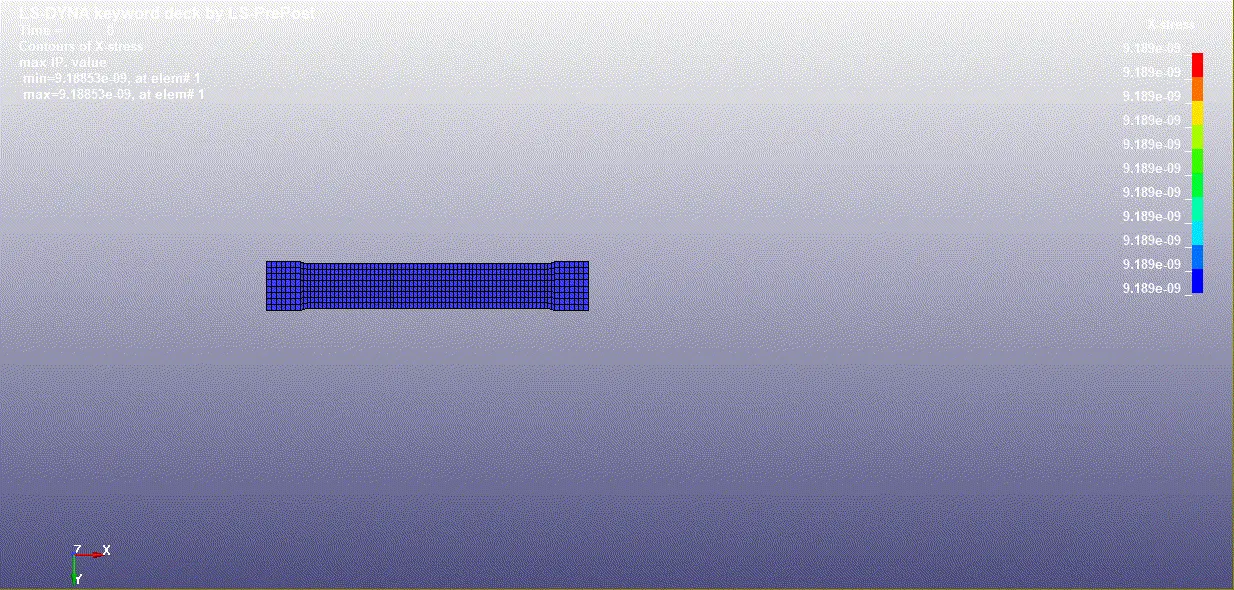
Animation:
Outcomes:
1. Both Mooney Rivlin and ogden model, give a close fit result compaired to original data using d3hsp file.
2. N values range from 1 to 3 used, all give approximately same results. With increase in N value simulation took few seconds more as more constants need to be calculated.