Week - 10 Hyperelastic Material Models
AIM: To Calculate the Mooney Rivlin and Ogden Material constants and to compare the both using stress-strain data from a Dogbone Specimen tensile test with 100% strain from d3hsp file and from the simulation as well.
THEORY:
- Hyper elastic material are the material which has the capablity to stretch with more than 100% strain without any sort of failure.
- These material are hard to replicate as the strain value are high. These materials have poission's ratio of almost 0.5. Altough keeping 0.5 poission's ratio creates instablity so for simulation purpose the value is assigned that is almost equal 0.5 but not 0.5 like 0.4999 or 0.4995 etc.
- Various material models like Mooney Rivlin,Ogden,Yeoh etc are used to model these materials.
- These materials can be defined using strain energy vs stretch relation, where strain energy is the area under stress-strain graph.
- Here we will discuss modelling of Mooney Rivlin and Ogden material using the given stress strain data.
PROCEDURE:
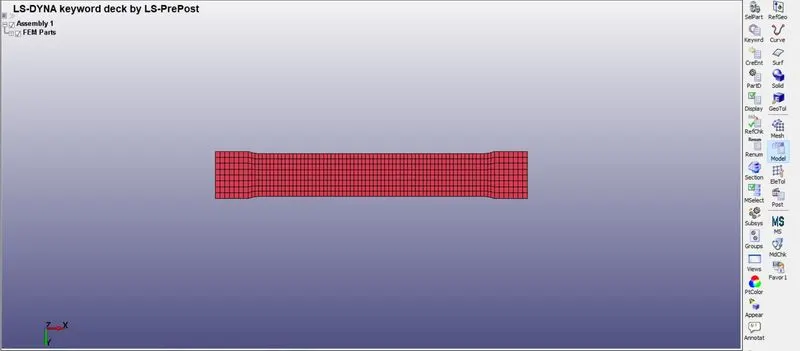
- We have to open the .K file in LS-Prepost, using the option Ftile then open then LS-DYNA keyword file as shown below.
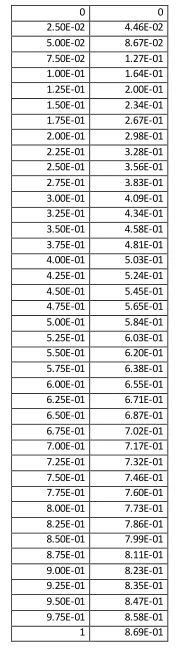
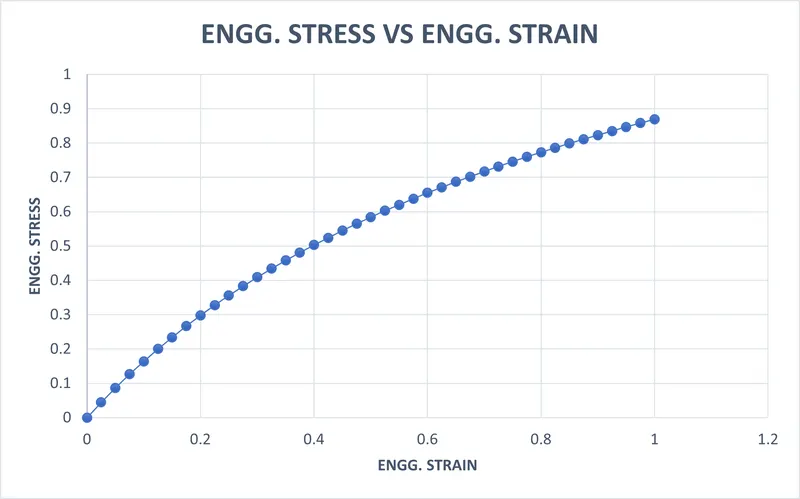
- Now from experimental data image we will input the given data into excel and create the stress-strain curve in excel.
MOONEY RIVLIN MATERIAL-
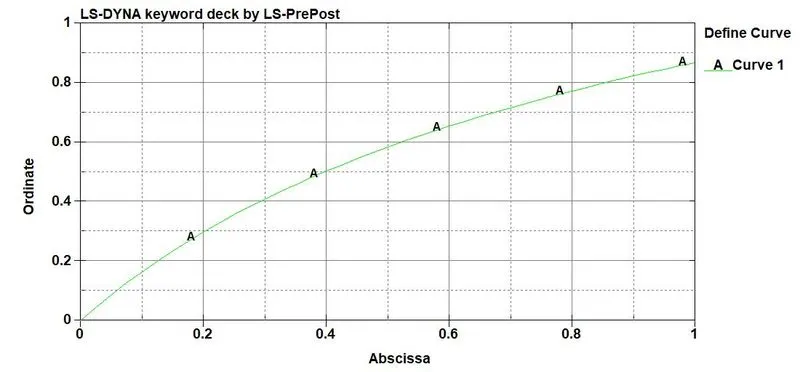
- Now from Experimental data image we will input data into excel and input the same data in the curve data of LS-DYNA.
- For that we will go to define then curve and input value as 0,0 then manually we will enter the vales in notepad++.
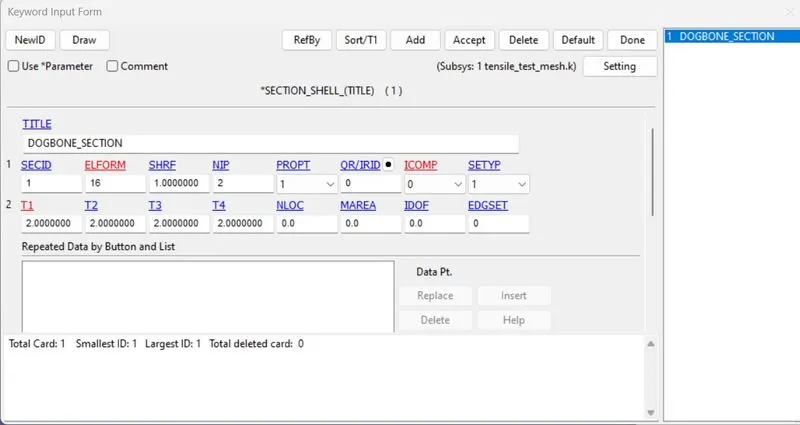
- After that we will be defining section as shell and inserting the necessary data in the fields.
- Now we will create the material card here as Hyperelastic material which is MAT_077_H.
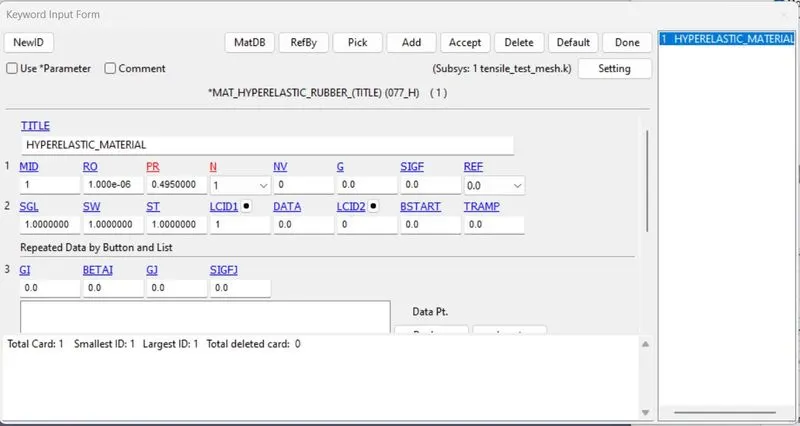
- Here we will start with N=1 till N=3 and calculate the stress and stretch ratio and then calculate the engg. stress and strain and also we will get the values of constant C10,C01 and other constants.
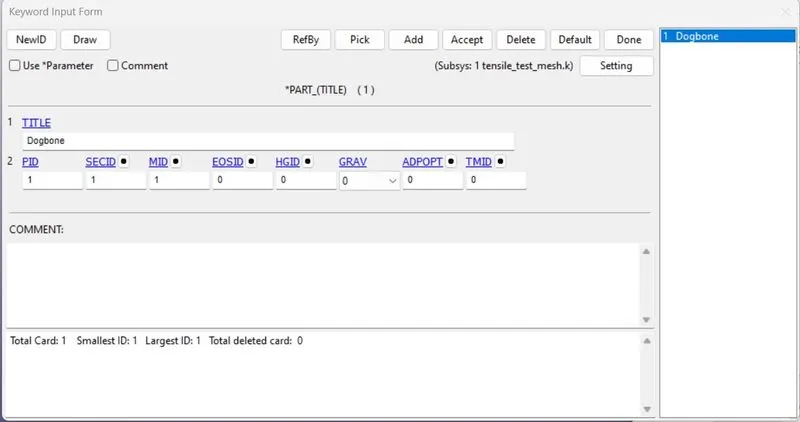
- Finally we will assign the section and material to the part.
- Now we will apply SPC to the edges which we need to fix.
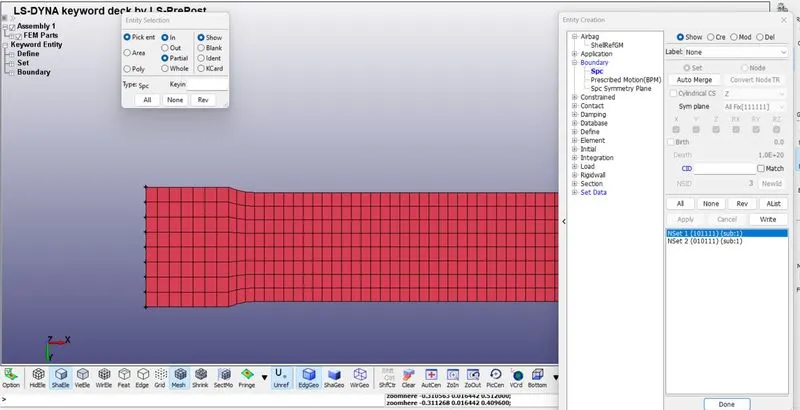
- Here we will constrain left side node in all direction except Y-Direction.
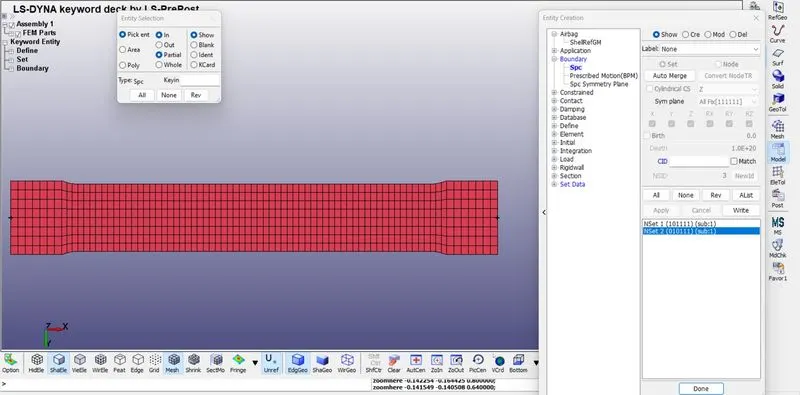
- Now we will constrain the mid nodes of both the ends of the edges of dogbone specimen to restrict the slip during the simulation.
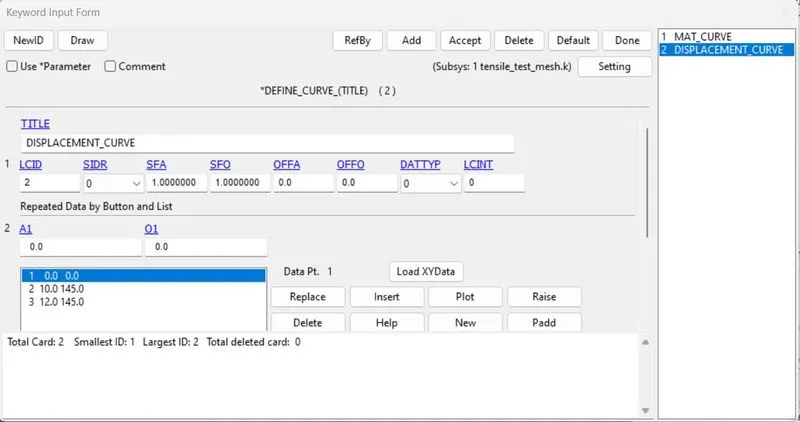
- After this we will assigning the displacement curve on other edge of the specimen where the force is going to act as given in question itself strain should be 100% hence we will take displacement as 145.
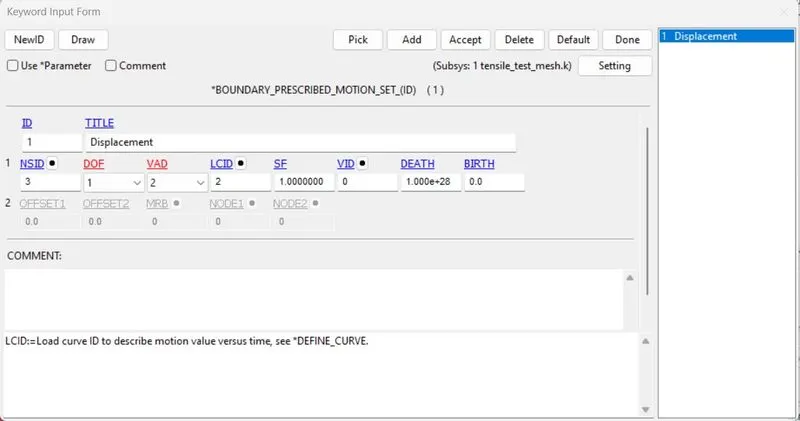
- Now we have to create the control cards for finalisation of output data.
- At first we will create the Control_Termination card.
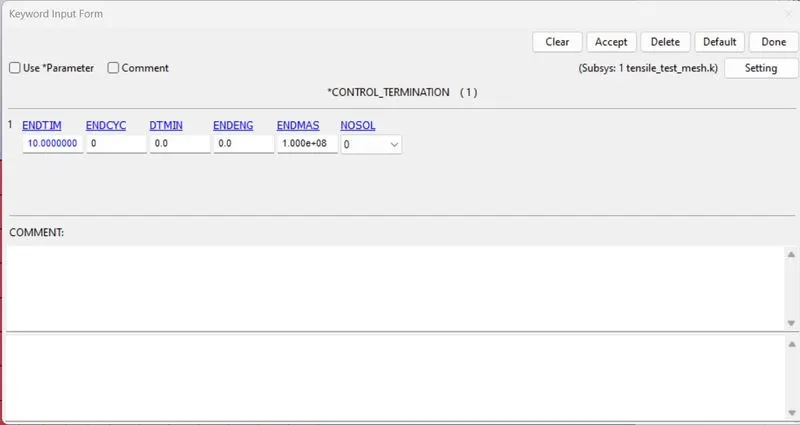
- Now we will create CONTROL_IMPLICIT_GENERAL, CONTROL_IMPLICIT_AUTO, CONTROL_IMPLICIT_SOLVER and HOURGLASS as well.
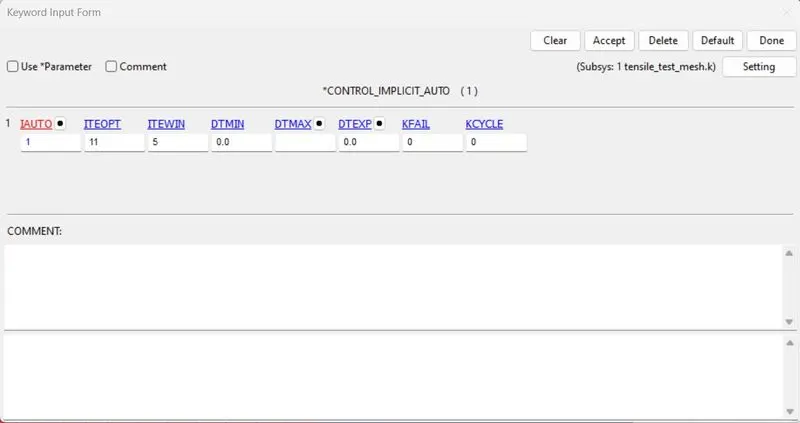
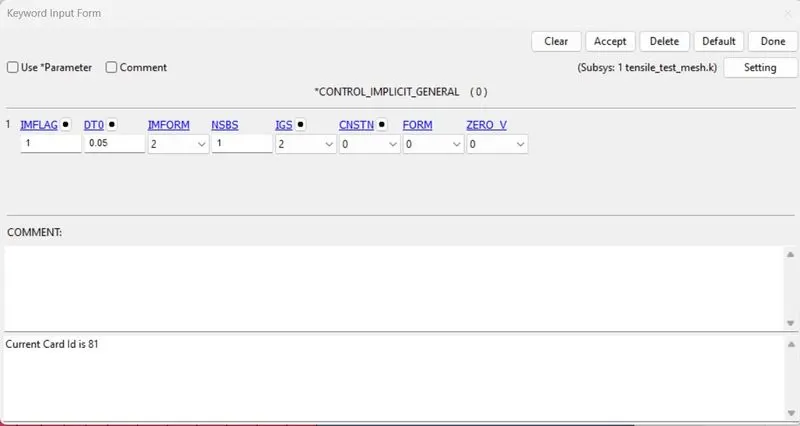
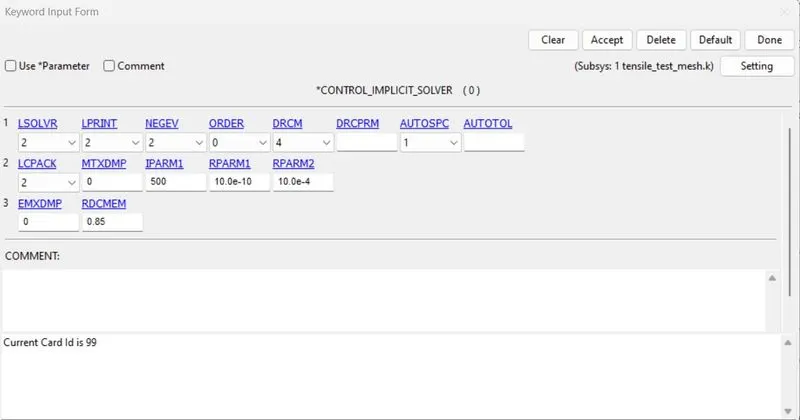
- As it is the tensile type of test so we need to use implicit analysis method here.
- Now we will create output database file.
- BINARY_D3PLOT- It is for defining the frequency at which the animation file is to be created and is set to 0.1ms.
- Extent Binary database and Database_history_node card are created.
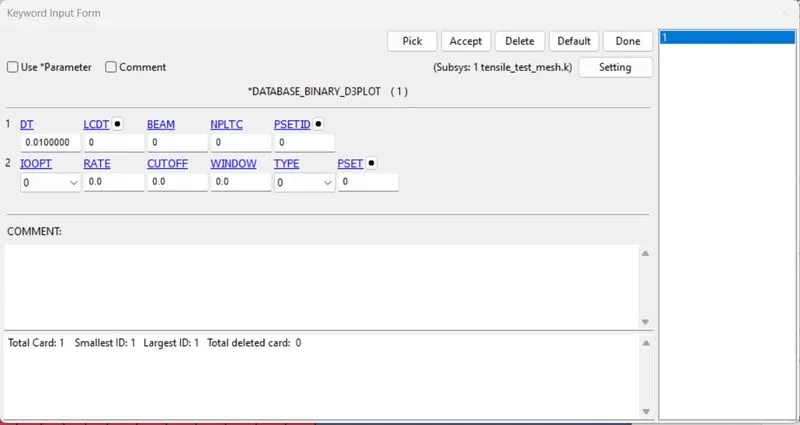
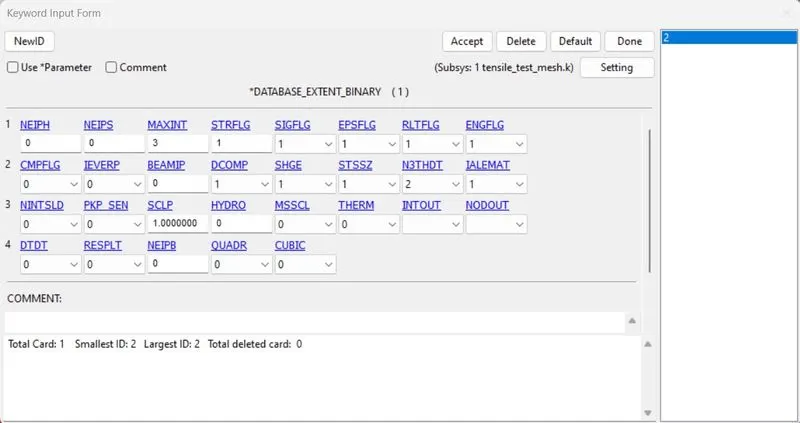
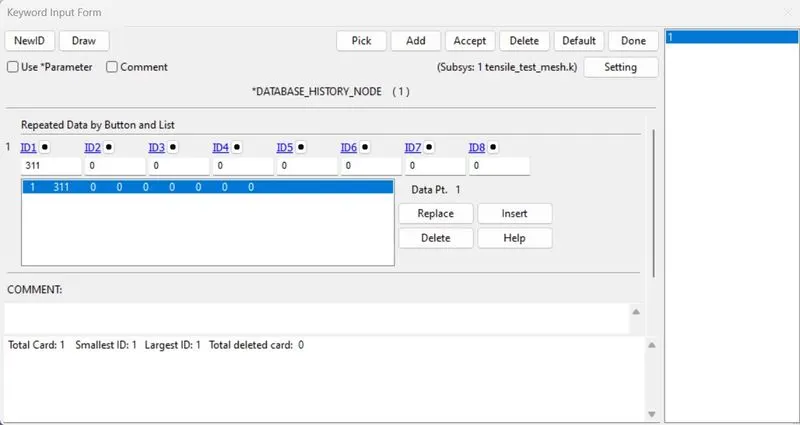
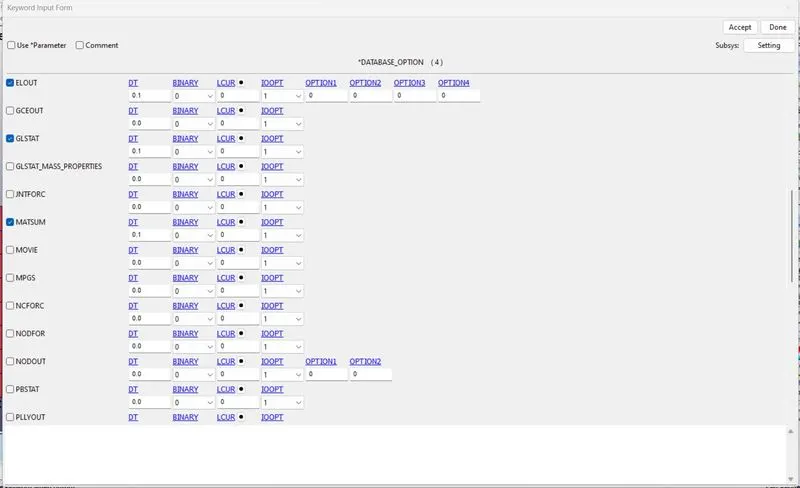
- Now the output request in ASCll_Option are given as-
- ELOUT-Element Output Data
- MATSUM-Material Energies
- GLSTAT-Global Data
- NODOUT-Nodal Data
- RCFORC-Resultant Inter Forces
- Now we will check the for the model check and run the keyword file.
- The d3hsp file for each material model is opened in Notepad++ and the material constants of MOONEY-RIVLIN as well as final fit data of stretch and Engg. Stress is obtained for each case.
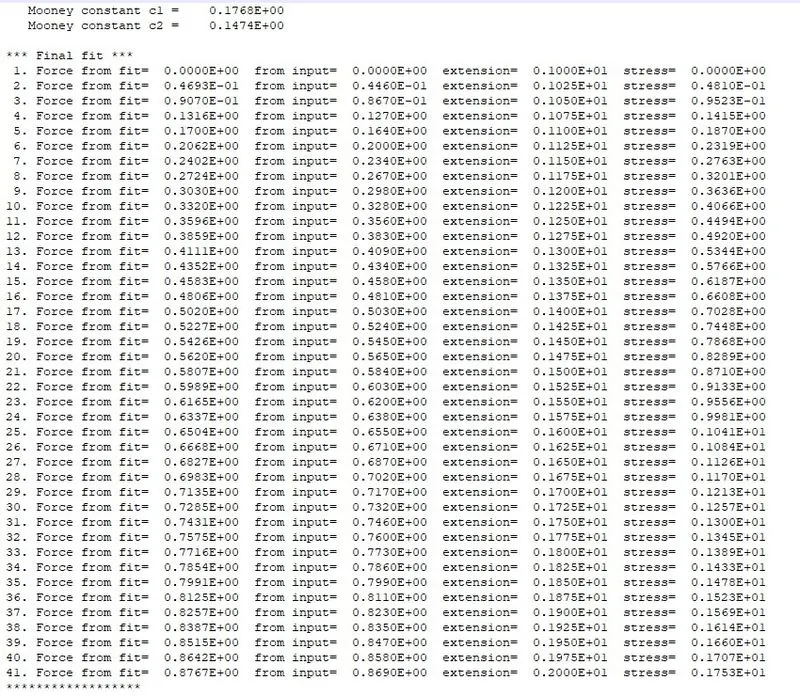
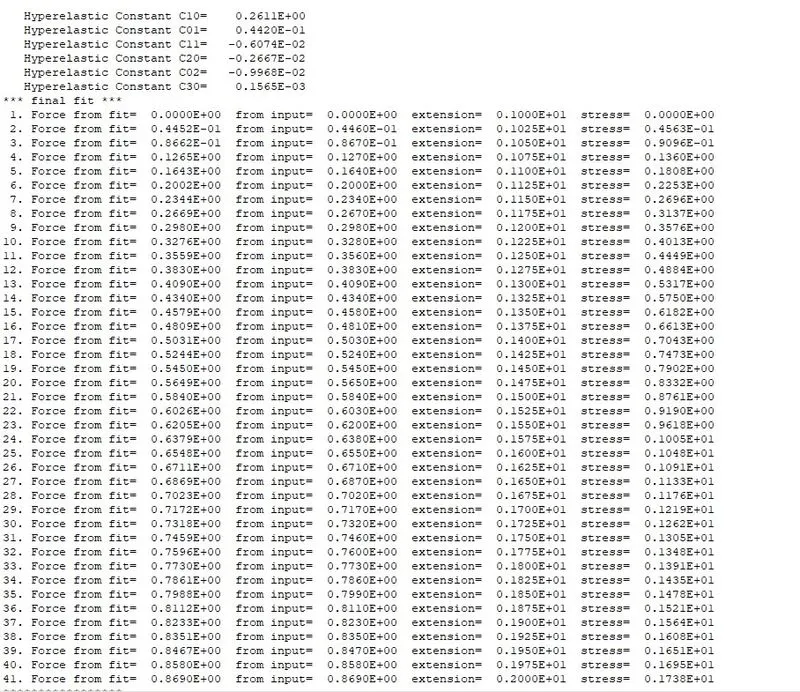
MOONEY-RIVLIN Material Constants (From N1) :-
MOONEY CONSTANT C1=0.1768E00
MOONEY CONSTANT C2=0.1474E00
OGDEN RUBBER CONSTANTS (From N2):-
HYPERELASTIC CONSTANT C10= 0.2611E00
HYPERELASTIC CONSTANT C01= 0.4420E-01
HYPERELASTIC CONSTANT C11= -0.6077E-02
HYPERELASTIC CONSTANT C20= -0.2666E-02
HYPERELASTIC CONSTANT C02= -0.9968E-02
HYPERELASTIC CONSTANT C30= 0.1565E-03
- Now we will calculate the engg. stress and engg. strain values from the calculated values by N= 1 and 3.
True Strain=ln(1+Engg. Strain)
True Stress=Engg. Stress*(1+Engg Strain)
Stretch Ratio=1+Engg. Strain
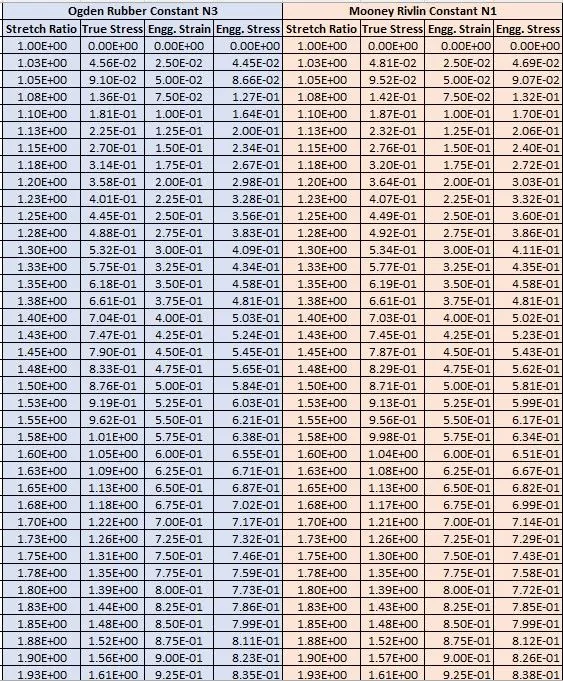
- Now we will create graphs for the each constants.
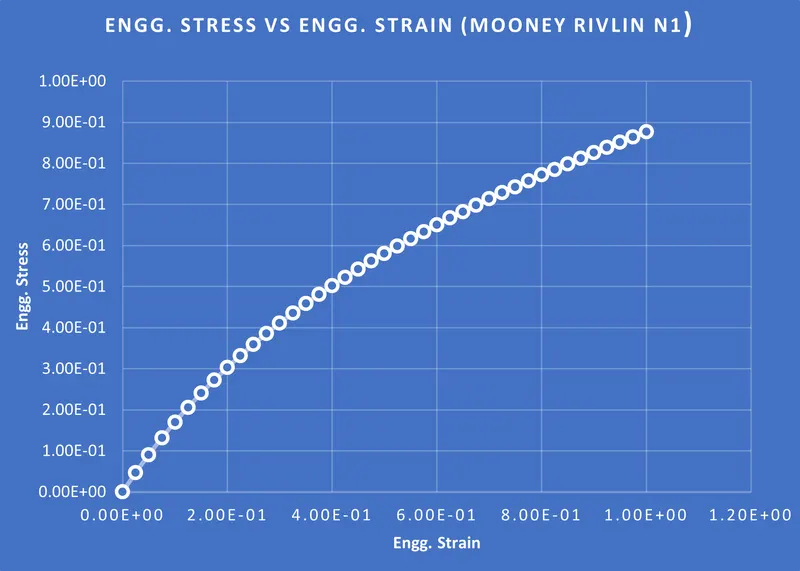
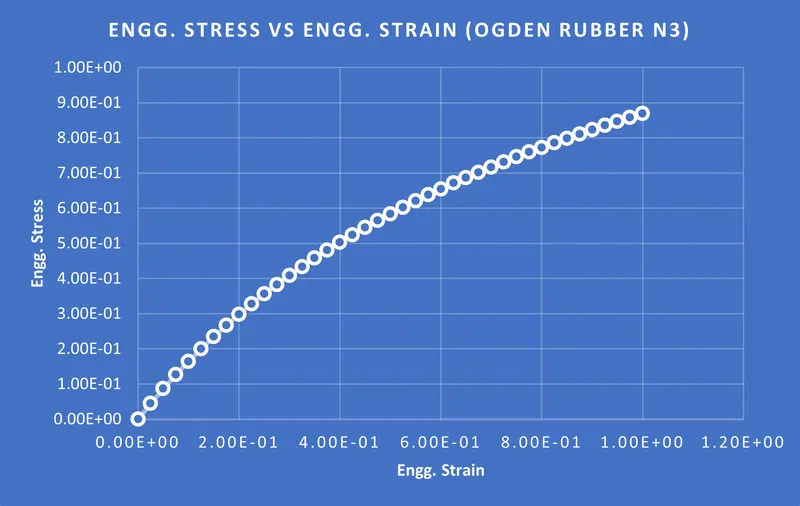
- Since above all the graphs looks almost similar to experimental data we had earlier, now to get exact material model we have to compare the value of stress from N1 & N3 Values.
- After comparing this we will come to know that the N3 values are more closer to the values of experimental data.
- So N3 model can be selected from that material model.
RESULT:
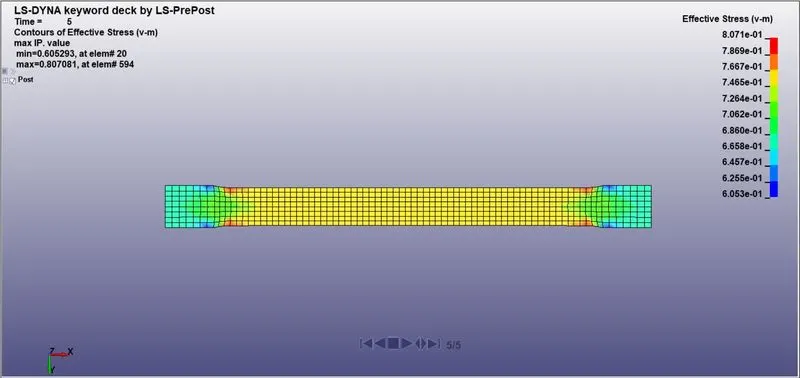
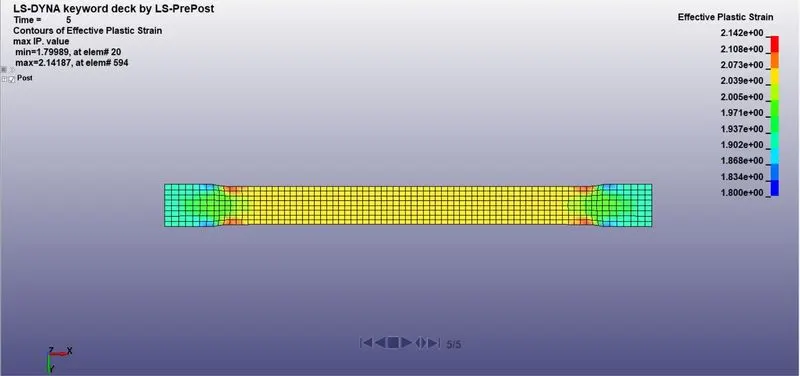
- For N=1
Effective Stress (V-M):-
Effective Plastic Strain:-
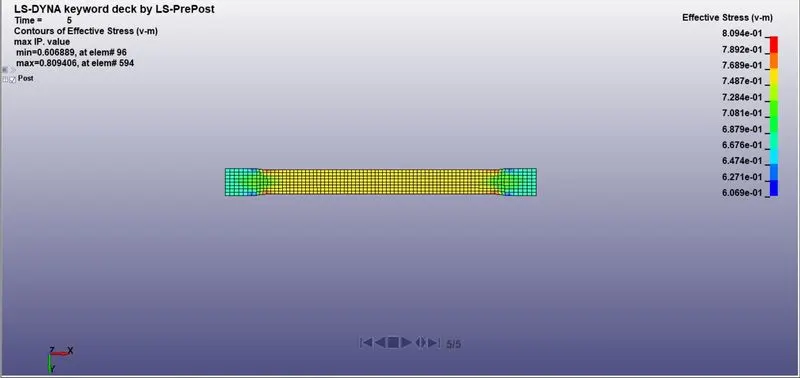
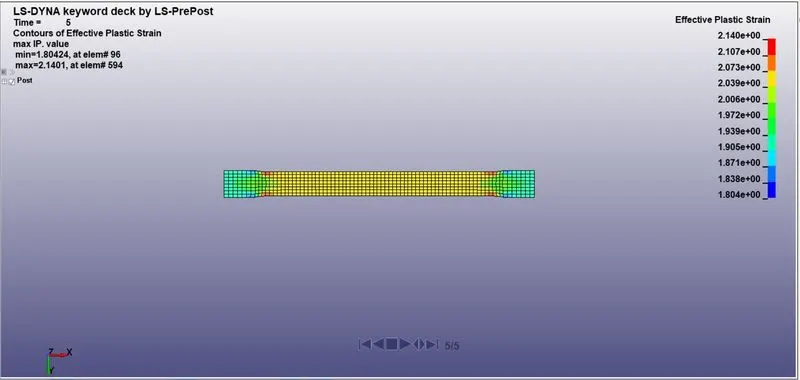
- For N=3
Effective Stress (V-M):-
Effective Plastic Strain:-
CONCLUSION:
- The above challange is for understanding the detail process involved in generating the hyperelastic material card.
- Also for this particular challange we have used poission's ratio as 0.495. And from our simulation report we have observed that ogden material has more accurate to experimental data, so we can use this material model for further refrence.