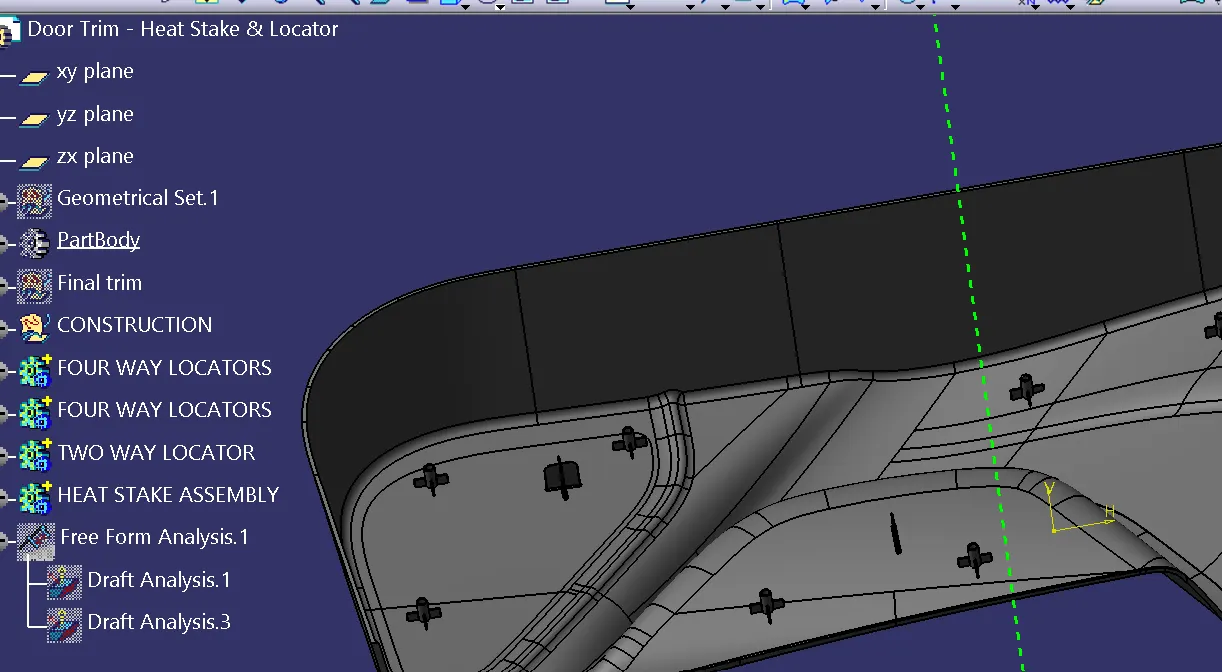
Week 10 - Challenge 3 - Door Trim Lower with Engineering Features
In this challenge, we're crafting a solid 'Door Trim Lower' using CATIA V5. First, we offset the given surface inward by 2.5mm to create thickness, then close any gaps caused by fillets. Next, we merge these closed patches to form a Class B surface. Using this surface, we trim the original surface to form a solid body. After adding features like Heat Stakes and Locators, we check draft angles for proper molding. The tooling axis is created to ensure correct positioning. Finally, we analyze the draft of the Class A surface to ensure proper angles are maintained.
Draft analysis of class A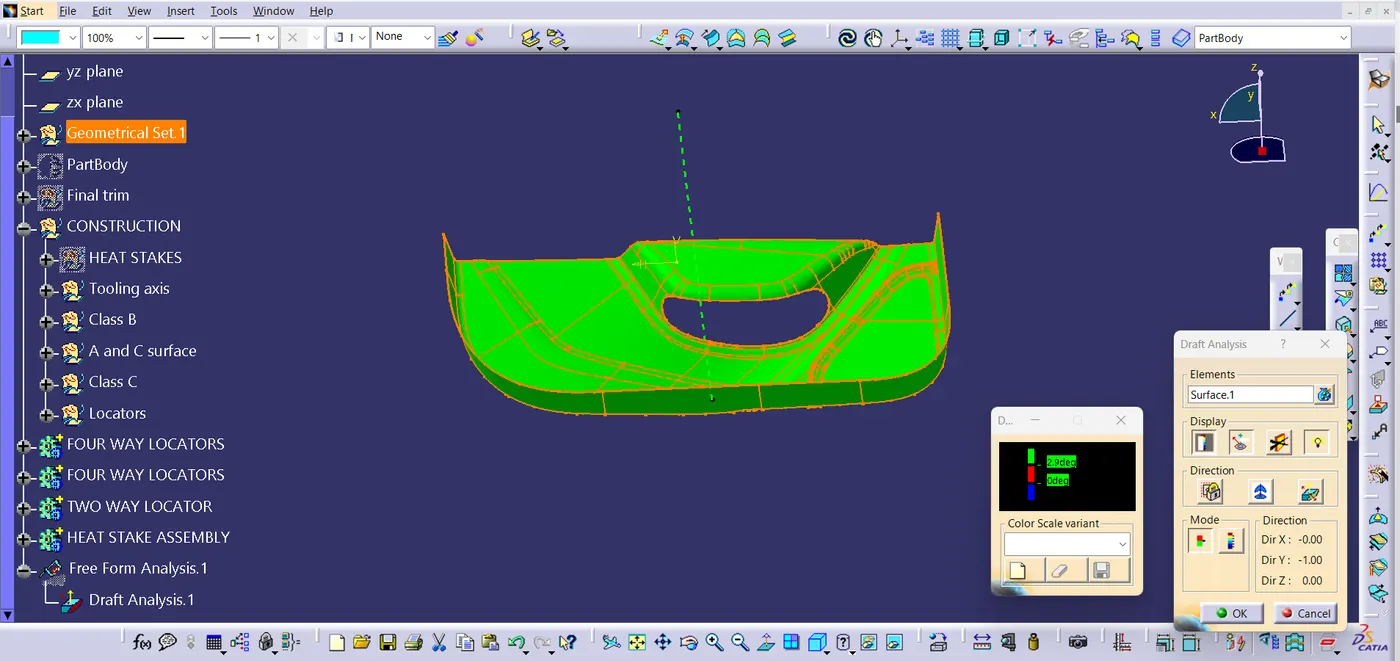
Draft analysis of final product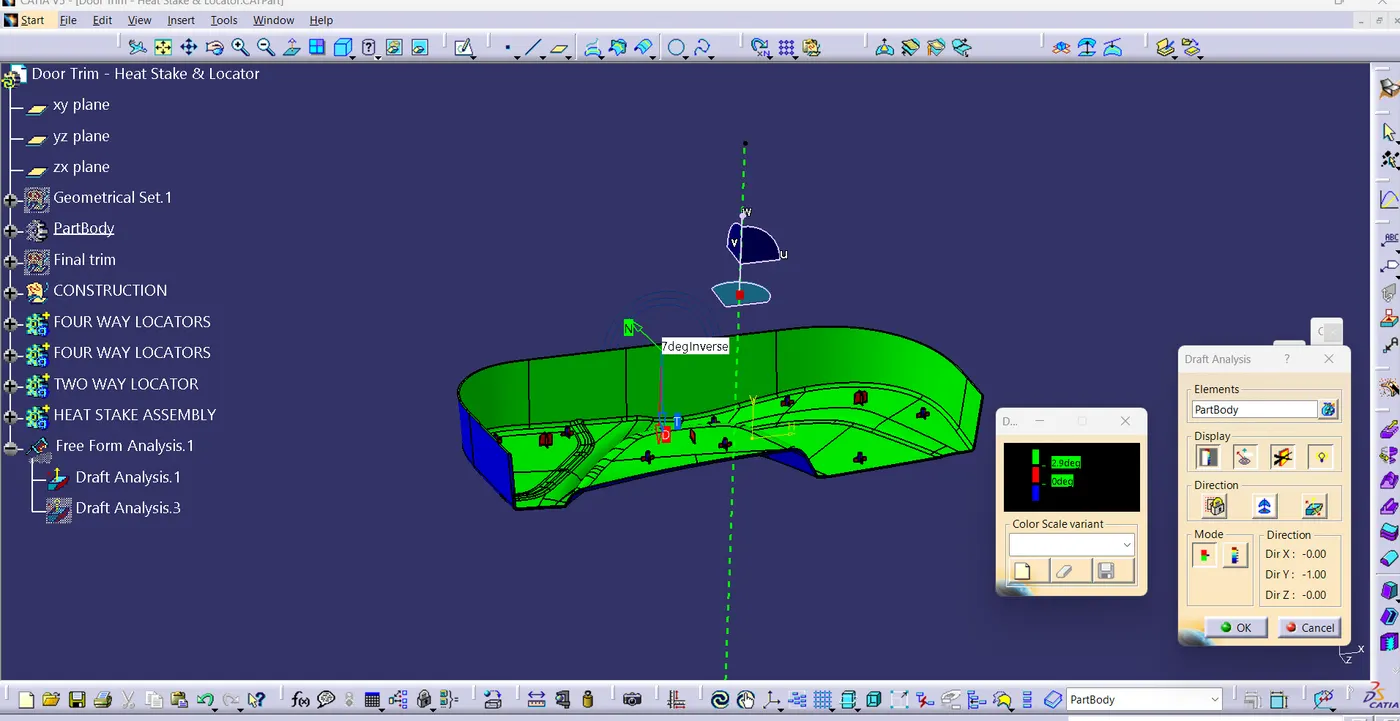 Once the Class B and Class C surfaces are unhidden, it's crucial to ensure they intersect properly for a closed surface. If any sides don't intersect, extrapolate them to meet. Check all boundaries to confirm intersection. Trim them together for closure. For locators, sketch on the body, pad to 20mm, then thicken to 1.3mm, drafting 0.5deg along the tooling axis. Add a 3mm chamfer at 45deg, plus a 0.3mm fillet. For heat stakes, sketch on the surface, pad to 15mm, draft 0.5deg on both sides, then fillet with a 0.25mm radius. Create supporting ribs by sketching, padding to 6mm, then 1mm thickness, drafting 0.5deg, and filleting with a 0.25mm radius. Union trim ribs within heat stakes for removal.