Week 10 Bullet penetrating a Bucket Challenge
Simulation of Bullet Penetration into Bucket.
Aim: Simulation of bullet penetration into bucket made up of Copper Alloy NL,Magnesium Alloy NL and Aluminium Alloy NL.
Steps followed:
1) Material selection:
Bullet:
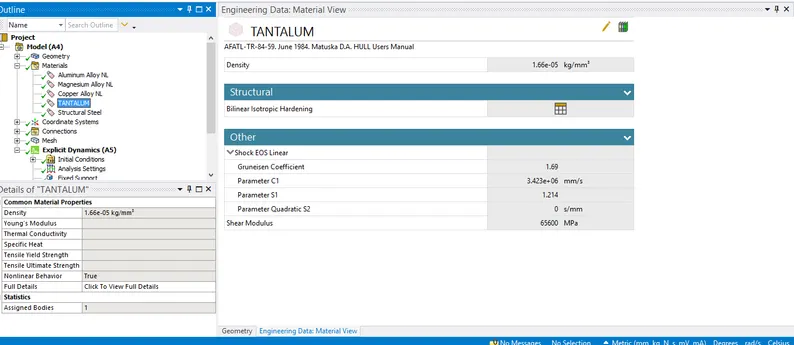
Material selected for Bullet is Tantalum with material specifications as shown in the image below:
Case 1:
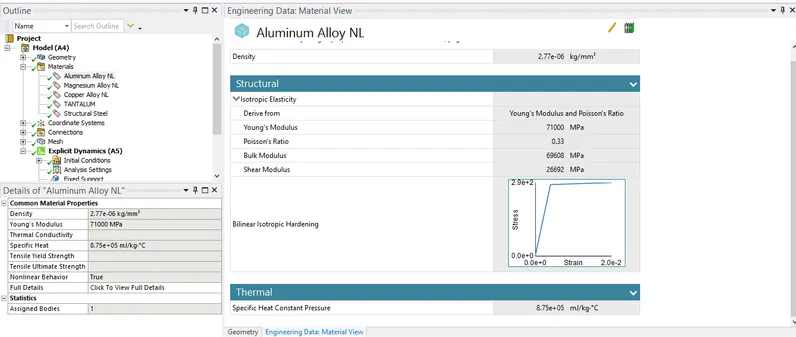
Material selected for Bucket is Aluminium Alloy NL with material specifications as shown in the image below:
Case 2:
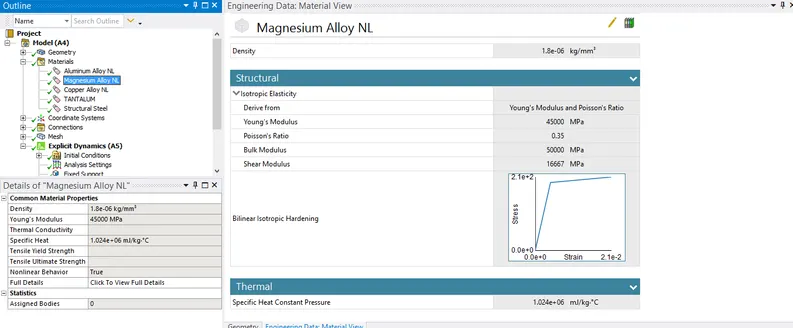
Material selected for Bucket is Magnesium Alloy NL with material specifications as shown in the image below:
Case 3:
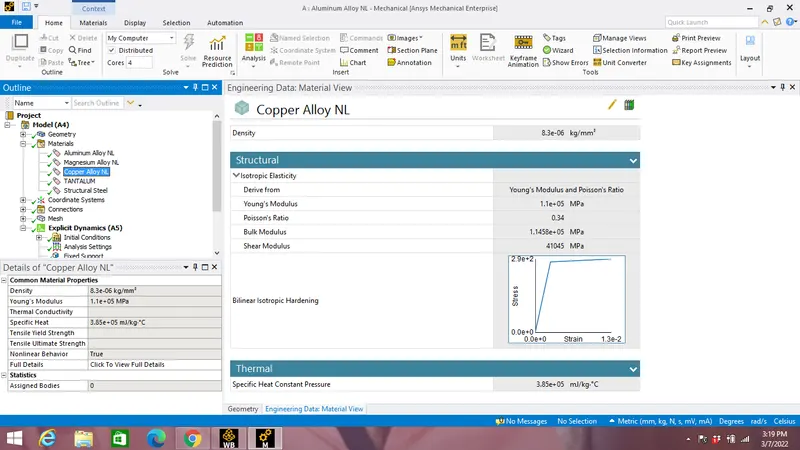
Material selected for Bucket is Copper Alloy NL with material specifications as shown in the image below:
2)Geometry:
A CAD model of Bullet-Bucket assembly is imported and parts are renamed as Bullet & Bucket will proper material assingment and behaviour of Bullet is taken Rigid, since we only want to study deformation & stress on bucket alone:
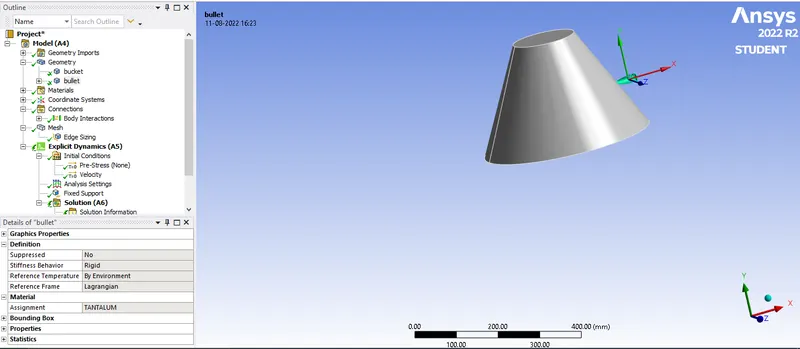
Case 1:
For bucket material assigned is Aluminium Alloy NL:
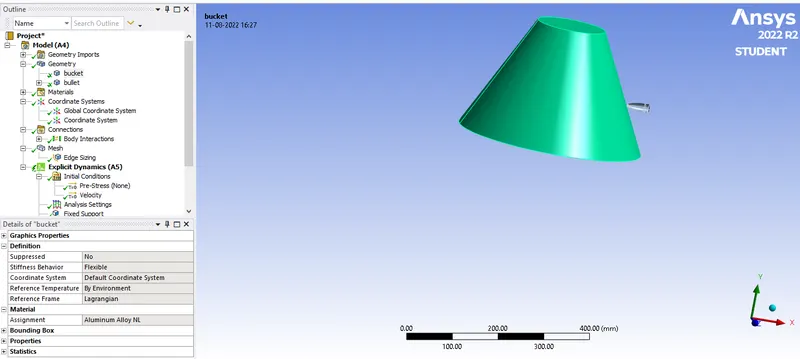
Case 2:
For bucket material assigned is Magnesium Alloy NL:
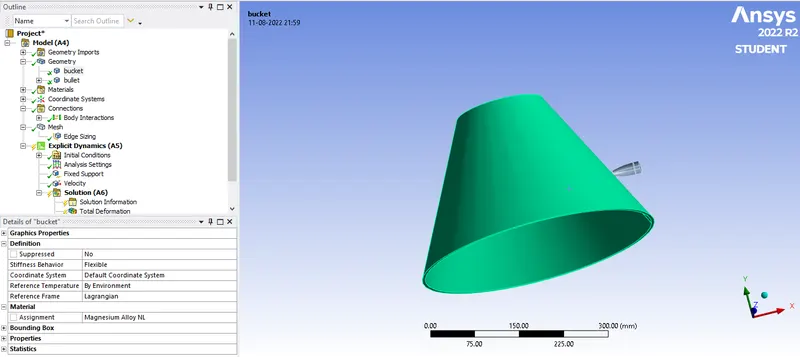
Case 3:
For bucket material assigned is Copper Alloy NL:
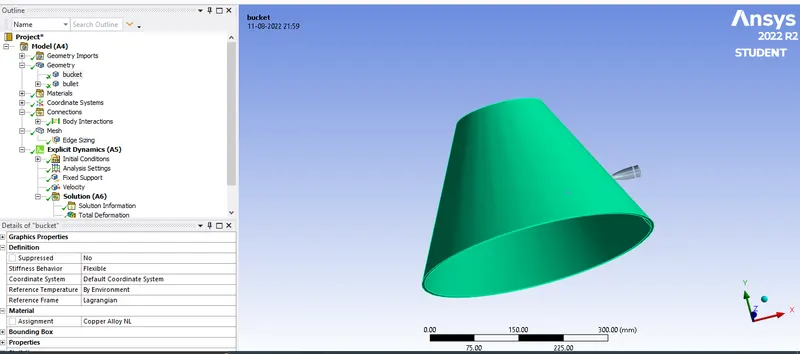
3)Contacts:
Delete all the contacts present in the Connections by default as we are interested in studying impact of bullet on bucket were contact is of not much importance.
4)Meshing:
Edge sizing of 6mm is applied to the bucket were bullet hits for proper results at the target point as shown in the image below: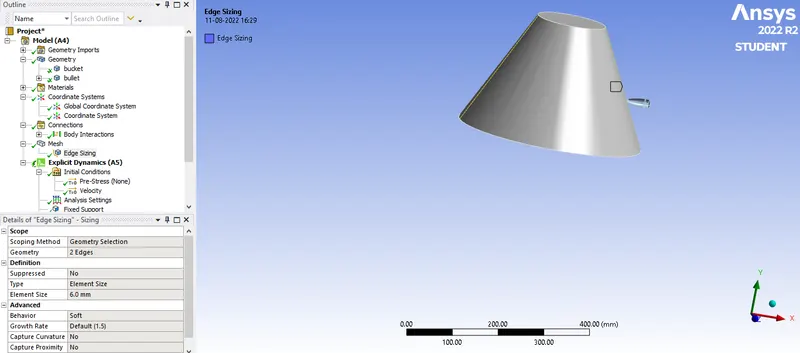
Meshing is shown in the image below:
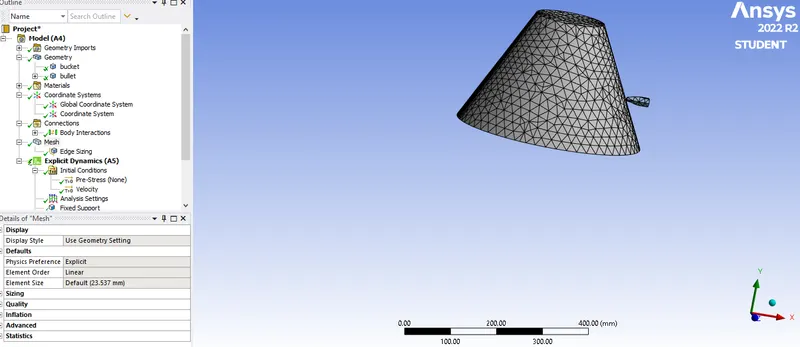
For case 1,2&3 meshing is kept similar as above.
5)Boundary canditions:
a) Analysis Settings:
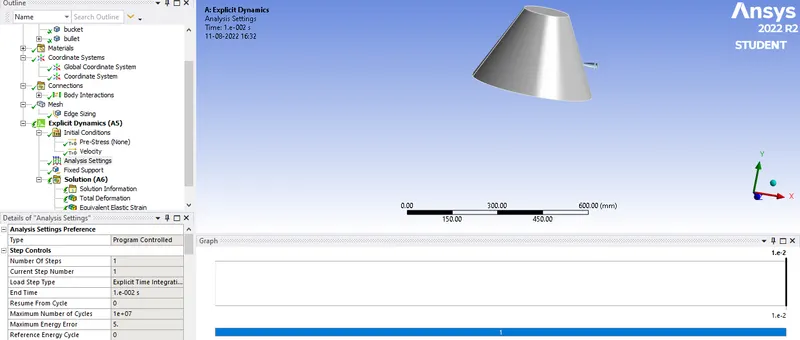
Number of steps taken for analysis is 1 with End time as 0.01 and Maximum Energy Error as 5. Intial time step,Minimum time step and Maximum time step all Programme Controlled as shown in the image below:
b)Fixed support:
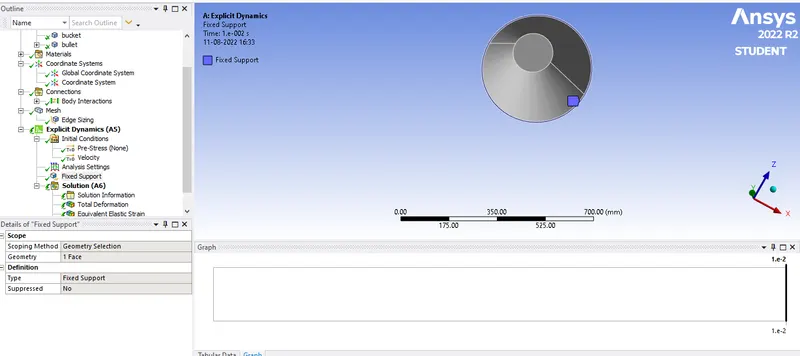
A fixed support is applied to the bucket in order to make it stationary after the impact of bullet on it as shown in the image below:
c)Velocity:
A velocity of 13900 mm/s is applied to the bullet along -ve X axis by selecting its entire body and keeping Y& Z axis velocity zero, as shown in the image below:
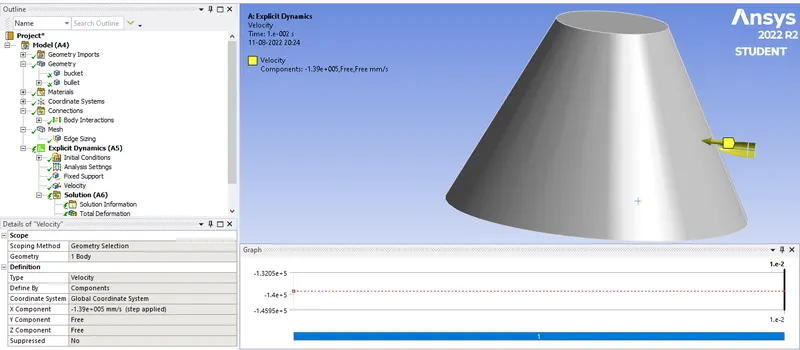
For case 1,2 & 3 boundary canditions are kept same as above.
Results:
Case 1: Bucket is made up of Aluminium alloy NL.
Total Deformation of bucket:
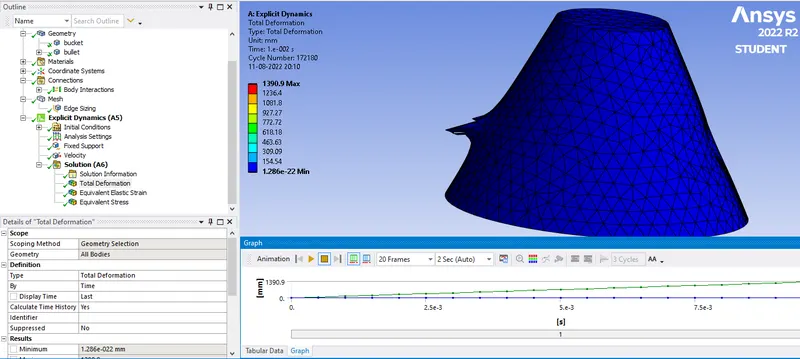
Total Deformation Vs Time Graph:
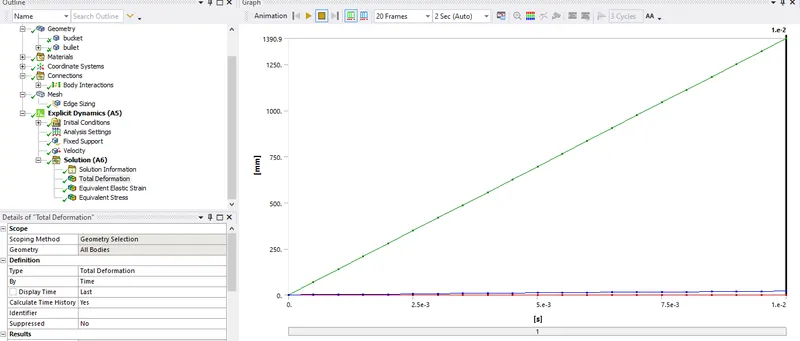
Maximum Total Deformation of the bucket after the impact of bullet:1390mm.
Equivalent Stress on bucket:
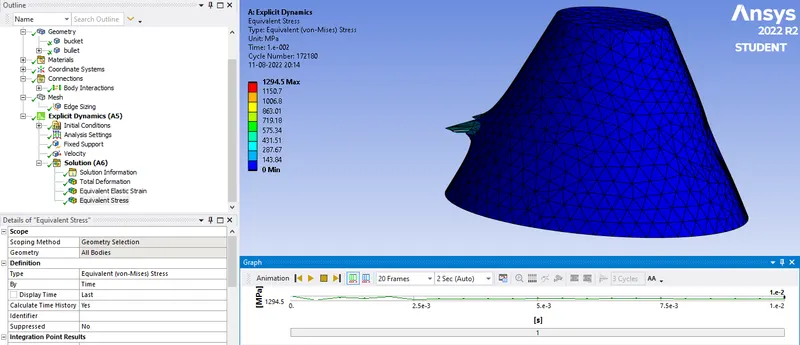
Stress Vs Time Graph:
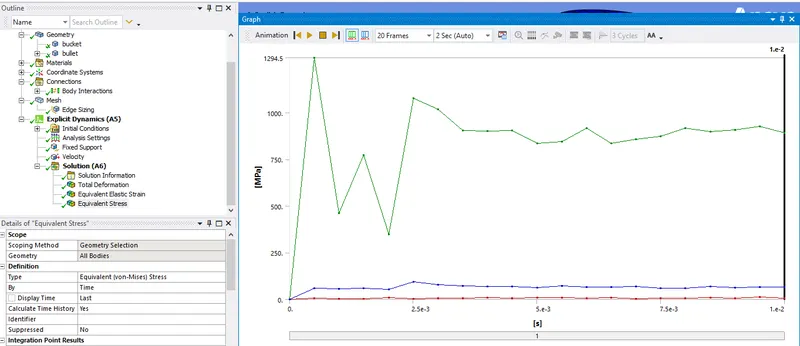
Maximum equivalent stress on bucket:1294.5 MPa
Equivalent Elastic Strain:
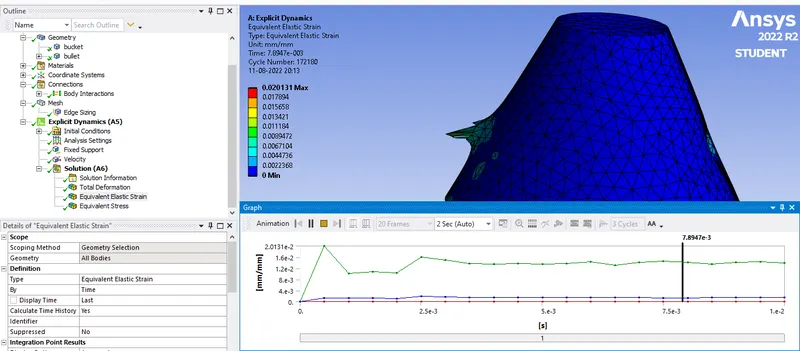
Strain Vs Time Graph:
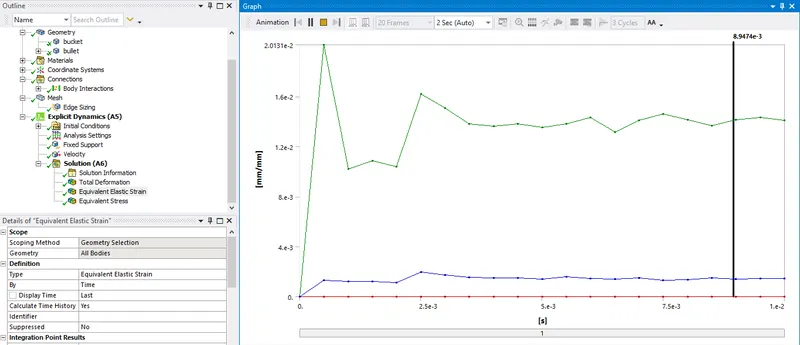
Maximum Equivalent Elastic Strain for bucket:2.013e-2
Case 2: Bucket is made up of Magnesium alloy NL.
Total Deformation of bucket:
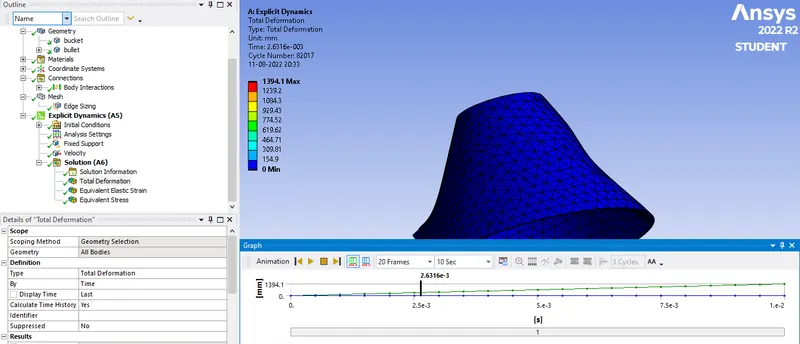
Total Deformation vs Time graph:
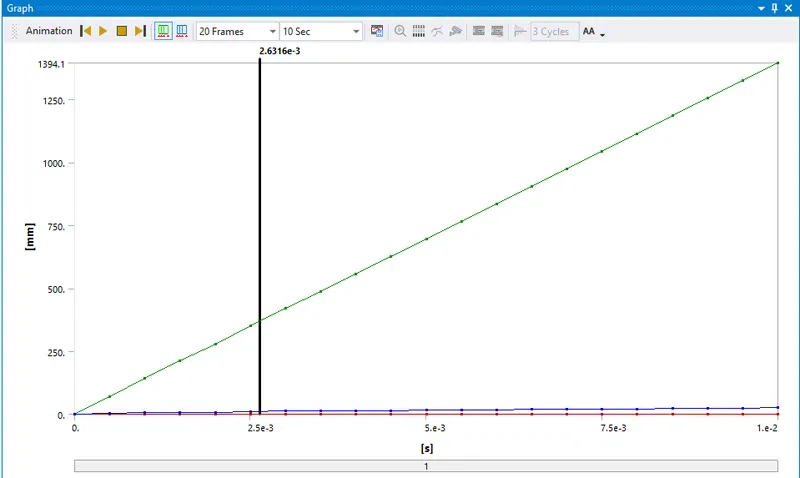
Maximum Total Deformation of the bucket after the impact of bullet:1394mm.
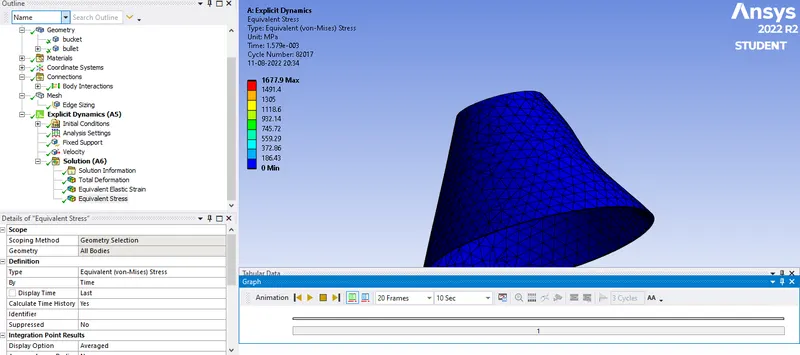
Equivalent Stress on bucket:
Equivalent Stress vs Time graph:
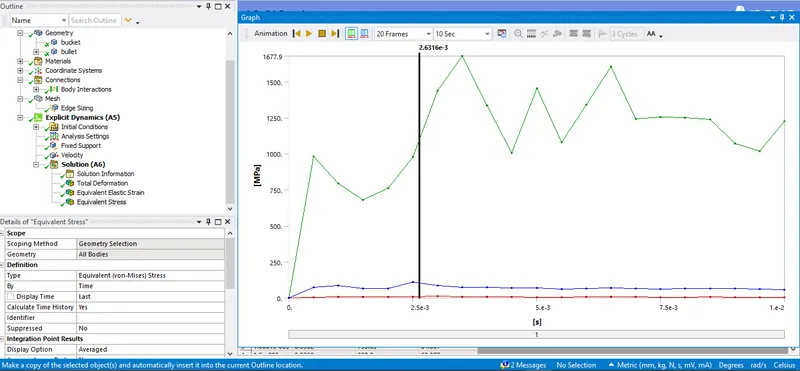
Maximum equivalent stress on bucket:1677.9 MPa
Equivalent Elastic Strain: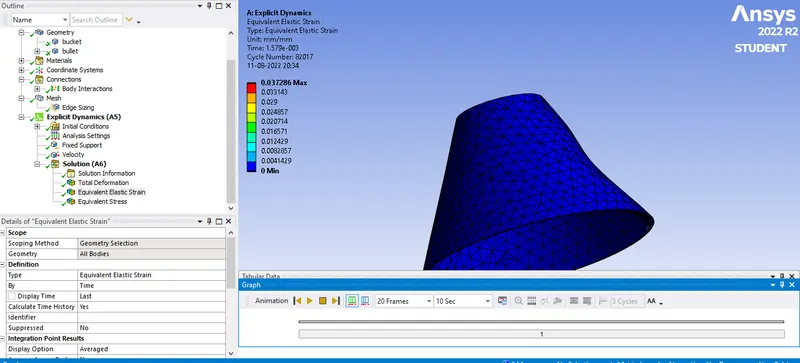
Equivalent Elastic Strain vs Time graph: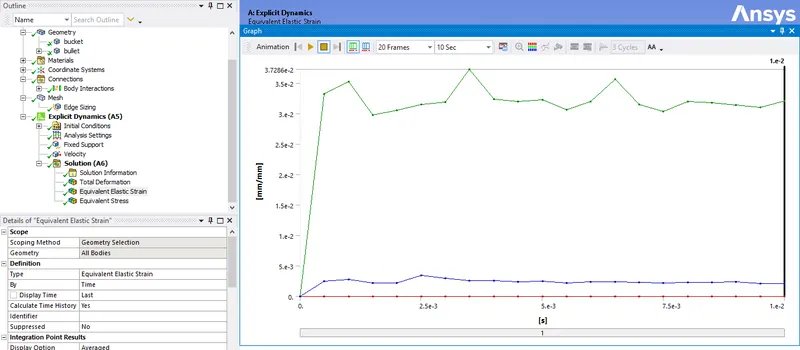
Maximum Equivalent Elastic Strain for bucket:3.7286e-2
Case 3: Bucket is made up of Copper alloy NL.
Total Deformation of bucket:
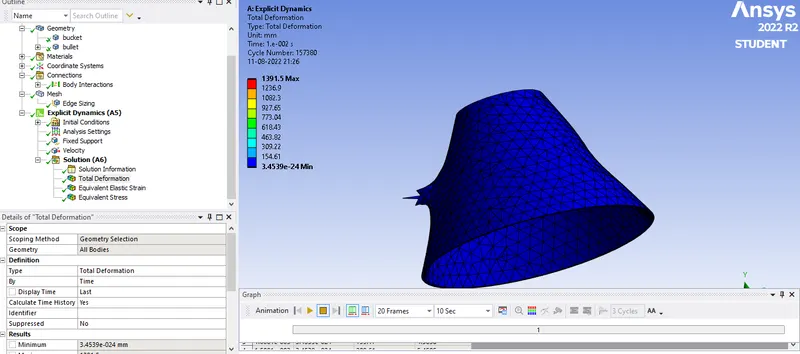
Total Deformation vs Time graph:
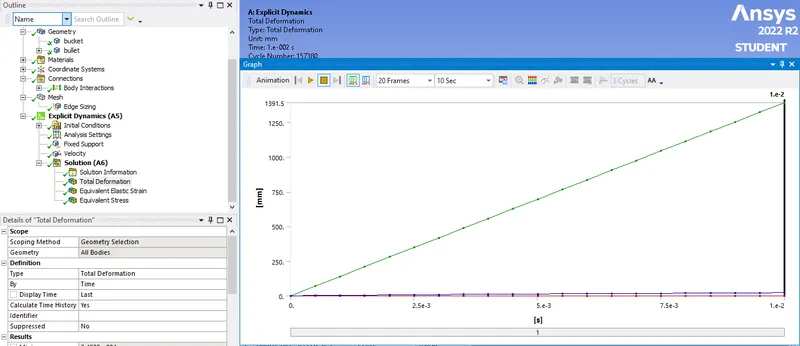
Maximum Total Deformation of the bucket after the impact of bullet:1391.5mm.
Equivalent Stress on bucket:
Maximum equivalent stress on bucket:3636.4 MPa
Equivalent Stress vs Time graph:
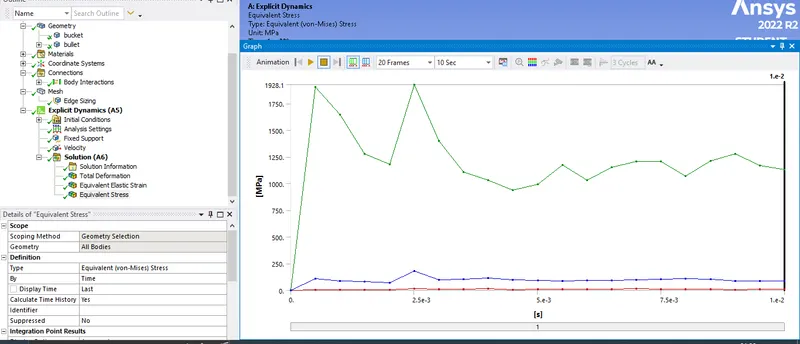
Maximum equivalent stress on bucket:1928.2MPa
Equivalent Elastic Strain:
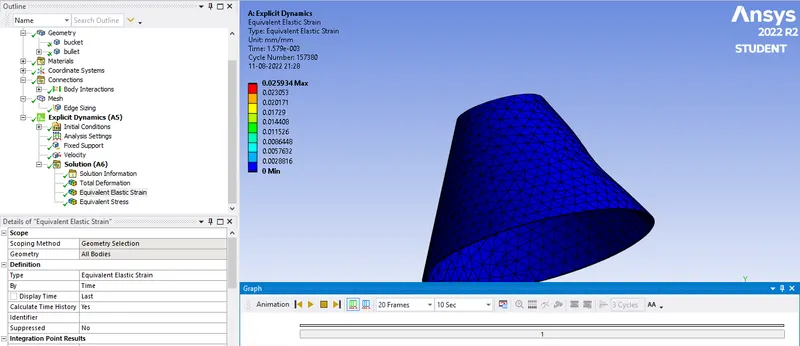
Equivalent Elastic Strain vs Time graph:
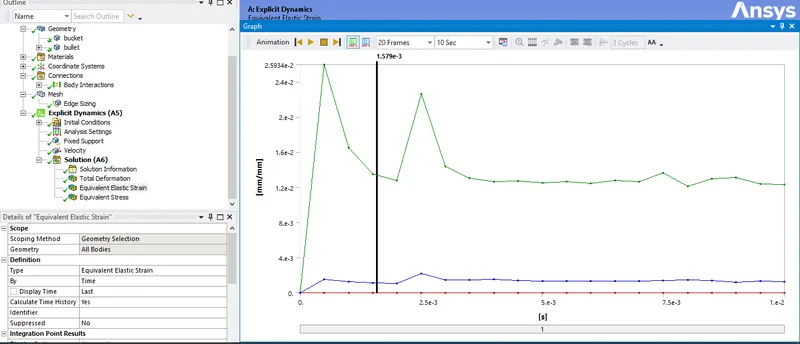
Maximum Equivalent Elastic Strain for bucket:2.5934e-2
Comparision of Total deformation,Maximum equivalent stress & strain for case 1,2 & 3.
| Case | Total Deformation(mm) | Maximum Equivalent Stress(MPa) | Maximum Equivalent Strain |
| 1 | 139 | 1294.5 | 2.013e-2 |
| 2 | 139 | 1677.9 | 3.7286e-2 |
| 3 | 139 | 1928.2 | 2.5934e-2 |
Conclusion:
- Highest equivalent stress occurs for case 3 where bucket is made up of Copper Alloy NL as it has highest Young's modulus of 1.1e+005 MPa compared to Aluminium Alloy NL & Magnesium Alloy NL. So bucket of Copper NL is applying high resistance during penetration of bullet.
- Total Deformation is similar in all three cases.
- The material which offers high resistance to penetration can be used as bullet proof materials.
- Main objective of the analysis of bucket is to find which material is best for avoiding bullet penetration.