Week 1 Understanding Different Battery Chemistry
Answer 1) The Lithium-ion battery is divided into 6 groups:
- LCO-Lithium Cobalt Oxide (LiCoO2):
First developed by Sony in 1991. It has a high specific energy. The cathode used is cobalt oxide and the anode is graphite carbon. During discharge lithium ions move from the anode to the cathode and vice versa for charging. Li-cobalt should not be charged and discharged at a current higher than its C-rating. These are commonly used for mobile phones, laptops and digital cameras.
Advantages:
- High energy density
- Long runtime making it optimum for new technologies
Disadvantages:
- Relatively short life span
- low thermal stability
- limited load capabilities (specific power)
|
Nominal Voltage |
3.60V |
|
Maximum Voltage |
4.2 V |
|
Cutoff voltage |
2.50 V |
|
Specific energy (capacity) |
150–200Wh/kg |
|
Charge (C-rate) |
0.7–1C |
|
Discharge (C-rate) |
1C; 2.50V cut off |
|
Cycle life |
500–1000, related to the depth of discharge, load, temperature |
|
Thermal runaway |
150°C Full charge promotes thermal runaway |
- LMO-Lithium Manganese Oxide (LiMn2O4)
Lithium manganese oxide batteries (LMO) were first introduced in the early 1980s. It is a lithium-ion cell that uses manganese dioxide, MnO2, as the cathode material. They function on the same intercalation/de-intercalation mechanism as other commercialized secondary battery technologies, such as LiCoO2. Li-manganese is used for power tools, medical instruments, as well as hybrid and electric vehicles.
Advantages:
- Low internal cell resistance enables fast charging and high-current discharging
- High thermal stability
- Enhanced safety
Disadvantages:
- Cycle and calendar life is limited
- limited load capabilities (specific power)
|
Nominal Voltage |
3.70-3.80V |
|
Maximum Voltage |
4.2 V |
|
Cutoff voltage |
2.50 V |
|
Specific energy (capacity) |
100–150Wh/kg |
|
Charge (C-rate) |
0.7–1C |
|
Discharge (C-rate) |
1C, 10C possible for few cells; 2.50V cut off |
|
Cycle life |
300-700, related to the depth of discharge, temperature |
|
Thermal runaway |
250°C High charge promotes thermal runaway |
- NMC-Lithium Nickel Manganese Cobalt Oxide (LiNiMnCoO2)
They are mixed metal oxides of lithium, nickel, manganese and cobalt. They have the general formula LiNixMnyCozO2. The most important representatives have a composition with x + y + z that is near 1, with a small amount of lithium on the transition metal site. This means the cathode combination is typically one-third nickel, one-third manganese, and one-third cobalt. These are used for providing high energy and power. NMC batteries are found in most electric cars. NMC batteries were installed in the BMW. It is very popular for EV applications.
Advantages:
- High specific energy and power
- Enhanced safety
- Longer lifecycle
Disadvantages:
- Costly
|
Nominal Voltage |
3.70-3.70V |
|
Maximum Voltage |
4.2 V |
|
Cutoff voltage |
2.50 V |
|
Specific energy (capacity) |
150–220Wh/kg |
|
Charge (C-rate) |
0.7–1C |
|
Discharge (C-rate) |
1-2C; 2.50V cut off |
|
Cycle life |
1000-2000 related to the depth of discharge, temperature |
|
Thermal runaway |
210°C High charge promotes thermal runaway |
- LFP-Lithium Iron Phosphate (LiFePO4)
It is a type of lithium-ion battery using lithium iron phosphate (LiFePO4) as the cathode material and a graphitic as carbon electrode as the anode. The energy density of LiFePO4 is lower than that of lithium cobalt oxide (LiCoO2), and also has a lower operating voltage. Li-phosphate is more tolerant to full charge conditions and is often used to replace the lead-acid starter battery. It is used for Portable and stationary applications needing high load currents and endurance.
Advantages:
- High current rating
- Long cycle life
- High thermal stability
- Enhanced safety
- Tolerance to abuse usage
Disadvantages:
- Higher self-discharge
- Low voltage
|
Nominal Voltage |
3.20-3.30V |
|
Maximum Voltage |
3.65 V |
|
Cutoff voltage |
2.50 V |
|
Specific energy (capacity) |
90–120Wh/kg |
|
Charge (C-rate) |
1C |
|
Discharge (C-rate) |
1C; 2.50V cut off |
|
Cycle life |
>2000, related to the depth of discharge, temperature |
|
Thermal runaway |
270°C Very safe battery even if fully charged |
- NCA-Lithium Nickel Cobalt Aluminium Oxide (LiNiCoAlO2)
NCAs are mixed oxides comprising the cations of the chemical elements lithium, nickel, cobalt and aluminium. The most important representatives have the general formula LiNixCoyAlzO2 with x + y + z = 1. These batteries share similar properties as NMC batteries as they both have high specific energy, reasonably good specific power and a long-life span. But these NCA batteries are of high cost and less safe for applications.
Advantages:
- High specific energy
- High specific power
- Good life span
Disadvantages:
- High cost
- Less safe
|
Nominal Voltage |
3.60V |
|
Maximum Voltage |
4.20V |
|
Cutoff voltage |
3.00 V |
|
Specific energy (capacity) |
200-260Wh/kg |
|
Charge (C-rate) |
1C |
|
Discharge (C-rate) |
1C; 3.00V cut off |
|
Cycle life |
500, related to the depth of discharge and temperature |
|
Thermal runaway |
150°C High charge promotes thermal runaway |
- LTO- Lithium Titanate (Li2TiO3)
This battery chemistry was synthesized by solid-state reaction with Li2CO3 and TiO2 powder. Lithium titanate is the anode component of the fast-recharging lithium-titanate battery. It is frequently utilized as a flux due to its good stability. Li-titanate is safe, has excellent low-temperature discharge characteristics. These are typical used for application in electric vehicles, UPS and solar-powered street lighting.
Advantages:
- No SEI film formation and no lithium plating
- High performance
- long life span
Disadvantages:
- High cost
- Low cell voltage
- Low specific energy and power
|
Nominal Voltage |
2.40V |
|
Maximum Voltage |
2.850V |
|
Cut-off voltage |
1.80 V |
|
Specific energy (capacity) |
50-80Wh/kg |
|
Charge (C-rate) |
1C-5C |
|
Discharge (C-rate) |
1-10C; 1.80V cut off |
|
Cycle life |
300-7000 |
|
Thermal runaway |
One of the safest Li-ion batteries |
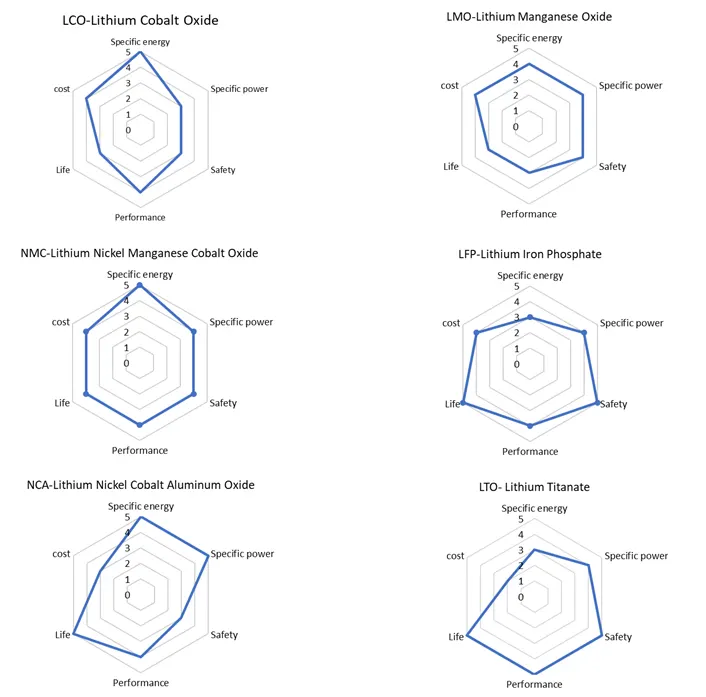
Answer2) The table below compares all lithium-ion chemistry on 6 characteristics
|
Sr No. |
Battery chemistry |
Specific energy |
Specific power |
Safety |
Performance |
Life |
cost |
|
1 |
LCO |
5 |
3 |
3 |
4 |
3 |
4 |
|
2 |
LMO |
4 |
4 |
4 |
3 |
3 |
4 |
|
3 |
NMC |
5 |
4 |
4 |
4 |
4 |
4 |
|
4 |
LFP |
3 |
4 |
5 |
4 |
5 |
4 |
|
5 |
NCA |
5 |
5 |
3 |
4 |
5 |
3 |
|
6 |
LTO |
3 |
4 |
5 |
5 |
5 |
2 |
Reference:
1) https://batteryuniversity.com/learn/article/types_of_lithium_ion
2) Simulation of Battery Systems: Fundamentals and Applications by Farschad Torabi and Pouria Ahmadi