Project 2 Thermal modeling of battery pack
Lithium-ion (Li-ion) batteries are commonly used in EVs. High energy density, high power density, longer life cycle, low self-discharge rate are some of the key features of Li-ion batteries which makes them the fit candidate for EV application. However, the Li-ion battery is very sensitive to temperature change. The adverse ambient conditions negatively affect the battery pack and introduce temperature gradient among the cell modules in the battery pack. Mismanagement of the battery pack charge/discharge cycles or the hostile climatic conditions can result in thermal runaway which in turn can cause fire accidents. The transformation from conventional vehicles to electric vehicles is principally associated with how these challenges can be addressed in the most efficient way.
- Lithium-ion batteries (LIB) are the technology of choice for many applications
- LIBs are sensitive to temperature as it impacts life, performance (capacity and resistance), safety, and (eventually) cost
- Higher temperatures degrade LIBs more quickly
- Low temperatures reduce power and energy capabilities
- Proper temperature control improves reliability, safety, and range
Battery thermal management is needed to:
- Keep the cells in the desired temperature range
- Minimize cell-to-cell temperature variations
- Prevent the battery from going above or below acceptable limits
- Maximize useful energy from cells and pack
However, battery thermal management systems (BTMS) should be designed to:
- Minimize increased complexity
- Added initial cost provide long term value
- Improve reliability
- Minimize parasitic losses
Simulink Model: 10 Cell in series
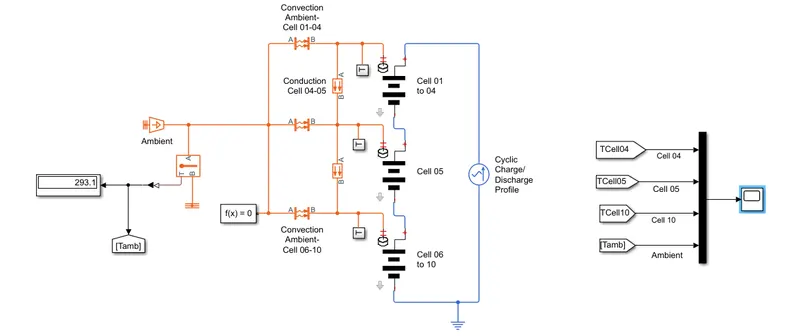
Results:
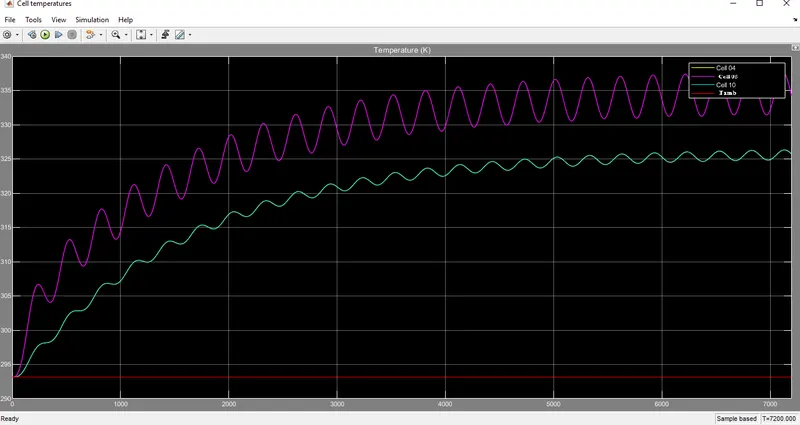
From the simulation results, it can be seen that Cell 04 are having the same temperature behaviour as that of Cell 10, while Cell 05 shows more temperature as cell 5 is receiving conduction heat transfer due to cell 01 to 04 and cell 06 to 10. This is why cell 05 is having more temperature. Overall the temperature of all the cells increases from the ambient temperature.
Simulink Model:
This model illustrates the effect of temperature on the performance of a 7.2 V, 5.4 Ah Lithium-Ion battery model. The model (which includes the impact of cell/ambient temperature on the voltage, capacity and resistance) is submitted to a variable ambient temperature during a discharge and charge process. Its performance is compared to the case where the impact of temperature is neglected. As observed from the Scope, the temperature-dependent battery model performs close to reality. As the cell/internal temperature increases/decreases due to charge(or discharge) heat losses and ambient temperature variations, the output voltage and capacity also increase/decrease.
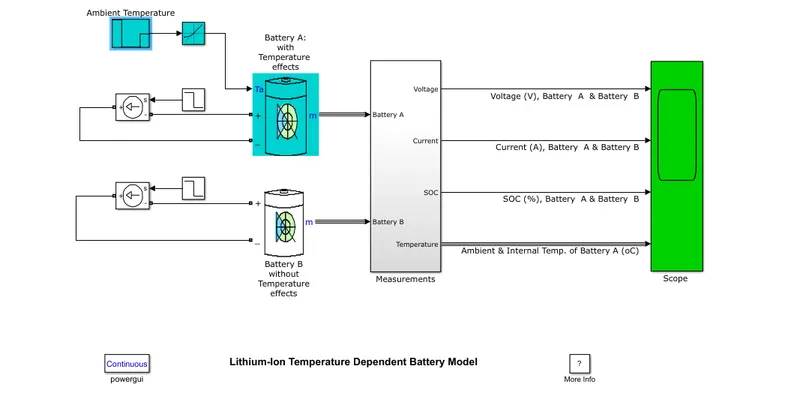
Results:
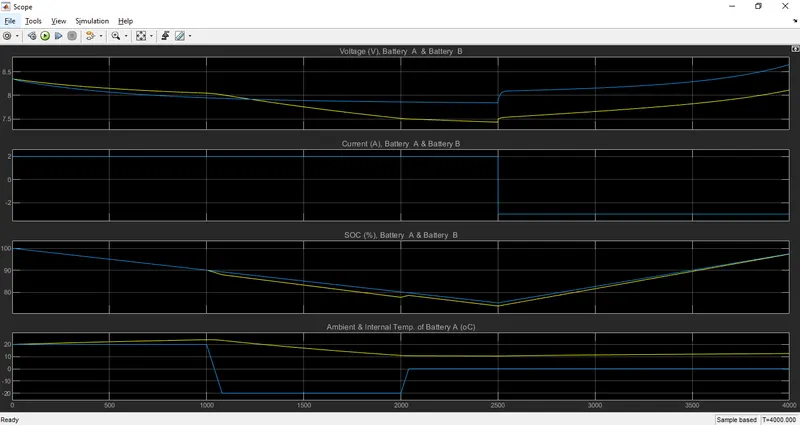
The simulation results show the performance of the temperature-dependent Lithium-Ion battery model (Battery A) when the ambient temperature is varied from 20 degrees C to -20 degrees C and then to 0 degrees C. Battery B represents the case where the effect of temperature is neglected. Start the Simulation and open the Scope to view all signals.
At t = 0 s, Battery A and B are discharged with 2 A at an ambient temperature of 20 degrees C.
At t = 150 s, the internal temperature has increased to its steady-state value of 29.2 degrees due to heat losses from the discharge process. This causes the output voltage of Battery A to slightly increase, while battery B output voltage continues to decrease.
At t = 1000 s, the ambient temperature is decreased to -20 degrees C. This causes the output voltage of Battery A to greatly decrease as the internal temperature decreases rapidly. Also, the SOC of Battery A decreases due to the reduction of battery capacity. The battery B output voltage continues to decrease slowly to its steady-state voltage.
At t = 2000 s, the ambient temperature is increased from -20 degrees C to 0 degrees C. As the internal temperature increases, the output voltage of Battery A increases. Also, as the capacity increases, the SOC of Battery A increases. The Battery B output voltage remains constant to its steady-state value.
At t = 2500 s, Battery A and B are charged with 3 A at an ambient temperature of 0 degrees C. This causes the internal temperature to increase due to heat losses during the charge process, which increases the charging voltage of Battery A. Afterwards, Battery A and B continue to charge up until fully charged.