Week 1 Understanding Different Battery Chemistry
UNDERSTANDING DIFFERENT BATTERY CHEMISTRY
- To prepare a table which includes materials & chemical reactions occurring at the anode and cathode of LCO, LMO, NCA, NMC, LFP and LTO type of lithium ion cells. Give your detailed explanation on it?
Lithium –ion cells are a secondary type of meaning that they are rechargeable and hence reusable which makes them ideally suited for automotive application and certain consumer electronics. When lithium ion cells are connected together in a series arrangement, it is referred to as lithium ion battery. Lithium ion batteries like other batteries rely on the chemical reaction occurring inside the cell. The chemical energy from this reaction is converted into electrical energy for us to use. Since lithium cells are rechargeable, they can perform the reverse reaction using electricity.
Internal Construction
Lithium ion batteries will consists of following components:
- Anode
- Cathode
Anode and cathode are the two electrodes that are connected by a wire in an external circuit between which electrons will be transferred during the chemical reaction. This transfer of electrons will results in a flow of charge, meaning a current is produced. The electrode through which conventional current enters a polarized electrical device is referred to as the anode. The electrode through which conventional current leaves a polarized electrical device is referred to as cathode. The anode and cathode are not defined by their voltage polarities but instead by the direction of current flowing through them. Often, the cathode is made from a lithium oxide, supplied or some other components where as the anode is made of a pure graphite or hard carbon.
- Separator
A separator is needed as an insulating barrier between the anode and cathode and prevents internal short circuiting. The separator is permeable to ions but to electron due to its micro-porosity.
- Electrolyte
The transfer of electrons there need to be chemical reaction involving ions are charged particles, that are formed when electrons have been lost or gained by them. This is where an electrolyte is needed. An electrolyte is medium through which ions can flow between the electrodes but not electrons. Electrolytes can be in the solid, liquid, or aqueous states but in lithium ion cells the electrolyte is non aqueous type. The ions of the electrolyte will move towards an electrode depending on their polarities as opposites attracts. So, a negative ion will move to a positive electrode and vice versa. So electrolyte permits ionic conduction but not electronic conduction will occur through the external circuit. The electrolyte used as salt of lithium dissolved in organic solvent.
- Current collector
Current collectors are electronic conductors that are mixed with the electrodes and allows for simple electronic connection to reduce the resistance of an electrode. In lithium ion cells, the current collector is copper foil at the graphite electrode and aluminum foil at the lithium oxide electrode and they receive electrons.
Working
There are 2 modes of operation for cells: Charging and Discharging
Charging:
In the charging mode, a power source is connected to lithium ion cell. The positive and negative terminals of power source will be connected to the lithium oxide and graphite electrodes respectively. The positive terminal will flow from the positive terminal through the external circuit to the negative terminal and get collected at the graphite electrode. This result in the formation of positively charged, lithium ions which will be attracted towards the negative terminal and get trapped in the space between graphite atomic layers. Once all the lithium ions have crossed over to the graphite electrode, the cell is fully charged. This creates an unstable state. In this operation, the lithium ion oxide electrode is the positive anode and the graphite is the negative cathode. This is because the direction of current is opposite to the flow of electrons. Electrons flow from the lithium oxide electrode to the graphite electrode, therefore current flows in reverse by definition the anode is electrode through the conventional current enters a polarized devices and the cathode is the electrode which conventional currents leaves a polarized devices.
Discharging:
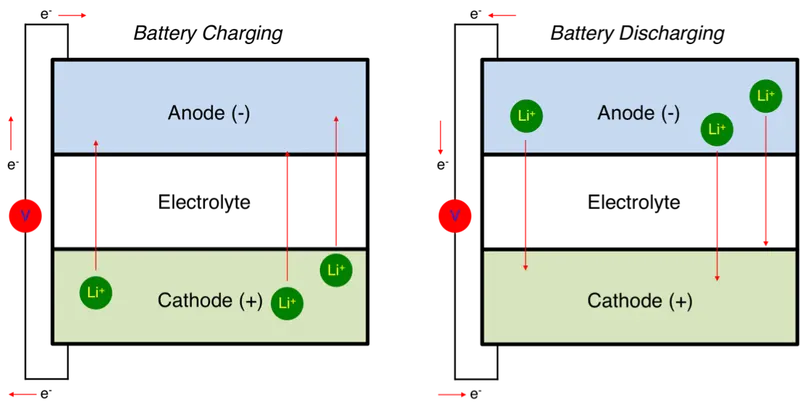
In this mode, the power source is replaced with a load instead a motor the terminal polarities of the cell are now reversed so that the negative terminal of load is connected to the lithium oxide electrode and the positive terminal are connected to the graphite electrode. Due to this lithium ion will be attracted back to the lithium oxide electrons will also leave the graphite electrode and return to the lithium oxide electrode. Once all the lithium ions and electrons have returned to the lithium oxide electrode, the cell is fully charged and the lithium is now in a stable state. In this operation the graphite electrode is now the anode and lithium oxide electrode is the cathode.
The electricity generated from Lithium ion cells ranges between 3 and 4.2v which is almost thrice of that Nickel cadmium or Nickel Metal hybrid batteries are capable of several types of Lithium ion cells, each with different constructions and chemical reactions occurring within them to produce different characteristics for different applications they are listed below:
- NMC – Lithium Manganese Cobalt Oxide
- NCA- Lithium Nickel Cobalt Aluminum Oxide
- LMO- Lithium Manganese Oxide
- LCO- Lithium Cobalt Oxide
- LTO- Lithium Titanium Oxide
- LIPO or LFP- Lithium Iron Phosphate
There is a variety of factors to consider when using any of these lithium ion cells for a particular application such as:
- Specific energy
- Specific power
- Safety
- Performance
- Life span
- Cost
- Compare the differences between each type of Li+ ion batteries based on their characteristics?
Characteristics
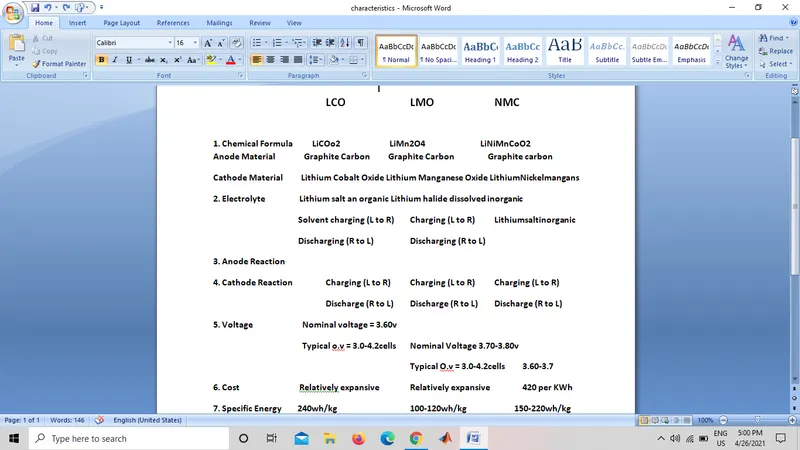
The diagrams below show the graphical representation of the performance
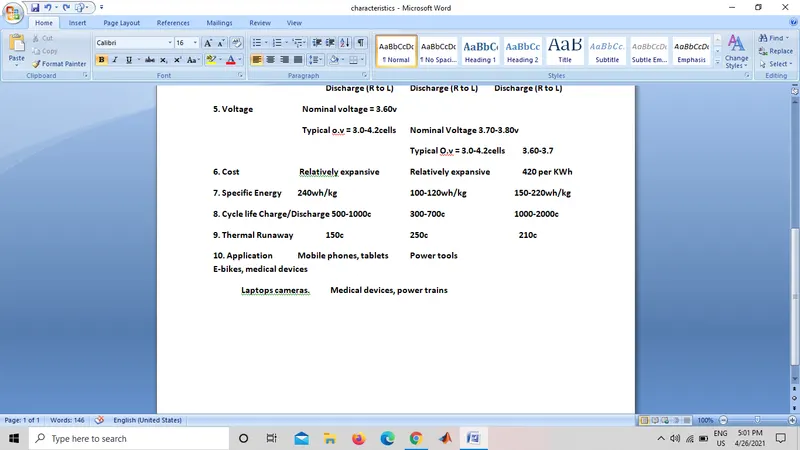 characteristics of the different types of “Lithium ion battery”.
LCO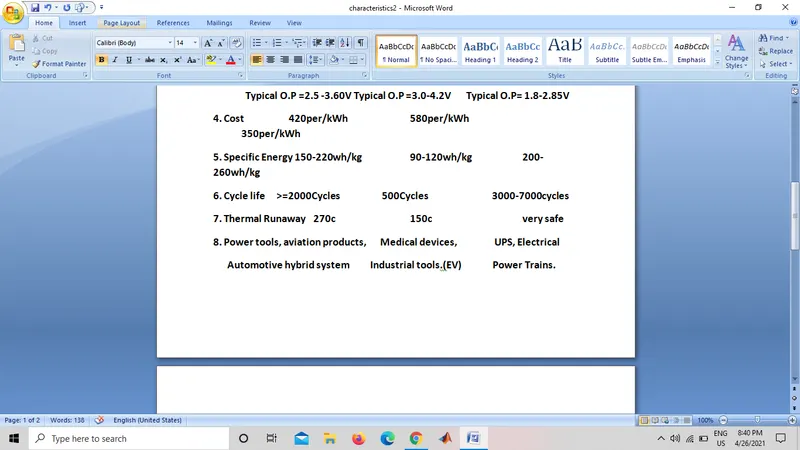
Currently, the most popular lithium-ion technology is the lithium-cobalt oxide (LCO)
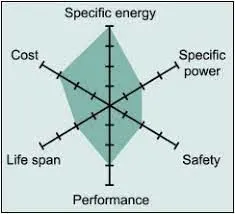 battery which has a cathode composed of LiCoO2. The main feature of the LCO battery is the high energy density translating into a long run-time for portable devices such as cell phones, tablets, laptops and cameras.
LMO
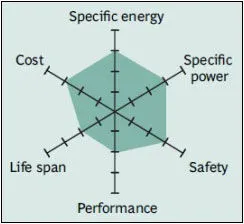
The LMO part of the battery, which can be about 30 percent, provides high current boost on acceleration; the NMC part gives the long driving range. Li-ion research gravitates heavily towards combining Li-manganese with cobalt, nickel, manganese and/or aluminium as active cathode material.
NMC
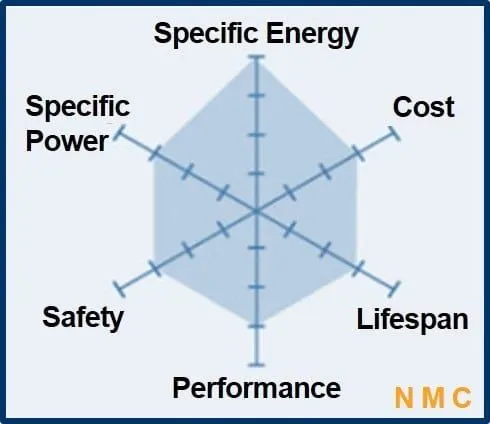
Lithium-Nickel-Manganese-Cobalt-Oxide (LiNiMnCoO2), abbreviated as NMC, has become the go-to cathode powder to develop batteries for power tools, e-bikes and other electric power trains. ... While NMC powder can refer to a variety of blends, the formula typically consists of 33% nickel, 33% manganese and 33% cobalt.
LFP
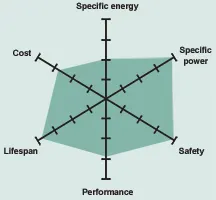
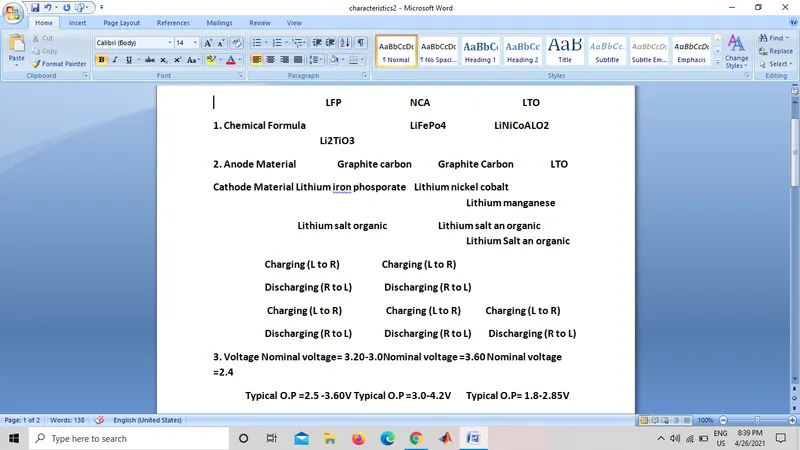
The advantage of LFP is that it is much more stable, and not prone to self-combustion. ... LFP also lasts longer in comparison to lithium-cobalt, and is more temperature-stable. Of all the various lithium battery technologies out there this makes LFP best suited for deep-cycle applications.
NCA
The use of NCA chemistry is thought to improve energy density, increase charging performance, and provide longer cycle life. The battery in these cars is made up of several thousand of these small cylindrical cells. An NCA battery generates power through chemical reactions between the anode and cathode.
LTO
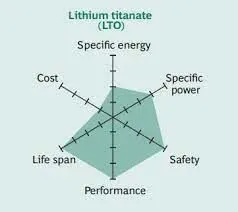
The LTO is a rechargeable battery based on the, or modified from, the Lithium-Ion (li-ion) battery technology. Li-titan ate oxide (LTO) replaces the graphite in the anode of the typical Li-Ion battery.