Project
Modeling Of Continuous Variable Transmission (CVT) By a Analysis of Baja All-Terrain Vehicle (ATV)
Keywords: Abstract, introduction, CVT, ATV, Conclusion
Aim: To prepare a technical report for BAJA ALL- Terrain Vehicle ATV model with Continuously Variable Transmission (CVT)
Platform:
- Software – Simulink(MATLAB)
- Version - R2020a
Abstract: All terrain vehicles (ATV) are achieving wider response and significance in the present world with their characteristic abilities of getting through any terrain along with their simple and compact structure they rule of off- roading world. A new field of engineering research has been developed because of the increasing number of ATV accidents. For determing the reasons to how so many crashes occurs and how they can be prevented, a series of ATV tests conducted. The test included simulating an ATV for frontal impact, side impact and rolling over with added weight of passenger and due to thrust effect of ATV.
Introduction: The whole and sole intention for developing all terrain vehicles (ATV) is off-roading. The vehicles generally consists of 4 wheeled geared or nongeared system, sometimes known as quad bike lateral stability and characteristics of ATV’s are a result of combinations of vehicle speed and ground surface. Many other factors such as tire type, weight distribution, rider weight transfer, and the solid rear axle added to it. These vehicles are designed for greater acceleration ratherthan higher top speeds.
CTV (Continuous Variable Transmission): A Continuously variable transmission (CTV) is an automatic transmission that can change seamlessly through a continuous range of gear ratios. This contrasts with other transmissions that provide a limited number of gear ratios in fixed steps. The flexibility of a CVT with suitable control may allow the engine to operate at a constant RPM while the vehicle moves at varying speeds.CVTs are used in automobiles, tractors, motor scooters, snow mobiles, and earth moving equipment.
A Continuously Variable Transmission (CTV) is an automatic transmission that operates on an ingenious pulley system that automatically varies the transmission ratio, that allowing an infinite variability between highest and lowest gears with no discrete steps or shifts. CVTs provide more usable power, better fuel economy and smoother driving experience than traditional transmission that use gearboxes with fixed number of gear sets.
ATV(All-Terrain Vehicles): An All terrain vehicle (ATV), also known as a quad, as defined by the American national standard institute (ANSI) is a vehicle that travels on low-pressure tires, with a seat that is straddled by the operator, along with handlebars for steering control. As the name implies, it is designed to handle a wider variety of terrain than most other vehicles. Although it is a street-legal vehicle in some countries, it is not street-legal within most states, territories, and provinces of Australia by the current Anis.
Working Principle:
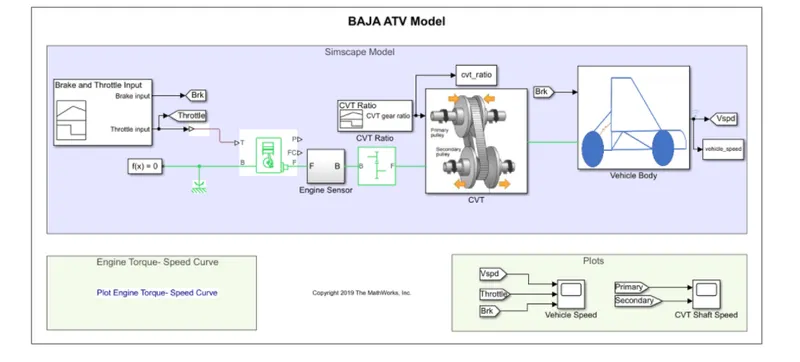
The ATV refers to a motorized single seated tri (or) Quadra cycle bike and buggy that is designed for off- road travel and activities. The vehicle consists of handlebars and low pressure tires that have deep threaded structures, which assists in driving over wetland and dune topologies.
The model consists of common blocks as follows:
Signal Builder:
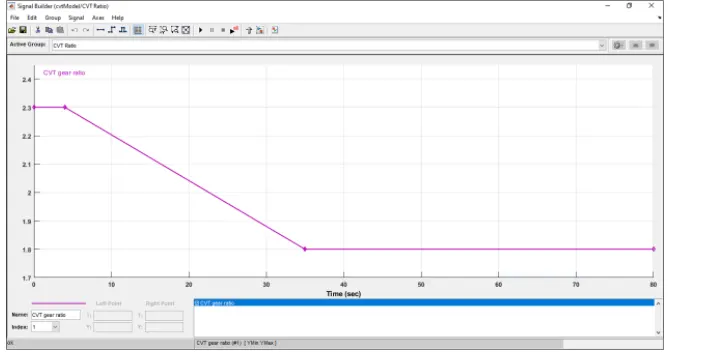
The signal builder blocks allow to create interchanable group of piecewise linear signal sources and use them in a model. if we can quickly switch the group signal into model of facilitate testing.
Generic engine:
It represents the system level model of spark ignition and diesel engines suitable for use at initial stages of modeling when only the basic parameters are available. The optional speed and control lines are included.
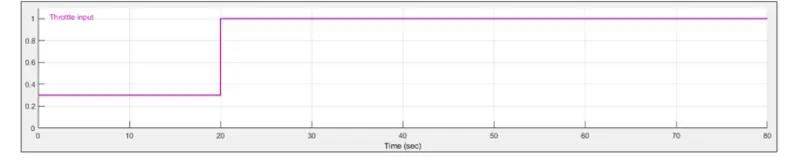
The Throttle input signal is lies between zero and one that specifies the torque demand from the engine as a friction of the maximum possible torque. If the engine speed is below the stall speed, the engine torque is blended to zero. If the engine speed is exceeds the maximum speed, the simulation stops and errors occurred.
Engine Sensor:
Ideal rotational motion sensor:
The block represents an ideal rotational motion sensor is a device, that converts an across variable measured between two mechanical rotational nodes into control signal proportional to angular velocity (or)angle.
The sensor is ideal since it doesn’t inertia, friction, delays, energy consumption and so on….Connections R and C are mechanical rotational ports and connections W and A physical signal output ports for velocity and angular displacement.
Simple Gear:
It represents fixed ratio gear(or)gearbox no compliance is modeled in this block it optionally include gear meshing and viscous bearing losses. Connections base and follower are mechanical rotational conserving ports. specify the relation between base and follower rotation directions with the output shaft rotate parameters. It includes thermal effects and expose thermal conserving ports.
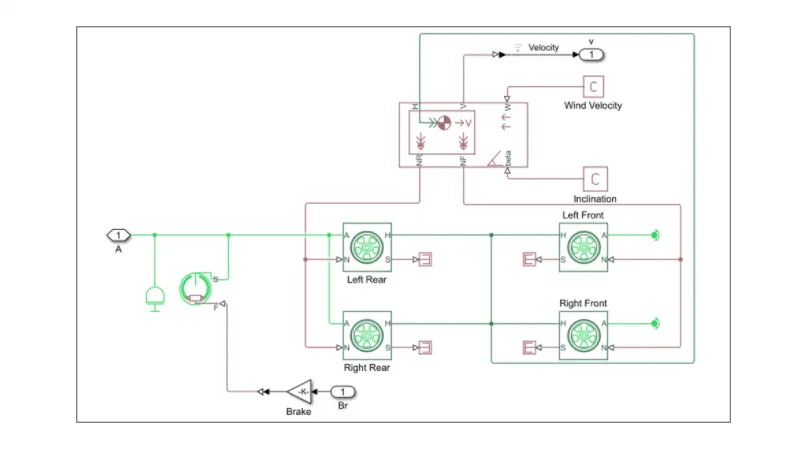
Vehicle Body:
Flow Process:
Torque and Speed Vector:
Advantages of All-Terrain Vehicles (ATV):
- Greater Traction Capacity: Facing a lot of traction can lead to a dangerous with a vehicle with all wheel drive, changes of happening to minimized.
- Better Acceleration: The moment of greater traction an ATV will have an acceleration superior to that of car with single driving axle. By having four points of support to drive a car, its easier for to accelerate in shorter amount of time.
Disadvantages of All-Terrain Vehicles (ATV):
- More Expensive and Delicate: Vehicles with integral traction are generally more expensive, ATV’s can be more susceptible to revision more noises and more vibrations may appear with the passage of time. Its maintenances also more expensive.
- Consume More Fuel: The type of ATV will always demand higher fuel consumption to the vehicle propulsion. The greater number of components are used. The engine will have to carry a large weight, the end results are in higher fuel consumption .The difference is increasingly reduced components.
Applications of All-Terrain Vehicles:
- Military and Defense
- Agriculture
- Forestry
- Sports
CVT Subsystem:
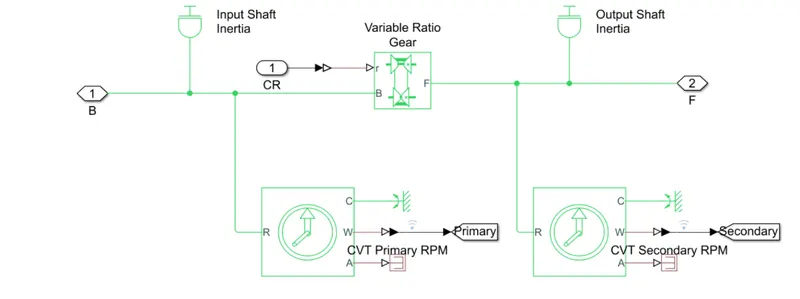
Inertia: The block represents an ideal mechanical rotational inertia.
The block has one mechanical rotational port. That positive direction is from its ports to reference point. it means inertia torque is positive if the inertia is accelerated in positive direction.
Variable Ratio Transmission:
It represents variable ratio gearbox such as implemented by mechanical belt CVT, electric, hydraulic transmissions. The physical signal input defines the ration of input to output angular shaft velocities. Connections base and follower are mechanical rotational conserving ports. It specify the relation between base and follower rotation direction with output shaft rotate parameter.
Advantages of Continuous variable Transmission (CVT):
- Compact design: The advantage of CVT is that is lighter and simpler as compared to additional transmission and manual transmission. there are no physical gears or set of planetary gears inside a typical CVT box. design and components are easy.
- Step less acceleration: Both automatic and manual transmission use different physical gears through to different fear ratio by step by step fashion. Shifting between the ratio can create a shifts rocks,
Another advantage of CVT is that allows the engine to almost immediately delivering the maximum torque. It also eliminates the gear hunting as the vehicle decelerates the traditional automatic transmission normally struggles while the vehicle is heavy load.CVT almost immediately find the exact gear ratio.
- Fuel efficiency: The ration between engine shaft speed and driveshaft speed is constantly changing in a CVT. That’s it also sensor to keep an engine its optimum power range regardless of fast or slow the vehicle is moving. That means CVT has a more fuel efficient than traditional automatic transmission.
Disadvantages of Continuously Variable Transmission (CVT):
- Different Experience: A vehicle equipped CVT provide different driving experience the traditional or manual automatic transmission will not feel the engine in a CVT vehicle accelerating the noise coming from the CVT vehicle can be cause for concern. That the engine speed typical produce a steady or unvarying sound is compatible to a slipping clutch.
- Cost and maintenance: This type of transmission is more expensive than their traditional automatic transmission counter parts. its due to cost of specific components and different process involved in manufacturing CVT vehicle. Maintenance and repair cost is also expansive.
Applications of CVT:
- Automobiles
- Racing cars
- Small vehicles
- Farm and earth moving equipment
- Power generating system
Conclusion: Today only a handful of car worldwide make use of CVTs, but the applications and benefits of continuously variable transmissions can only increase based on development. The automakers continue to develop CVTs, more and more vehicle lines will begin to use them. as development continues, fuel efficiency and performance benefits will enviably increase, this will lead to increase benefit of equipped vehicles.