Week 1 Understanding Different Battery Chemistry
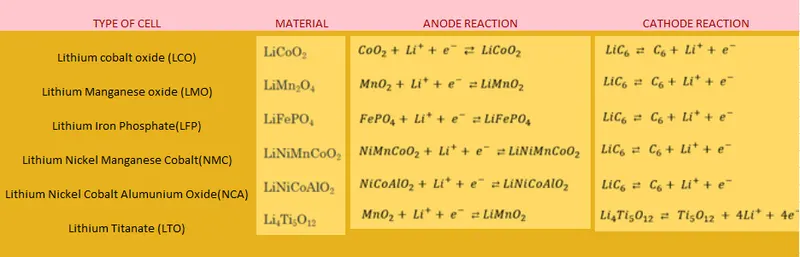
Aim: To prepare a table which includes materials & chemical reactions occurring at the anode and cathode of LCO, LMO, NCA, NMC, LFP and LTO type of lithium ion cells.
Explanation:
A Lithium-ion battery is a type of rechargeable battery in which lithium ions move from the negative electrode to the positive electrode during discharge and back when charging. Lithium-ion batteries are common in consumer electronics. Lithium-ion batteries are now growing in popularity for military, electric vehicle and aerospace applications due to their high energy density.
Charging and Discharging of Lithium-ion Battery:
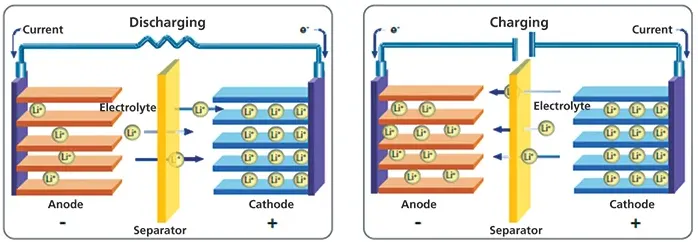
- During charging, lithium ions flow from the positive electrode to the negative electrode through the electrolyte. Electrons also flow from the positive electrode to the negative electrode, but take the longer path around the outer circuit. The electrons and ions combine at the negative electrode and deposit lithium there.
- When no more ions will flow, the battery is fully charged and ready to use.
- During discharging, the ions flow back through the electrolyte from the negative electrode to the positive electrode. Electrons flow from the negative electrode to the positive electrode through the outer circuit. When the ions and electrons combine at the positive electrode, lithium is deposited there.
- When all the ions have moved back, the battery is fully discharged.
Table:
Differences between each type of Li-ion batteries:
Aim: To study the difference between each type of Li-ion batteries based on their characteristics.
Explanation:
Lithium cobalt oxide -LiCoO2 (LCO):
The battery consists of a cobalt oxide cathode and a graphite carbon anode. The cathode has a layered structure and during discharge, lithium ions move from the anode to the cathode. The flow reverses on charge. The drawback of Li-cobalt is a relatively short life span, low thermal stability and limited load capabilities.
Lithium Manganese oxide (LMO):
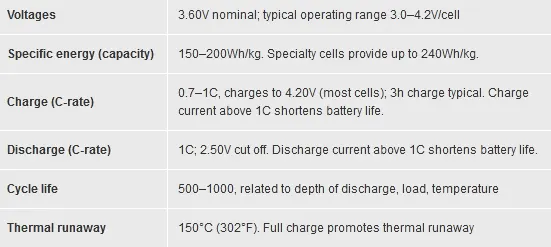
Li-ion with manganese spinel was first published in the Materials Research Bulletin in 1983. In 1996, Moli Energy commercialized a Li-ion cell with lithium manganese oxide as cathode material. The architecture forms a three-dimensional spinel structure that improves ion flow on the electrode, which results in lower internal resistance and improved current handling. A further advantage of spinel is high thermal stability and enhanced safety, but the cycle and calendar life are limited.
Low internal cell resistance enables fast charging and high-current discharging.
Lithium Iron Phosphate(LFP):
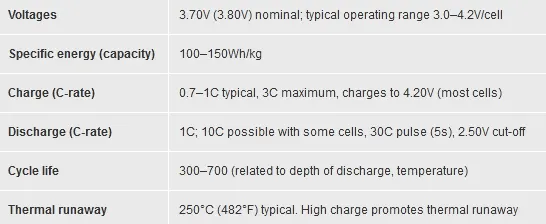
Li-phosphate offers good electrochemical performance with low resistance. This is made possible with nano-scale phosphate cathode material. The key benefits are high current rating and long cycle life, besides good thermal stability, enhanced safety and tolerance if abused. Li-phosphate is more tolerant to full charge conditions and is less stressed than other lithium-ion systems if kept at high voltage for a prolonged time.
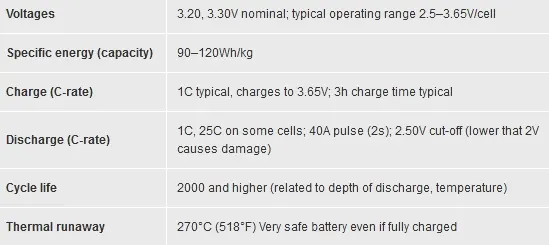
Lithium Nickel Manganese Cobalt(NMC):
One of the most successful Li-ion systems is a cathode combination of nickel-manganese-cobalt (NMC). Nickel is known for its high specific energy but poor stability; manganese has the benefit of forming a spinel structure to achieve low internal resistance but offers a low specific energy. The three active materials of nickel, manganese and cobalt can easily be blended to suit a wide range of applications for automotive and energy storage systems (ESS) that need frequent cycling.
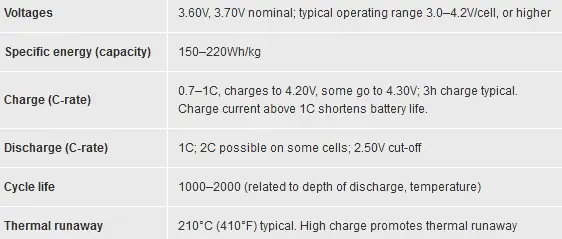
Lithium Nickel Cobalt Alumunium Oxide(NCA):
Lithium nickel cobalt aluminum oxide battery, or NCA, has been around since 1999 for special applications. It shares similarities with NMC by offering high specific energy, reasonably good specific power and a long life span. Less flattering are safety and cost.
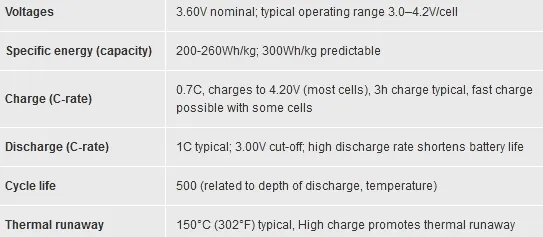
Lithium Titanate (LTO):
Li-titanate replaces the graphite in the anode of a typical lithium-ion battery and the material forms into a spinel structure. The cathode can be lithium manganese oxide or NMC.
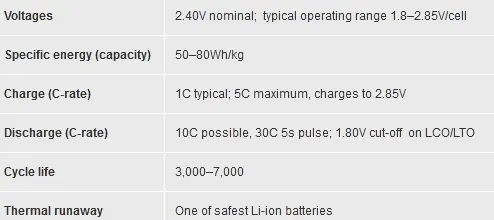
Conclusion:
The charging of any type of battery occurs when the chemical reaction takes place from right to left and the opposite for discharging.
Based on the characteristics we can say that NMC type of batteries can be more suitable for Electric Vehicles.