Week 1 Understanding Different Battery Chemistry
1.Answer:
Lithium Ion Batteries
Lithium ion batteries are the most used batteries in the current generation due to its high Specific energy compared to other lead and zinc batteries. Lithium ion batteries work by using the transfer of lithium ions and electrons from the anode to the cathode.There are different types of lithium ion batteries which is explained in detail below.
Lithium Cobalt Oxide (Cathode)
This is the Cathode which is used in the battery. It is also called as lithium cobaltate or lithium cobaltite, is a Chemical compond with formula LiCoO. The cobalt atoms are formally in the +3 oxidation state, hence the IUPAC name lithium cobalt(III) oxide.
Lithium cobalt oxide is a dark blue or bluish-gray crystalline solid,and is commonly used in the positive eletrodes of lithum ion batteries.
Lithium Graphite ( Anode )
One of the most common anode materials used today is lithiated graphite,LixC6 which is composed of graphene sheets intercalated with lithium.New materials such as those based on Silicon and other elemental blends
are being researched. Lithiated graphite has a unit cell with a HCP structure.
Electrolyte
There are many different kinds of materials that are used as electrolytes.All of them are based on a lithium-containing material that allows for the easy diffusion of lithium. LiPF6 Ethylene Carbonate Liquid: Most commonly used today. Often use LiPF6 or similar lithium salt and Ethylene Carbonate as a solvent. Solid State and polymer: Are being researched, but are rarely used due to the low diffusivity of lithium.
Working
During discharge, lithium is oxidized from Li to Li + (0 to +1 oxidation state) in the lithium-graphite anode through the following reaction:

These reactions can be run in reverse to recharge the cell. In this case the lithium ions leave the lithium cobalt oxide cathode and migrate back to the anode, where they are reduced back to neutral lithium and reincorporated into the graphite network.
Seperator
The lithium-ion battery separator cells are made from polyolefin as they have a good mechanical property, chemically stable and available at low cost. The polyolefin is created from polyethylene, polypropylene or by laminating them both. The polyolefin separator material used in lithium battery is shown below.
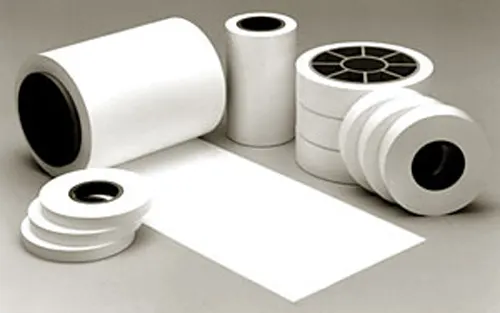
At present, the separators are developed from various types of materials such as cotton, nylon, polyesters, glass, ceramic, polyvinyl chloride, tetrafluoroethylene, rubber, asbestos, etc...
LMO
Lithium Ion Magnanese Oxide ( Cathode )
A lithium ion manganese oxide battery (LMO) is a lithium-ion cell that uses manganese dioxide, MnO2, as the cathode material. They function through the same intercalation/de-intercalation mechanism as other commercialized secondary battery technologies, such as LiCoO2. Cathodes based on manganese-oxide components are earth-abundant, inexpensive, non-toxic, and provide better thermal stability.
One of the more studied manganese oxide-based cathodes is LiMn2O4, a cation ordered member of the spinel structural family. In addition to containing inexpensive materials, the three-dimensional structure of LiMn2O4 lends itself to high rate capability by providing a well connected framework for the insertion and de-insertion of Li+ ions during discharge and charge of the battery. In particular, the Li+ ions occupy the tetrahedral sites within the Mn2O4 polyhedral frameworks adjacent to empty octahedral sites. As a consequence of this structural arrangement, batteries based on LiMn2O4 cathodes have demonstrated a higher rate-capability compared to materials with two-dimensional frameworks for Li+diffusion.A significant disadvantage of cathodes based on LiMn2O4 is the surface degradation observed when the average oxidation state of the manganese drops below Mn+3.5. At this concentration, the formally Mn(III) at the surface can disproportionate to form Mn(IV) and Mn(II) by the Hunter mechanism. The Mn(II) formed is soluble in most electrolytes and its dissolution degrades the cathode. With this in mind many manganese cathodes are substituted or doped to keep the average manganese oxidation state above +3.5 during battery use or they will suffer from lower overall capacities as a function of cycle life and temperature.
Lithium Graphite ( Anode )
One of the most common anode materials used today is lithiated graphite,LixC6 which is composed of graphene sheets intercalated with lithium.New materials such as those based on Silicon and other elemental blends
are being researched. Lithiated graphite has a unit cell with a HCP structure.
Electrolyte
There are many different kinds of materials that are used as electrolytes.All of them are based on a lithium-containing material that allows for the easy diffusion of lithium. LiPF6 Ethylene Carbonate Liquid: Most commonly used today. Often use LiPF6 or similar lithium salt and Ethylene Carbonate as a solvent. Solid State and polymer: Are being researched, but are rarely used due to the low diffusivity of lithium.
The lithium-ion battery separator cells are made from polyolefin as they have a good mechanical property, chemically stable and available at low cost. The polyolefin is created from polyethylene, polypropylene or by laminating them both. The polyolefin separator material used in lithium battery is shown below.
At present, the separators are developed from various types of materials such as cotton, nylon, polyesters, glass, ceramic, polyvinyl chloride, tetrafluoroethylene, rubber, asbestos, etc...
Chemical Reaction
The reaction on the anode Li1-xMn2O4+xli++xe(electron)==LiMn2O4
The reaction on the cathode LixC6==6C+xLi+xe
Nca
Lithium Nickel Cobalt Aluminium ( Cathode )
Lithium nickel cobalt aluminum oxide battery, or NCA, has been around since 1999 for special applications. It shares similarities with NMC by offering high specific energy, reasonably good specific power and a long life span. Less flattering are safety and cost. summarizes the six key characteristics. NCA is a further development of lithium nickel oxide; adding aluminum gives the chemistry greater stability.
Lithium Graphite ( Anode )
One of the most common anode materials used today is lithiated graphite,LixC6 which is composed of graphene sheets intercalated with lithium.New materials such as those based on Silicon and other elemental blends
are being researched. Lithiated graphite has a unit cell with a HCP structure.
Electrolyte
There are many different kinds of materials that are used as electrolytes.All of them are based on a lithium-containing material that allows for the easy diffusion of lithium. LiPF6 Ethylene Carbonate Liquid: Most commonly used today. Often use LiPF6 or similar lithium salt and Ethylene Carbonate as a solvent. Solid State and polymer: Are being researched, but are rarely used due to the low diffusivity of lithium.
The lithium-ion battery separator cells are made from polyolefin as they have a good mechanical property, chemically stable and available at low cost. The polyolefin is created from polyethylene, polypropylene or by laminating them both. The polyolefin separator material used in lithium battery is shown below.
At present, the separators are developed from various types of materials such as cotton, nylon, polyesters, glass, ceramic, polyvinyl chloride, tetrafluoroethylene, rubber, asbestos, etc...
Nmc
Lithium Magnanese Oxide ( Catode )
LiMn2O4 is a promising cathode material with a cubic spinel structure. LiMn2O4 is one of the most studied manganese oxide-based cathodes because it contains inexpensive materials. A further advantage of this battery is enhanced safety and high thermal stability, but the cycle and calendar life is limited. This type of battery is found in power tools, medical devices, and powertrains.
Lithium Graphite ( Anode )
One of the most common anode materials used today is lithiated graphite,LixC6 which is composed of graphene sheets intercalated with lithium.New materials such as those based on Silicon and other elemental blends
are being researched. Lithiated graphite has a unit cell with a HCP structure.
Electrolyte
There are many different kinds of materials that are used as electrolytes.All of them are based on a lithium-containing material that allows for the easy diffusion of lithium. LiPF6 Ethylene Carbonate Liquid: Most commonly used today. Often use LiPF6 or similar lithium salt and Ethylene Carbonate as a solvent. Solid State and polymer: Are being researched, but are rarely used due to the low diffusivity of lithium.
The lithium-ion battery separator cells are made from polyolefin as they have a good mechanical property, chemically stable and available at low cost. The polyolefin is created from polyethylene, polypropylene or by laminating them both. The polyolefin separator material used in lithium battery is shown below.
At present, the separators are developed from various types of materials such as cotton, nylon, polyesters, glass, ceramic, polyvinyl chloride, tetrafluoroethylene, rubber, asbestos, etc...
Chemical Reaction
2LiMO 2, (s) + 8HCl (l) ⇌ 2LiCl (l) + 2MCl 2, (l) + 4H 2 O (l) + Cl 2, (g)
Lfp
Lithium Iron Phospate ( Cathode )
The lithium iron phosphate battery (LFP (lithium ferro-phosphate), or Li-IP) is a type of lithium-ion battery using lithium iron phosphate (LiFePO
4) as the cathode material, and a graphitic carbon electrode with a metallic backing as the anode. Because of their lower cost, high safety, low toxicity, long cycle life and other factors, LFP batteries are finding a number of roles in vehicle use, utility-scale stationary applications, and backup power.[6] LFP batteries are cobalt-free.[7] As of September 2022, LFP type battery market share for EV's reached 31%, and of that, 68% was from Tesla and Chinese EV maker BYD production alone.[8] Chinese manufacturers currently hold a near monopoly of LFP battery type production,[9] however, with patents having started to expire in 2022 and the increased demand for cheaper EV batteries,[10] LFP type production is expected to rise further to surpass NMC type batteries in 2028.[11]
The energy density of an LFP battery is lower than that of other common lithium ion battery types such as nickel manganese cobalt (NMC) and nickel cobalt aluminum (NCA), and also has a lower operating voltage; CATL's LFP batteries are currently at 125 watt hours (Wh) per kg, up to possibly 160 Wh/kg with improved packing technology, while BYD's LFP batteries are at 150 Wh/kg, compared to over 300 Wh/kg for the highest NMC batteries. Notably, the energy density of Panasonic’s “2170” NCA batteries used in 2020 in Tesla’s Model 3 is around 260 Wh/kg, which is 70% of its "pure chemicals" value.
Lithium Graphite ( Anode )
One of the most common anode materials used today is lithiated graphite,LixC6 which is composed of graphene sheets intercalated with lithium.New materials such as those based on Silicon and other elemental blends
are being researched. Lithiated graphite has a unit cell with a HCP structure.
Electrolyte
There are many different kinds of materials that are used as electrolytes.All of them are based on a lithium-containing material that allows for the easy diffusion of lithium. LiPF6 Ethylene Carbonate Liquid: Most commonly used today. Often use LiPF6 or similar lithium salt and Ethylene Carbonate as a solvent. Solid State and polymer: Are being researched, but are rarely used due to the low diffusivity of lithium.
The lithium-ion battery separator cells are made from polyolefin as they have a good mechanical property, chemically stable and available at low cost. The polyolefin is created from polyethylene, polypropylene or by laminating them both. The polyolefin separator material used in lithium battery is shown below.
At present, the separators are developed from various types of materials such as cotton, nylon, polyesters, glass, ceramic, polyvinyl chloride, tetrafluoroethylene, rubber, asbestos, etc...
Chemical Reaction

Lto
Lithium titanate ( Cathode )
A lithium-titanate battery is a modified lithium-ion battery that uses lithium-titanate nanocrystals, instead of carbon, on the surface of its anode. This gives the anode a surface area of about 100 square meters per gram, compared with 3 square meters per gram for carbon, allowing electrons to enter and leave the anode quickly. Also, the redox potential of Li+ intercalation into titanium oxides is more positive than that of Li+ intercalation into graphite. This leads to fast charging (higher charging current) being much safer in the case of the titanate, than in the case of carbon, since lithium dendrites are less likely to form in the former case.[10] Lithium-titanate cells last for 3000 to 7000 charge cycles;[11] a life cycle of ~1000 cycles before reaching 80% capacity is possible when charged and discharged at 55 °C (131 °F), rather than the standard 25 °C (77 °F).[12]
A disadvantage of lithium-titanate batteries is their lower inherent voltage (2.4 V), which leads to a lower specific energy (about 30–110 Wh/kg[1]) than conventional lithium-ion battery technologies, which have an inherent voltage of 3.7 V.[13] Some lithium-titanate batteries, however, have an energy density of up to 177 Wh/L.[1]
Lithium Graphite ( Anode )
One of the most common anode materials used today is lithiated graphite,LixC6 which is composed of graphene sheets intercalated with lithium.New materials such as those based on Silicon and other elemental blends
are being researched. Lithiated graphite has a unit cell with a HCP structure.
Electrolyte
There are many different kinds of materials that are used as electrolytes.All of them are based on a lithium-containing material that allows for the easy diffusion of lithium. LiPF6 Ethylene Carbonate Liquid: Most commonly used today. Often use LiPF6 or similar lithium salt and Ethylene Carbonate as a solvent. Solid State and polymer: Are being researched, but are rarely used due to the low diffusivity of lithium.
The lithium-ion battery separator cells are made from polyolefin as they have a good mechanical property, chemically stable and available at low cost. The polyolefin is created from polyethylene, polypropylene or by laminating them both. The polyolefin separator material used in lithium battery is shown below.
At present, the separators are developed from various types of materials such as cotton, nylon, polyesters, glass, ceramic, polyvinyl chloride, tetrafluoroethylene, rubber, asbestos, etc...
2.Answer:
- Lithium Cobalt Oxide (LiCoO2). LiCoO2 is the most commonly used cathode material. LiCoO2 batteries have very stable capacities, although their capacities are lower than those based on nickel-cobalt-aluminum (NCA) oxides. However, cobalt is relatively expensive compared to other transition metals, such as manganese and iron, despite the attractive electrical properties of LiCoO2 cathodes. Currently, we can find this type of battery in mobile phones, tablets, laptops, and cameras.
- Lithium Manganese Oxide (LiMn2O4). LiMn2O4 is a promising cathode material with a cubic spinel structure. LiMn2O4 is one of the most studied manganese oxide-based cathodes because it contains inexpensive materials. A further advantage of this battery is enhanced safety and high thermal stability, but the cycle and calendar life is limited. This type of battery is found in power tools, medical devices, and powertrains.
- Lithium Nickel Manganese Cobalt Oxide (LiNiMnCoO2) – NMC. Nickel manganese cobalt (NMC) batteries contain a cathode made of a combination of nickel, manganese, and cobalt. NMC is one of the most successful cathode combinations in Li-ion systems. It can be tailored to serve as energy cells or power cells like Li-manganese. NMC batteries are used for power tools, e-bikes, and other electric powertrains.
- Lithium Iron Phosphate (LiFePO4) – LFP. LiFePO4 is one of the most recent cathode materials to be introduced. As of 2017, LiFePO4 is a candidate for large-scale production of lithium-ion batteries, such as electric vehicle applications, due to its low cost, excellent safety, and high cycle durability. The energy density of an LFP battery is lower than that of other common lithium-ion battery types, such as Nickel Manganese Cobalt (NMC). Because of their lower cost, high safety, low toxicity, long cycle life, and other factors, LFP batteries are finding a number of roles in vehicle use, utility-scale stationary applications, and backup power. Working voltage = 3.0 ~ 3.3 V. Cycle life ranges from 2,700 to more than 10,000 cycles depending on conditions.
- Lithium Nickel Cobalt Aluminum Oxide (LiNiCoAlO2) – NCA. In 1999, Lithium nickel cobalt aluminum oxide battery, or NCA, appeared in some special applications, and it is similar to the NMC. It offers high specific energy, a long life span, and a reasonably good specific power. NCA’s usable charge storage capacity is about 180 to 200 mAh/g. The capacity of NCA is significantly higher than that of alternative materials such as LiCoO2 with 148 mAh/g, LiFePO4 with 165 mAh/g, and NMC 333 (LiNi0,33Mn0,33Co0,33O2)with 170 mAh/g. The voltage of these batteries is between 3.6 V and 4.0 V, at a nominal voltage of 3.6 V or 3.7 V. Another advantage of NCA is its excellent fast charging capability. Nevertheless, its weak points are the limited resources of cobalt and nickel and the high cost.
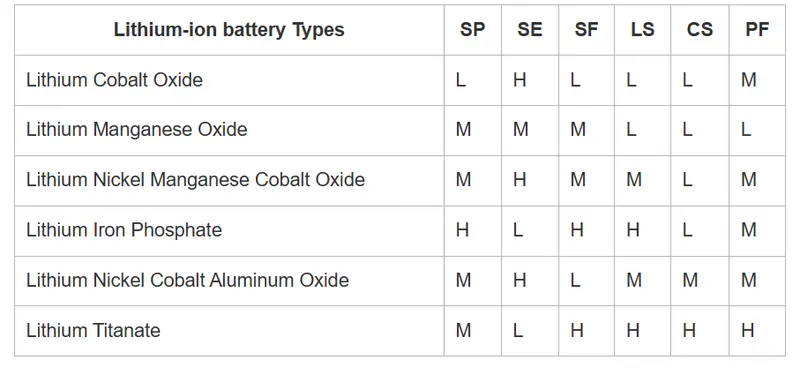
- SP stands for specific power
- SE stands for specific energy
- SF stands for safety
- LS stands for lifespan
- CS stands for cost
- PF stands for performance
- L stands for low
- M stands for moderate
- H stands for high