Week 1 Understanding Different Battery Chemistry
Week-1 Challenge
Aim: To understand different battery chemistries
Objectives: 1.Prepare a table that includes materials & chemical reactions occurring at the anode and cathode of LCO, LMO, NCA, NMC, LFP and LTO type of lithium ion cells. Give your detailed explanation for it.
2. Compare the differences between each type of Li+ ion batteries based on their characteristics
Solution:
1. Lithium ion batteries are batteries that function based on the transfer of lithium ions between a cathode and an anode. Lithium ion batteries have higher specific energies than batteries made from other materials such as zinc and lead due to the relatively light weight and low density of lithium. Lithium batteries are also more stable over charge/recharge cycles due to the small radii of lithium ions, which causes fewer disruptions of the electrode structure during ion transfer. Lithium ion batteries commonly use graphite and cobalt oxide as additional electrode materials. Lithium ion batteries work by using the transfer of lithium ions and electrons from the anode to the cathode. At the anode, neutral lithium is oxidized and converted to Li+ . These Li+ ions then migrate to the cathode.
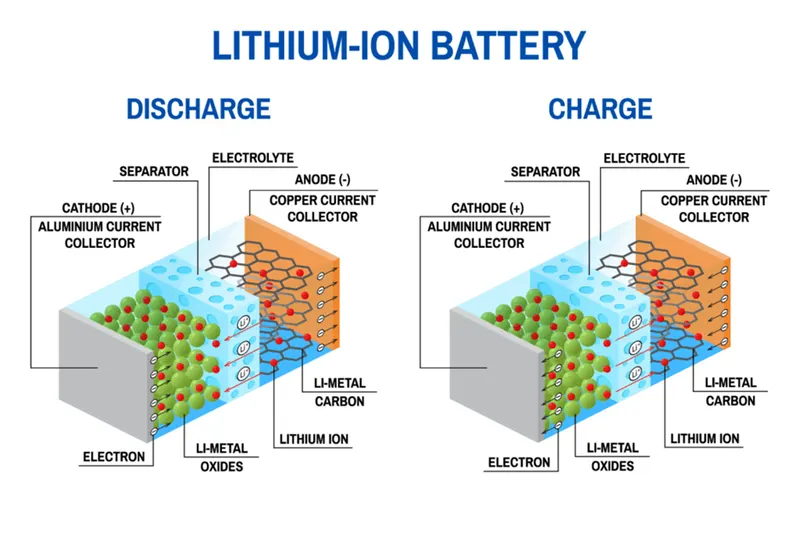
Types:
A. Lithium ion Cobalt Oxide (LCO) battery - Anode for most of the cells is the Lithium-graphite electrode.
Reaction at anode:
C6Li `harr` 6 C(graphite) + Li+ + e-
During discharge, lithium is oxidized from Li to Li+ (0 to +1 oxidation state) in the lithium-graphite anode.
Reaction at cathode:
These lithium ions migrate through the electrolyte medium to the cathode, where they are incorporated into lithium cobalt oxide through the following reaction, which reduces cobalt from a +4 to a +3 oxidation state :
Li1-xCoO2(s) + x Li+ + x e- `harr` LiCoO2 (s)
B. Lithium ion Manganese Oxide (LMO) battery –
LMO batteries were first commercialized in 1975 by the Sanyo company, making it one of the first Li-ion batteries to be used commercially. Newer LMO batteries contain a three-dimensional spinel structure to improve the diffusion of lithium ions, allowing it to have high thermal stability, low cost, and environmental affinity. However, LMO batteries suffer from severe capacity fading due to the surface dissolution of manganese in the electrolyte at temperatures above 60°C.
A typical LMO battery provides a working voltage of 3.7 V and a specific capacity of 148 mAhg-1. When compared to the average NMC battery, which has a working voltage of 3.6 V and a specific capacity of 170 mAhg-1, the LMO battery has a slightly higher working voltage but a lower specific capacity.
The discharge chemistry is as follows, with the discharge reaction occurring from left to right and the charge reaction occurring from right to left:

C. Lithium Nickel Cobalt Aluminium Oxide (NCA) battery –
NCA batteries share many similarities with NMC batteries as they both share the layered cathode structure. However, NCA batteries replace the manganese of the NMC batteries with aluminum. This improves the specific energy and lifespan when compared to its NMC counterpart. NCA batteries also have a high gravimetric capacity of 200 mAhg-1 when compared to the capacities of LMO and LFP batteries at 148 mAhg-1 and 170 mAhg-1, respectively. Finally, NCA batteries are known to have a long lifespan. The main disadvantage of NCA batteries is that they are not as safe as other battery types. These batteries require special safety monitoring measures for use in applications such as electric vehicles.

D. Lithium Manganese Cobalt Oxide (NMC) battery –
NMC is a Li-ion battery with a different type of cathode. Unlike LFP, which possesses good capacity and stability, NMC demonstrates an improved cycle life, thermal stability, and energy density. Its layered cathode structure demonstrates a single-phase intercalation process as opposed to olivine structures with two phases. The cathode of NMC consists of Li(NixMnyCoz)O2, where the sum of the molar fractions (x, y, z) is equal to one. The discharge chemistry of NMC is similar to LFP, as they are both Li-ion batteries. It follows the process of lithium oxidation on the anode and reduces at the cathode. The discharge reaction proceeds from left to right, whilst the charge reaction proceeds from right to left:

E. Lithium ion Phosphate (LFP) battery-
When LFP batteries discharge, lithium molecules from the negative electrode detach from layered graphene, becoming lithium ions and electrons. The electrons travel out of the battery as lithium ions move across a separator and both integrate into iron phosphates at the positive electrode. During charge, lithium separates from the iron phosphate, generating lithium ions and electrons. The lithium ions and electrons transfer to the positive electrode and integrate into the graphene structure. The reaction occurs from right to left. The electrochemical reactions are shown below:

F. Lithium Titanate Oxide (LTO) battery-
One of the candidates to replace graphite as an anode material in lithium-ion batteries is lithium–titanium oxide (Li4Ti5O12, LTO) of spinel structure. It shows excellent cyclability due to negligible volume change during intercalation/deintercalation reactions (so called “zero-strain” electrode material). A high operating potential of 1.55 V vs. Li+ /Li0 is responsible for LTO's enhanced safety, due to hindering the formation of a Solid Electrolyte Interface (SEI) layer on the electrode's surface, although some research groups reported SEI creation as a result of spontaneous reactions with the electrolyte or migration of SEI components formed on counter electrodes. Li4Ti5O12 has an acceptable specific capacity of 175 mAhg-1 when charged/discharged in the potential range of 1.00–3.00 V (vs. Li+ /Li0 ) when the following reaction occurs:

2. The comparison between the different battery chemistries, based on their characteristics is as shown below:
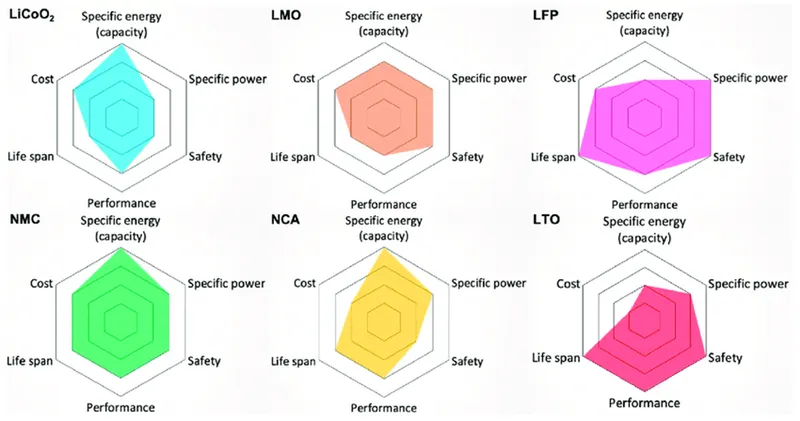
The ratings are on a scale from 0-5 with 0 being the worst and 5 the best.