Week 1 Understanding Different Battery Chemistry
Q1.
INTRODUCTION OF LITHIUM ION BATTERY
Lithium battery rely on lithium ions to store energy by creating an electrical potential diffenreces between the negative and positive poles of the battery. An insulating layer called a seperator devide the two side of the battery and blocks the electrons while still allowing the lithium ions to pass through.
During the charging phase, lithium ions move from the positive side of the battery to the negative side through the seperator. While battery discharging, the ions moves in the reverse direction. The movement of lithium ions couses the electrical potential difference. The electrical potential dfference is called voltage. When electronics assesories connected to a lithium battery, the electrons which are blocked by the seperator are forced to pass through the device and poewer it.
Lithium batteries are more popular today than ever before. As lithium battery used in cell phone, laptop computer, cordless power tools, and even electric vehicles.
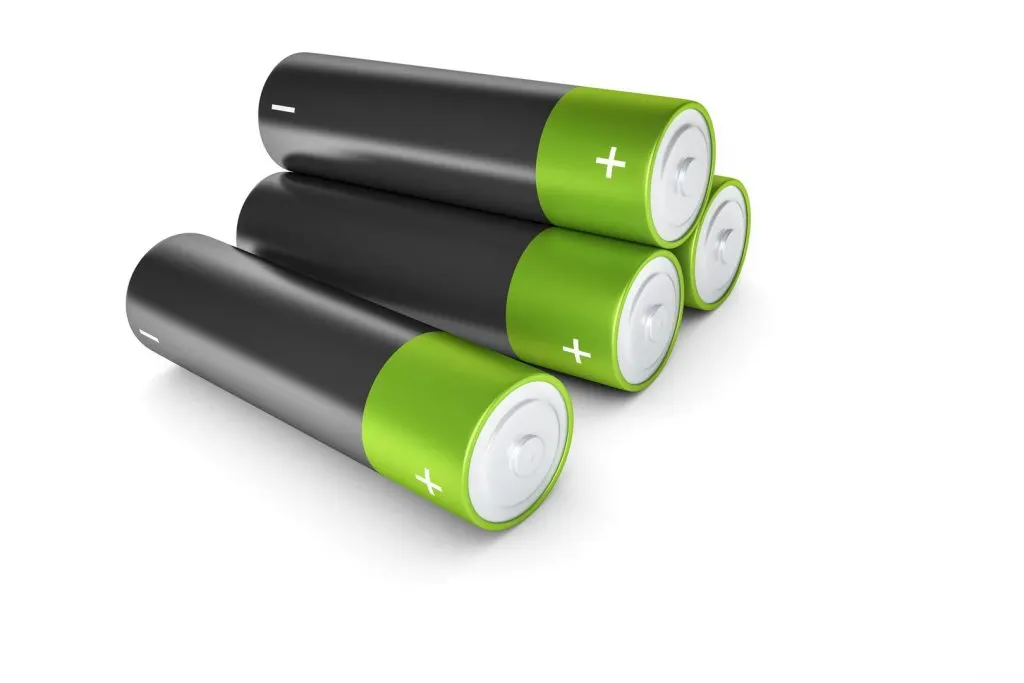
There are 6 type of Lithium battery
Different types of lithium batteries rely on unique active materials and chemical reactions to store energy. Each type of lithium battery has its benefits and drawbacks, along with its best-suited applications.
The different lithium battery types get their names from their active materials. For example, lithium iron phosphate battery, also known as LiFePO4, based on the chemical symbols for the active materials. However, many people shorten the name further to simply LFP.
- Lithium cobalt oxide (LCO): Lithium cobalt oxide (LCO) batteries have high specific energy but low specific power. This means that they do not perform well in high-load applications, but they can deliver power over a long period.
LCO batteries were common in small portable electronics such as mobile phones,keyboard,tablets, laptops, and cameras.
- Lithium manganese oxide (LMO): Lithium Manganese Oxide (LMO) batteries use lithium manganese oxide as the cathode material. This chemistry creates a three-dimensional structure that improves ion flow,lowers internal resistance, and increases current handling while improving thermal stability and safety.
LMO batteries are commonly found in portable power tools, medical instruments, and some hybrid and electric vehicles.
- Lithium nickel cobalt alumunium (NCA): Lithium nickel cobalt aluminum oxide (NCA) batteries offer high specific energy with decent specific power and a long lifecycle. This means they can deliver a relatively high amount of current for extended periods.
The ability to perform in high load applications with a long battery life makes NCA batteris popular in the electric vehicle market. Specifically, NCA is the battery of choice of Tesla.
- Lithium nickel manganese cobalt (NMC): Lithium nickel manganese cobalt oxide (NMC) batteries combine the benefits of the three main elements used in the cathode: nickel, manganese, and cobalt. Nickel on its own has high specific energy but is not stable. Manganese is exceptionally stable but has a low specific energy. Combining them yields a stable chemistry with a high specific energy.
Similar to LMO batteries, NMC batteries are popular in power tools as well as electronic powertrains for e-bike, scooters, and some electric vehicles.
- Lithium iron phosphate (LFP): Lithium irom phosphate(LFP) batteries use phosphate as the cathode material and a graphitic carbon electrode as the anode. LFP batteries have a long life cycle with good thermal stability and electrochemical performance.
LFP battery cells have a nominal voltage of 3.2 volts, so connecting four of them in series results in a 12.8-volt battery. This makes LFP batteries the most common type of lithium battery for replacing lead-acid deep-cycle batteries.
- Lithium titanium oxide (LTO): Lithium titanate (LTO) batteries replace the graphite in the anode with lithium titanate and use LMO or NMC as the cathode chemistry. The result is an extremely safe battery with a long lifespan that charges faster than any other lithium battery type.
Many applications use LTO batteries. Electric vehicles and charging stations, uninterrupted power supplies, wind and solar energy storage, solar street lights, telecommunications systems, and aerospace and military equipment are just some of the use cases
LTO batteries offer many benefits, including fast charging, an extremely wide operating temperature, a long lifespan,and superb safety because of their stability.
The table which includes material and chemical reactions occuring at anode, cathode and electrochemical reaction given below.
| Sr.No | Battery | Full Form | Cathode | Anode | Electrolyte | Reaction at anode | Reaction at cathode | Redox reaction |
| 1 | LCO | Lithium Cobalt Oxide | LiCoO2 | LiC6 | LiPF6 | LixC6→xLi++xe-+C6 | Li1-xCoO2+xLi++xe-→LiCoO2 | C6+LiCoO2↔LiC6+CoO2 |
| 2 | LMO | Lithum Manganese Spinel Oxide | LiMn2O4 | LiC6 | LiPF6 | LixC6→xLi++xe-+C6 | Li1-xMn2O4+xLi++xe-→LiMn2O4 | C6+LiMn2O4↔LiC6+Mn2O4 |
| 3 | NCA | Lithium Nickel Cobalt Aluminium Oxide | LiNiCoAlO2 | LiC6 | LiPF6 | LixC6→xLi++xe-+C6 | Li1-xNiCoAlO2+xLi++xe-→LiNiCoAlO2 | C6+LiNiCoAlO2↔LiC6+NiCoAlO2 |
| 4 | NMC | Lithium Nickel Manganese Cobalt Oxide | LiNi0.8Mn0.1Co0.1O2 | LiC6 | LiPF6 | LixC6→xLi++xe-+C6 | Li1-xNi0.8Mn0.1Co0.1O2+xLi++xe-→LiNi0.8Mn0.1Co0.1O2 | C6+LiNi0.8Mn0.1Co0.1O2↔LiC6+Ni0.8Mn0.1Co0.1O2 |
| 5 | LFP | Lithium Iron Phosphate | LiFePO4 | LiC6 | LiPF6 | LixC6→ xLi++xe-+C6 | Li1-xFePO4+xLi++xe-→LiFePO4 | C6+LiFePO4↔LiC6+FePO4 |
| 6 | LTO | Lithium Titanium Oxide | LiMn2O4 | Li4Ti5O12 | LiPF6 | Li4Ti5O12→Ti5O12+4Li++4e- | 4Li1-xMn2O4+4Li++4e-→4LiMn2O4 | Li4Ti5O12+4Mn2O4↔4LiMn2O4+Ti5O12 |
Q2.
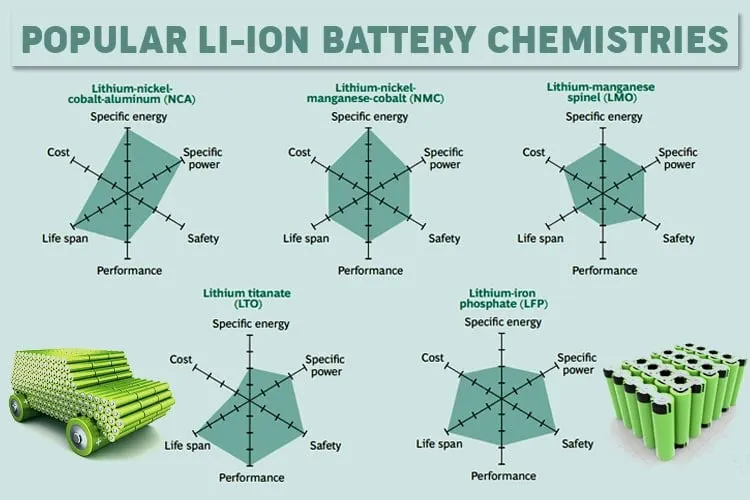
Comparison between each type of Li+ ion batteries based on their characteristics.
The battery can be compared on many different parameters such as nominal voltage, the weight of the battery, specific energy, etc.
|
|
Lithium Titanate (Li2TiO3) — LTO |
Lithium Nickel Manganese Cobalt Oxide (LiNiMnCoO2) — NMC |
Lithium Iron Phosphate(LiFePO4) — LFP |
Lithium Nickel Cobalt Aluminum Oxide (LiNiCoAlO2) — NCA |
Lithium Cobalt Oxide(LiCoO2) — LCO |
|
Voltages Nominal (Volt) |
2.40V |
3.70V |
3.30V |
3.70V |
3.70V |
|
Typical operating range (V/cell) |
1.8V–2.85V |
3.0V–4.2V |
2.5V–3.65V |
3.0 V–4.2V |
3.0 V–4.2V |
|
Specific energy (Wh/kg) |
50–80Wh/kg |
150–220Wh/kg |
90–120Wh/kg |
200-260Wh/kg |
150–200Wh/kg. |
|
Charge (C-rate) |
1C typical; 5C maximum, charges to 2.85V |
0.7–1C, charges to 4.20V |
1C typical, charges to 3.65V |
0.7C, charges to 4.20V, fast charging possible with some cells |
0.7–1C, charges to 4.20V |
|
Discharge (C-rate) |
10C possible, 30C 5s pulse |
1C, 2C possible on some cells |
1C, 25C on some cells |
1C |
1C |
|
Thermal runaway |
200°C + |
210°C (410°F) |
270°C (518°F) |
150°C (302°F) |
150°C (302°F) |
|
Application |
Electric vehicles, UPS, etc |
E-bikes, E-Rikshaw, industrial equipment, etc |
E-bikes, E-Rikshaw, Battery Energy storage system for discoms, offices and homes |
Medical devices, industrial equipment, electric vehicles |
Smart watches, mobile phones, tablets, laptops, cameras |
The graph shown below compares the nominal voltages of different Li-ion Chemistry.
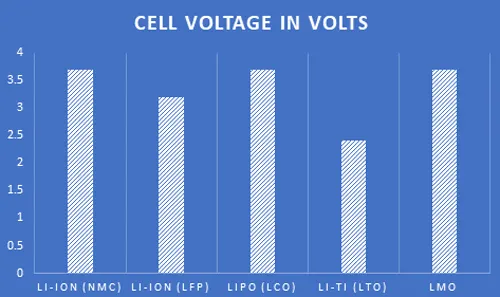
From the above graph, we can say that the nominal voltage of NMC, LCO and LMO is higher than other chemistries while that of LTO is lowest. If we compare the data for energy density from the table, we find that the chemistry follows the same trend with LTO having the lowest energy density.
In terms of life span, LFP, NCA and LTO have the best cycle life while the LMO and NMC have a very low cycle life making them unfit for EVs.
LFP, NMC and LTO have the best thermal runaway making them most suitable for operations in extreme temperature.
When considering the costs,LTO and NCA have the best cost for customers while NMC, LMO and LFP consist more cost than others which is not suited for customer as well as productioners. LTO performs well in most parameters, but the cost is not justifiable for consumer products and everyday portable equipment, whereas, NMC and LFP provides best of both worlds, they are competitively priced, while providing a decent performance and although NCA is cheaper than the other options but its poor thermal performance makes it dangerous for EVs and other operations where high temperature and mechanical stress is common, thus extra cost has to be considered for employing additional safety features to make it safe to use.
To sum up, it can be said that Li-ion batteries are the future of energy storage, the specification of cell depends on the internal composition, i.e. the material used for the electrodes, separator and the electrolyte. By changing the cathode, properties such as specific energy, charging rates, cycle life, nominal voltage, etc. can be controlled but every chemistry has their own pros and cons which needs to be considered while selecting the li-ion cell for a product.
A lot of research is going on in the field of battery and according to industry experts, the energy density of battery will increase with the cost expected to decline in the coming future.