Week 1 Understanding Different Battery Chemistry
1)
Aim :
To prepare a table which includes materials & chemical reactions occurring at the anode and cathode of LCO, LMO, NCA, NMC, LFP and LTO type of lithium ion cells
Lithium ions (Li+), as the name suggests, play a role in the reactions powering the battery. Similar to the hydride ions in the Nihm Battery, both electrodes in a lithium-ion cell are comprised of materials that may intercalate or "absorb" lithium ions. When charged ions of an element can be "kept" inside the framework of a host material without noticeably altering it, this is known as intercalation. The lithium ions in a lithium-ion battery are "attached" to an electron within the anode's structure. Intercalated lithium ions are released from the anode during battery discharge, travel through the electrolyte solution, and are eventually absorbed (intercalated) in the cathode.
Lithium Cobalt Oxide (LiCoO2)
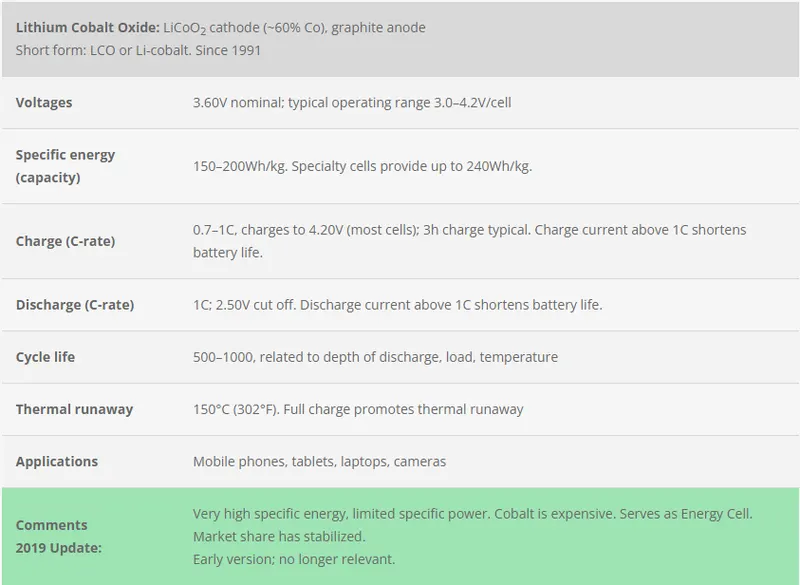
An anode made of carbon (C) and a cathode made of lithium cobalt oxide are found in the majority of lithium-ion batteries (LiCoO2). Actually, the first lithium-ion battery was the lithium cobalt oxide battery, which was created by R Yazami and J Goodenough and sold by Sony in 1991. Cobalt and oxygen combine to form layers of octahedral cobalt oxide structures, which are separated from one another by sheets of lithium. It's crucial that this structure enables the cobalt ions to switch between Co+3 and Co+4 valence states (lose and acquire a negatively charged electron) when the cobalt ions are charged and discharged. These lithium-ion batteries, out of all the many types, offer the highest energy density, which is why we currently use them in our phones, computers, and digital cameras. Thermal instability is one of their shortcomings. Their anodes have a tendency to overheat, and at high temperatures the cobalt oxide cathode might break down and release oxygen. As a result of the flammability of certain of the chemicals used in the electrolyte solution, such as diethyl carbonate, there may be some safety concerns with this battery if oxygen and heat are combined. In-built protections in lithium-ion batteries stop overheating and the battery from being completely discharged, which can potentially be harmful. In some cases, these protective circuits can also be employed to stop lithium-ion batteries from being overcharged, which can have negative effects. Lithium-ion batteries come in a wide range of sizes and forms, and some have built-in safety features like venting caps to increase security.
Chemical reaction
During discharging :-
LiC6 --> xLi++xe−+C6">LiC6 --> xLi++xe−+C6
Li1−xCoO2+xLi++xe− --> LiCoO2">Li1−xCoO2+xLi++xe− --> LiCoO2
overall reaction ->
C6+LiCoO2 <--> LixC6+Li1−xCoO2">C6+LiCoO2 <--> LixC6+Li1−xCoO2
Lithium Manganese Oxide (LiMn2O4)
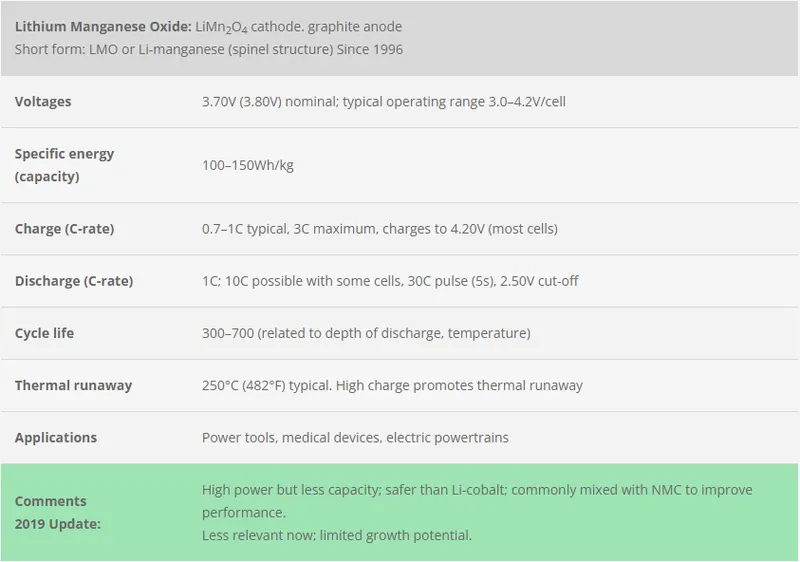
The cathode of this kind of lithium battery is built of lithium-manganese spinel (Li+Mn3+Mn4+O4). Spinel is a particular class of mineral with the recognisable AB2O4 structure. The spinel structure's excellent thermal stability increases the safety of the battery. Additionally, it encourages ion flow within the electrolyte and reduces internal resistance, both of which help a battery lose power over time.
Lithum Iron Phosphate (LiFePO4)
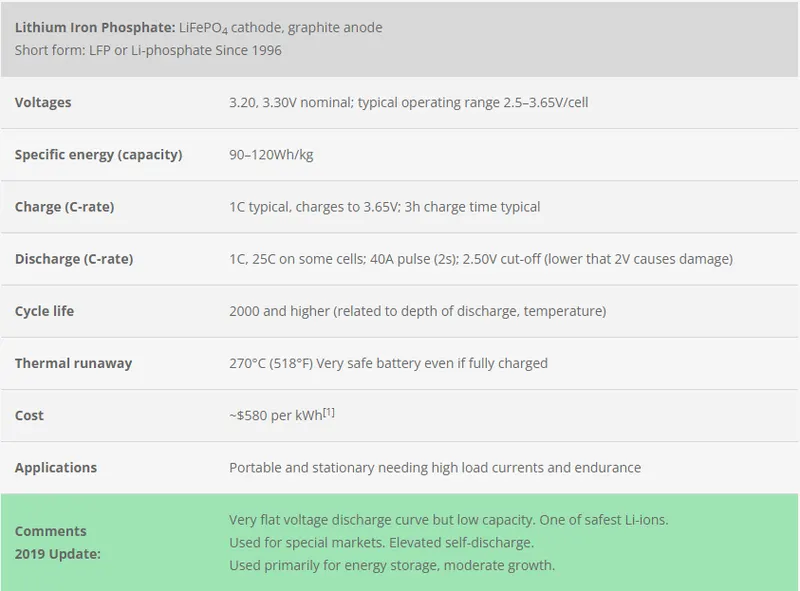
Because phosphate (PO4) can withstand high temperatures and this cell has a rapid discharge rate, the battery's thermal stability is good, increasing safety. This makes it a sensible option for items like power tools and electric vehicles, as well as for storing energy at power plants. Additionally, it has a lengthy cycle life, allowing for repeated charging and discharging. Its higher self-discharge rate and lower energy density make it less efficient than lithium cobalt oxide cells. The lithium cobalt oxide battery cell is comparable to the lithium iron phosphate battery cell. The electrolyte is largely the same, and the anode continues to be made of graphite. The cathode has changed from lithium cobalt dioxide to lithium iron phosphate, which is more stable. In actuality, the iron phosphate (FePO4) cathode of a fully charged cell contains no lithium or iron ions. Without appreciably changing the iron phosphate framework, the lithium ions can intercalate into or out of the cathode material through clearly defined tunnels in its structure. This kind of cell's cathode is formed of negatively charged phosphate anions bound to positively charged iron cations in a way that allows the iron phosphate molecules to store lithium ions. Because of the way the bonds are arranged in this structure, the oxygen atoms are strongly bound to one another, giving the cathode its chemical stability.
Chemical reaction :
During discharging ->
Lithium ions are taken up by lithium dioxide at the cathode, and the electrode is reduced as it also takes up electrons from the circuit:
Overall reaction
Lithium Nickel Manganese Cobalt Oxide (LiNiMnCoO2)
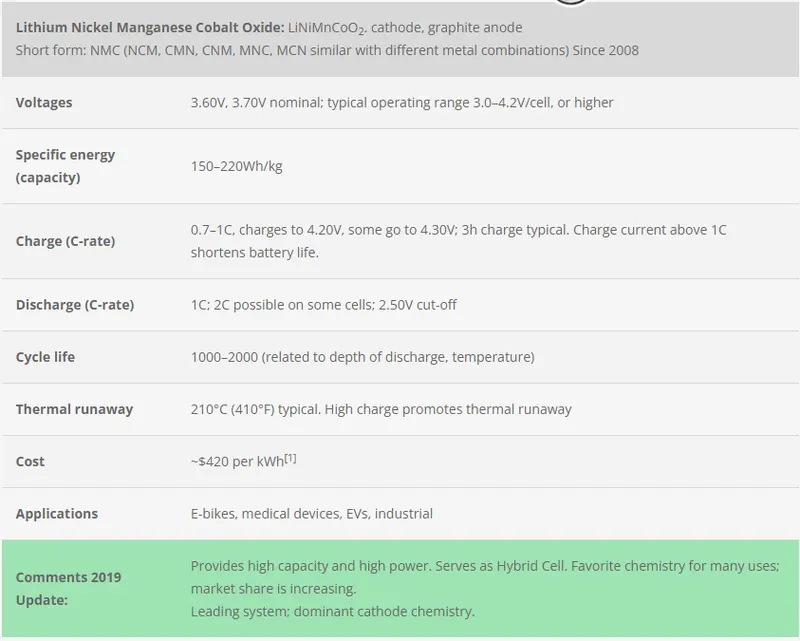
An effective Li-ion system uses nickel, manganese, and cobalt as the cathode (NMC). These systems can be configured to function as Energy cells or Power cells, much as Li-manganese. For instance, NMC in an 18650 cell optimised for specific power has a capacity of just around 2,000mAh but offers a continuous discharge current of 20A. NMC in the same cell designed for moderate load situation has a capacity of about 2,800mAh and may deliver 4A to 5A. The maximum capacity of a silicon-based anode is 4,000mAh, albeit with a reduced loading capability and a shorter cycle life. The disadvantage of silicon added to graphite is that the anode expands and contracts with charge and discharge, resulting in mechanical instability in the cell. Nickel and manganese together is the key of NMC. An example of this is table salt, whose primary components, sodium and chloride, are harmful when consumed separately but act as a food preservative when combined. Manganese has the advantage of developing a spinel structure to create low internal resistance but delivers low specific energy. Nickel is recognised for its high specific energy but poor stability. The metals' combined strengths are increased. Power tools, e-bikes, and other electric vehicles all use NMC batteries as their primary power source. The cathode combination, often known as 1-1-1, typically consists of one third nickel, one third manganese, and one third cobalt. Cobalt is pricey and hard to get by. Manufacturers of batteries are lowering the cobalt concentration while making some performance sacrifices. NCM532, which contains 5 parts nickel, 3 parts cobalt, and 2 parts manganese, is an effective combination. NMC622 and NMC811 are more combinations. Nickel, a substance with strong energetic activity, is stabilised by cobalt.
2)
Aim :
To compare the differences between each type of Li+ion batteries based on their characteristics
Lithium Cobalt Oxide :
Lithium Manganese Oxide :
Lithium Nickel Manganese Cobalt Oxide :
Lithium Iron Phosphate :
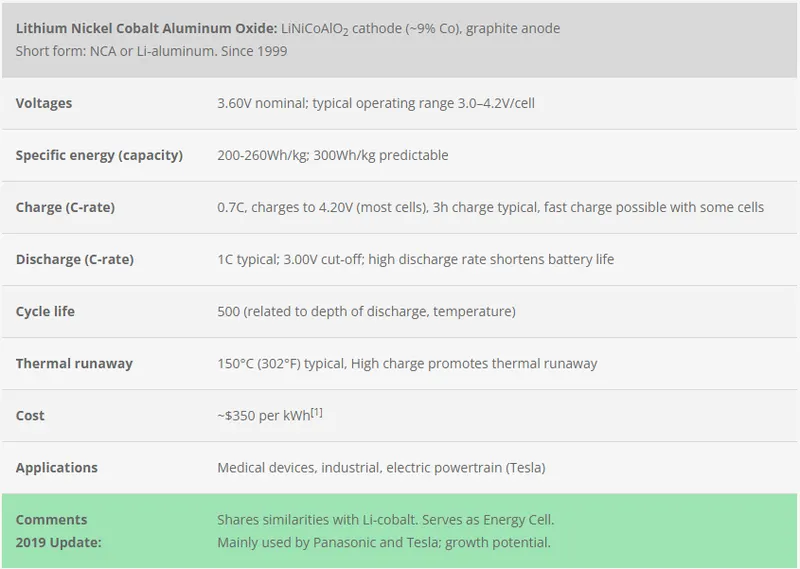
Lithium Nickel Cobalt Aluminium Oxide :
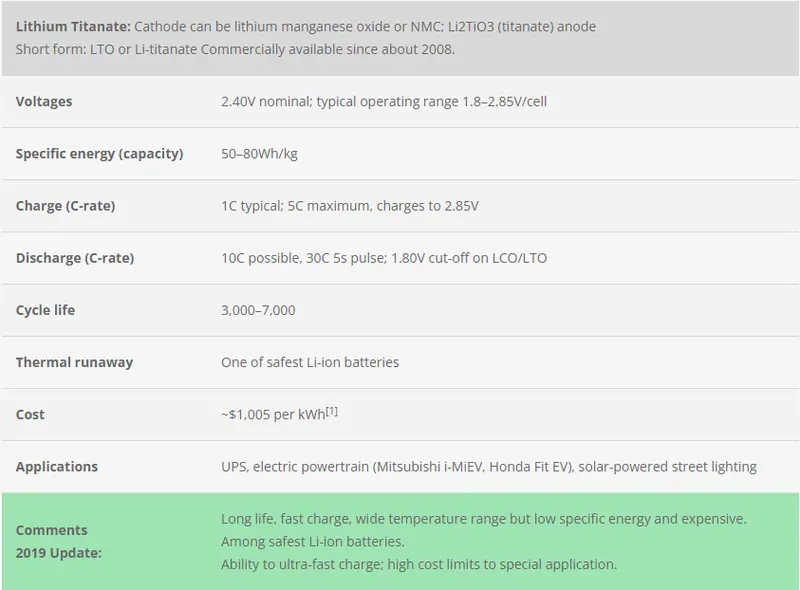
Lithium Titanate :
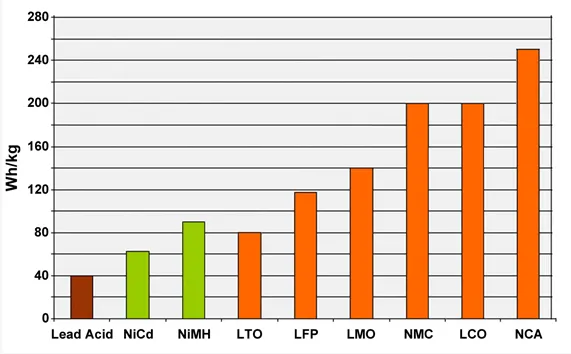
Typical specific energy of lead-, nickel- and lithium-based batteries :
Reference :
https://batteryuniversity.com/article/bu-205-types-of-lithium-ion