Week 1 Understanding Different Battery Chemistry
Aim- 1.Prepare a table which includes materials & chemical reactions occurring at the anode and cathode of LCO, LMO, NCA, NMC, LFP and LTO type of lithium-ion cells. Give your detailed explanation on it.
2.Compare the differences between each type of Li+ion batteries based on their characteristics.
Solution-
Lithiumion batteries -A lithium-ion battery is a rechargeable lithium battery that depends upon lithium ions flowing between negative and positive electrodes.During the charging phase, lithium ions flow from the positive electrode of the battery to the negative electrode. While in the case of discharging the flow of ions is reversed.The movement of these ions creates a potential difference (voltage). Hence, when the device is connected to the battery the electrons pass to it and power your device.
Types-
1) Lithium Cobalt Oxide (LiCoO2) — LCO-Lithium Cobalt Oxide battery is manufactured using cobalt and lithium carbonate. In these batteries, cobalt oxide acts as a cathode while graphite carbon acts as an anode
Pros
The key feature of lithium cobalt oxide batteries is that they possess high specific energy. This makes them offer power for a long period even under low-load applications.
Cons
In addition to the benefits of LCO, they also have some drawbacks which are listed below:
● These batteries have a short lifespan as compared to other types of lithium-ion batteries.
● They have low thermal stability which makes them unsafe for use.
● Due to high specific energy, they cannot perform well under high load applications.
● LCO batteries are not cost-effective according to their performance.
Lithium Manganese Oxide (LiMn2O4) — LMO
In Lithium Manganese Oxide batteries, lithium manganese oxide acts as the cathode material. This compound provides a three-dimensional structure that is responsible for better ion flow. Also, this structure aids in lowering the internal resistance, thus the ability of current handling increases.
Pros
The lithium manganese battery is much better in performance than the lithium cobalt oxide battery. Following are the plus points of an LMO battery:
● These batteries provide relatively high specific power and charge quickly.
● They have better thermal stability which means that they can safely operate at higher temperatures.
● LMO batteries are pretty flexible as they can handle high load applications.
● They are low in cost.
Cons
The major drawback of lithium manganese batteries is their shorter life span. Generally, the last 300 to 700 charge cycles which are lesser than many types of lithium-ion batteries.
Lithium Iron Phosphate (LiFePO4) — LFP
Lithium iron phospahte use graphitic carbon electrodes as the anode and phosphate electrodes act as cathode.
Pros
LFP batteries have the following benefits:
● They have a longer lifespan as they last 2000 or more charge cycles.
● The materials used in these batteries provide low resistance. So they are pretty stable and safe.
● LFP batteries offer 80 to 100% discharging without causing any damage.
Cons
Besides the benefits, LFP batteries also have some downsides which are as follows:
● These batteries have a relatively low specific energy.
● They don’t perform well at lower temperatures.
Lithium Nickel Manganese Cobalt Oxide (LiNiMnCoO2) — NMC
Lithium nickel manganese cobalt oxide battery is made up of a combination of three elements, nickel, manganese, and cobalt. These three combined elements act as the cathode of NMC batteries. Nickel is present in high proportion, i.e, 60% while, manganese and cobalt constitute 20%.
Pros
● NMC batteries offer a longer lifespan at a lower cost as compared to cobalt-based batteries.
● They are also safer due to higher thermal stability.
Cons
● The main demerit of the NMC battery is that it has a comparatively lower voltage than cobalt-based batteries.
Lithium Titanate (Li2TiO3) — LTO
lithium titanate is the type of lithium-ion battery that uses lithium manganate as a positive electrode. These batteries have zero strain, and no lithium plating during fast and low-temperature charging. This results in remarkable charge-discharge performance.
Pros
● The major advantage of lithium titanate batteries is that they feature super-fast recharge time.
● The cycle times are higher and are pretty safe to use.
Cons
● They have low inherent voltage.
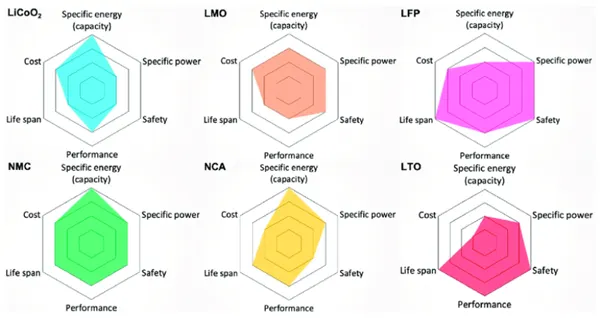
Comparison of diff types of battery are shown below-
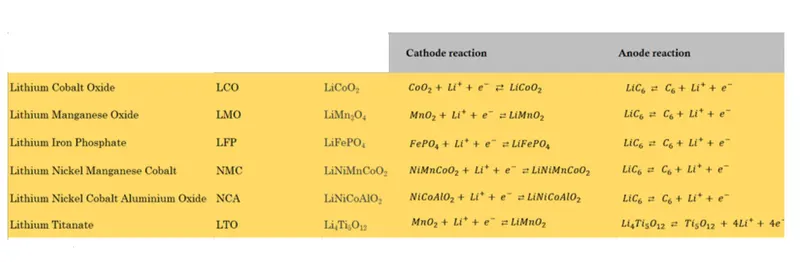
chemical reaction at anode and cathode of each type of battery are shown below-
Comparison table of each type of battery is given below-
| Types | Chemical Name | Cathode Material | Chemical Reaction at the cathode(discharge) | Anode material | Chemical Reaction at the anode(discharge) | Overall Reaction |
| Lithium Cobalt Oxide (LCO) | LiCoO2 | Lithium Cobalt oxide | CoO2+Li++e−_↔LiCoO2 | Graphite Carbon | LiC6↔C6+Li++e | LiCoO2+C6↔LiC6+C02 |
| Lithium-ion mangenese oxide battery(LMO) | LiMn2O2 | Lithium mangenese oxide | MnO2+Li++e−_↔LiMnO2 | Graphite Carbon | LiC6↔C6+Li++e= | LiCo2+C6↔LiC6+CoO2 |
| Lithium Nickel cobalt aluminium oxide(NCA) | LiNiCoAlO2 | Lithium Nickel cobalt aluminium oxide | NiCoAlO2+Li++e−_↔LiNiCoAlO2 | Graphite Carbon | LiC6↔C6+Li++e− | LiCoO2+C6↔Lic6+CoO2 |
| Lithium Nickel Mangenese Cobalt Oxide(NMC) | LiNiMnCoO2 | Lithium Nickel Mangenese Cobalt Oxide | NiMnCoO2+Li++e−_↔LiNiMnCoO2 | Graphite Carbon | LiC6↔C6+Li++e− | LiCoO2+C6↔LiC6+CoO2 |
| Lithium Iron Phosphate(LFP) | LiFePO4 | Lithium Iron Phosphate | FePO4+Li++e−_↔LiFePO4 | Graphite Carbon | LiC6↔C6+Li++e− | LiCoO2+C6↔LiC6+CoO2 |
| Lithium Titanate oxide(LTO) | Li2TiO3 | Manganese oxide | 4Mn2PO4+PO4+4Li++e−_↔4LiMn2O4 | Lithium Titanium Oxide | Li4Ti5O12+4Li++4e−_↔4LIMn2O4 | 4Mn2O4+Li4Ti5O12↔4LiMn2O4+Ti4O12 |
result - study of diff Li battery is completed