Week 1 Understanding Different Battery Chemistry
1.Prepare a table which includes materials & chemical reactions occurring at the anode and cathode of LCO, LMO, NCA, NMC, LFP and LTO type of lithium ion cells.Give your detailed explanation on it
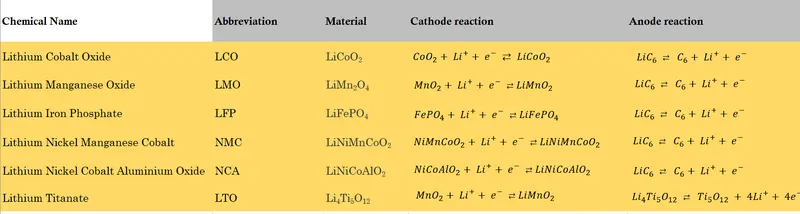
Lithium - ion batteries are the best and most commonly found batteries that are almost used in every field of application due to their robust and most often liquid less designs that have high energy densities and specific energy values. they are relitively inexpensive to make depending upon the type . they operate well under loads and are capable of bearing high temperature and shocks .
LOC – Lithium cobalt battery:
These batteries are manufactured using lithium carbonate and cobalt. They have a very heigh specific energy and thus are used in electronics. They have short battery life and low specific power.
Chemical formulae - LiCo02 (Lithium cobalt oxide)
Invention – 1991
Energy density – 150-200 Wh/kg
Cycle life – 500 – 1000
Charge (C-rate)- 0.7 to 1C , 4.20V
Anode – LiaC6 (graphite Carbone)
Cathode – LibCoO2 (cobalt oxide)
Carrier – Li+
Used: electronic devices and older or cheaper laptop batteries
Advantages:
- High energy density
- Long runtime
Disadvantages
- High loads heat the battery
- Low discharge current
- Limited safety
- Effected by cycling and aging
- High resistance and unserviceable
NMC – Lithium Manganese Cobolt Oxide :-
These are also known as lithium manganate spinel batteries(Li-NMC, LNMC NMC , or NCM). The moli energy manufactured the first commercial lithium-ion cells using lithium manganese oxide as the cathode material in 1996. These batteries are safer and hive a higher stability towards high temperature operations. They are mostly found and used in medical applications and tool
For these types of batteries generally the cathode and anode is a blend of multiple materials and cannot be defined as it varies from each manufacturer.
Chemical formulae – LiNixMnyCozO2
Invention – 1980
Energy density – 150-200 Wh/kg
Anode – LiaC6 (Multi-material mixture)
Cathode – LibCoO2
Carrier – Li+
Used: mostly found in mobile electronics
Advantages:
- Long life
- Low cost
- High density in a small package
- Cathode contains most current
Disadvantages
- Based on the materials added the disadvantages vary
- The growth or shrinkage of batteries
- Poor stability
- Low voltage output
LFP – Lithium Iron Phosphate
The phosphate is used as cathode, these are also often used as li-phosphate batteries . They have low resistance qualities which improve thermal stability and safety. They are more durable and perform for higher life cycles and cost less. They form a carbon nanotube type of structure to store energy.
Chemical formulae – LiFePO4
Cycles – 2000 to 12000
Invention – John B Goodenough 1950
Energy density – 90-160 Wh/kg
Charge – 3.2V or 610 C/g
Anode – graphite carbone in metallic backing
Cathode – polyanion class of cathode (C-LiFePO4)
Carrier – Li+
Specific capacity – 170mA
Used: it is mostly seen in solar energy related applications.
Advantages:
- Low cost
- Low toxicity
- Well defined performance
- Stability
Disadvantages
- More stable at fully charged conditions
- Low nominal voltage
- Self discharge
LTO – Lithium Titanate
These are often called as li-titanate. These batteries have a growing number of uses because of its superior nano-technology . these batteries recharge very quickly, these batteries are often coupled and used with other batteries and are mostly used in electric vehicles. The problem with such batteries is that they have very low intrinsic voltages and energy density. They are also used in aerospace applications and they can be made smaller than other batteries and thus are used in several backup and data protection applications.
Chemical formulae – Li2TiO3
Invention – 2005 by altairnano
Energy density – 117 Wh/L
Specific energy – 60 -110 Wh/Kg
Cycles – 6000 -10000
Anode – Lithium titanate nanocrystals
Cathode – layers of molten carbon
Charge – 2.4 V
Carrier – Li+
Used: military, aerospace are the two main industries that use these batteries
Advantages:
- Safety and stability during use
- Highly reliable
- Fast charging and performance
- Long life cycle
- Temperature resistance
Disadvantages
- Low energy density
- Cost
- Excessive R&D required before use
NCAs – Lithium Nickel Cobalt Aluminum Oxide
Lithium nickel cobalt aluminium oxide batteries are being used in electric vehicles and grid storage. They have very little use in the general consumer electronics and mostly used for automobiles or defence related industries. They are of a high energy with long life span. They however lack in terms of safety. Thus, they require sophisticated monitoring and regulating control systems.
Chemical formulae - LiNi0,84Co0,12Al0,04O2
Invention – 1999
Anode – graphite’s and hard carbons
Cathode – lithium, nickle, cobalt, aluminium cations
Carrier – any of the cations
Charge – 3.6 to 4 V
Used: used greatly by Panasonic and tesla
Advantages:
- Cost
- Storage
- Stability and safety
Disadvantages
- Deuteriation and breakdown
- Overcharge thermal runaway
LMO – Lithium manganes oxide battery:
This is structured as a spinel inside the battery to improve the flow of ions. It includes lithium saults that serve as an organic solvent and acts like the bridge. These types of batteries are generally not rechargeable. They are designed to be very flexible and can be used in a wide range of applications
Chemical formulae – LiMnO2
Invention – 1996
Energy density – 150-200 Wh/kg
Cycle life – 500 – 1000
Charge (C-rate)- 1C-10C , 3.5 V
Anode – Lithium
Cathode – Manganese
Carrier – Li+
Used: non rechargeable batteries for small scale electronics.
Advantages:
- Low cost
- Easy to manufacture
- High temperature range
- Stable and safe
Disadvantages
- Not rechargeable
- Although safe may explode
- Due to ease of manufacturing. Fakes and low quality products are made
- May get damaged during transporting
- And if harmful when exposed to ultrasonic waves.
2.Compare the differences between each type of Li+ion batteries based on their characteristics
| Battery Type | Voltage | Specific energy | C-rate (Charge) | C-rate (disharge) | Cycle | Thermal runway |
| LCO | 3.60V nominal; typical operating range 3.0–4.2V/cell | 150–200Wh/kg. Specialty cells provide up to 240Wh/kg. | 0.7–1C, charges to 4.20V (most cells); 3h charge typical. Charge current above 1C shortens battery life. | 1C; 2.50V cut off. Discharge current above 1C shortens battery life. | 500–1000, related to depth of discharge, load, temperature | 150°C (302°F). Full charge promotes thermal runaway |
| LMO | 3.70V (3.80V) nominal; typical operating range 3.0–4.2V/cell | 100–150Wh/kg | 0.7–1C typical, 3C maximum, charges to 4.20V (most cells) | 1C; 10C possible with some cells, 30C pulse (5s), 2.50V cut-off | 300–700 (related to depth of discharge, temperature) | 250°C (482°F) typical. High charge promotes thermal runaway |
| NMC | 3.60V, 3.70V nominal; typical operating range 3.0–4.2V/cell, or higher | 150–220Wh/kg | 0.7–1C, charges to 4.20V, some go to 4.30V; 3h charge typical. Charge current above 1C shortens battery life. | 1C; 2C possible on some cells; 2.50V cut-off | 1000–2000 (related to depth of discharge, temperature) | 210°C (410°F) typical. High charge promotes thermal runaway |
| LFP | 3.20, 3.30V nominal; typical operating range 2.5–3.65V/cell | 90–120Wh/kg | 1C typical, charges to 3.65V; 3h charge time typical | 1C, 25C on some cells; 40A pulse (2s); 2.50V cut-off (lower that 2V causes damage) | 2000 and higher (related to depth of discharge, temperature) | 270°C (518°F) Very safe battery even if fully charged |
| NCA | 3.60V nominal; typical operating range 3.0–4.2V/cell | 200-260Wh/kg; 300Wh/kg predictable | 0.7C, charges to 4.20V (most cells), 3h charge typical, fast charge possible with some cells | 1C typical; 3.00V cut-off; high discharge rate shortens battery life | 500 (related to depth of discharge, temperature) | 150°C (302°F) typical, High charge promotes thermal runaway |
| LTO | 2.40V nominal; typical operating range 1.8–2.85V/cell | 50–80Wh/kg | 1C typical; 5C maximum, charges to 2.85V | 10C possible, 30C 5s pulse; 1.80V cut-off on LCO/LTO | 3,000–7,000 | One of safest Li-ion batteries |