Week 1 Understanding Different Battery Chemistry
Que.1:Prepare a table which includes materials & chemical reactions occurring at the anode and cathode of LCO, LMO, NCA, NMC, LFP and LTO type of lithium ion cells.Give your detailed explanation on it.
Ans:
The lithium ion battery: The lithium ion battery was introduced in the early 1990s and it uses a lithiated transition metal intercalation oxide for the positive electrode and lithiated carbon for the negative electrode. The electrolyte is either a liquid organic solution or a solid polymer. Electrical energy is obtained from the combination of the lithium carbon and the lithium metal oxide to form carbon and lithium metal oxide. The overall chemical reaction for the battery is:
C6Lix + MyOz ←→ 6C + LixMyOz
An important point about lithium ion batteries is that accurate control of voltage is needed when charging lithium cells. If it is slightly too high it can damage the battery, and if too low the battery will be insufficiently charged. Suitable commercial chargers are being developed along with the battery.
Nominal battery parameters for lithium ion batteries. These figures are based on the Sony lithium ion batteries as in 1998. Higher energy and power figures may be quoted, but these tend to be data for single cells or very small batteries, where packaging can be much more flimsy, and no provision need be made for cooling:
| Specific energy | 90 Wh/kg |
| Energy density | 153 Wh/L |
| Specific power | 300 W/kg |
| Nominal cell voltage | 3.5 V |
| Amphour efficiency | Very good |
| Internal resistance | Very low |
| Commercially available | Only in very small cells not suitable for electric vehicles |
| Operating temperature | Ambient |
| Self-discharge | Very low, ∼10% per month |
| Number of life cycles | >1000 |
| Recharge time | 2–3 h |
The lithium ion battery has a considerable weight advantage over other battery systems, and this makes it a highly attractive candidate for future electric vehicle. The specific energy, for example, is about three times that of lead acid batteries, and this could give a car with a very reasonable range.
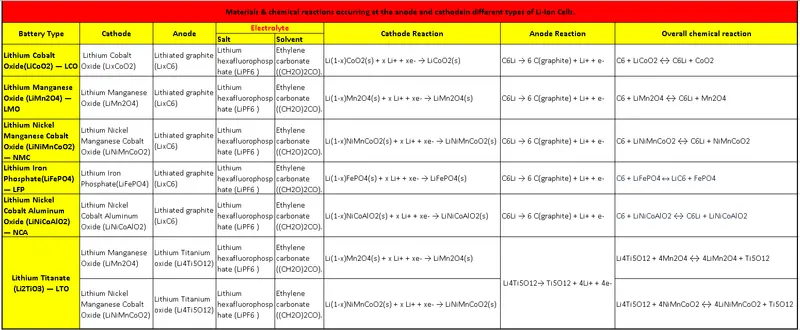
1) Lithium Cobalt Oxide (LiCoO2) LCO: Lithium cobalt oxide, one of the most common Li-ions, has the chemical symbols LiCoO2 and the abbreviation LCO. For reasons of simplicity, the short form Li-cobalt can also be used for this battery. Cobalt is the main active material that gives this battery character. The battery consists of a cobalt oxide cathode and a graphite carbon anode. The cathode has a layered structure. During discharge, lithium ions move from the anode to the cathode. The flow reverses on a charge. The drawback of Li–cobalt batteries is their relatively short life span, low thermal stability, and limited load capabilities.
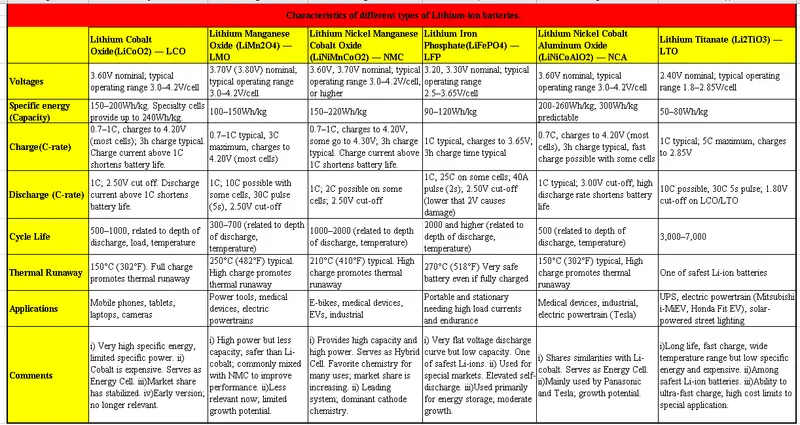
2)Lithium manganese oxide (LiMn2O4) LMO: Li-ion with manganese spinel was first published in the Materials Research Bulletin in 1983. The architecture forms a three-dimensional spinel structure that improves ion flow on the electrode, resulting in lower internal resistance and improved current handling. A further advantage of the spinel structure is high thermal stability and enhanced safety, but the cycle and calendar life is limited. Li-manganese has a capacity that is roughly one-third lower than Li-cobalt. Design flexibility allows engineers to maximize the battery for either optimal longevity (life span), maximum load current (specific power) or high capacity (specific energy).
3)Lithium Nickel Manganese Cobalt Oxide (LiNiMnCoO2) NMC: Lithium Nickel Manganese Cobalt Oxide (NMC) electrodes can be designed for high specific energy or power with high density. The secret of NMC lies in combining nickel and manganese:
nickel is known for its high specific energy but poor stability; manganese has the benefit of forming a spinel structure to achieve low internal resistance but offers a low specific energy. The mix of the various metals (nickel and manganese) varies by manufacturer and is a very closely guarded formula.
The secret of NMC lies in combining nickel and manganese. An analogy of this is table salt in which the main ingredients, sodium and chloride, are toxic on their own but mixing them serves as seasoning salt and food preserver. Nickel is known for its high specific energy but poor stability; manganese has the benefit of forming a spinel structure to achieve low internal resistance but offers a low specific energy. Combining the metals enhances each other strengths. NMC is the battery of choice for power tools, e-bikes and other electric powertrains. The cathode combination is typically one-third nickel, one-third manganese and one-third cobalt, also known as 1-1-1. This offers a unique blend that also lowers the raw material cost due to reduced cobalt content. Another successful combination is NCM with 5 parts nickel, 3 parts cobalt and 2 parts manganese (5-3-2). Other combinations using various amounts of cathode materials are possible. Battery manufacturers move away from cobalt systems toward nickel cathodes because of the high cost of cobalt. Nickel-based systems have higher energy density, lower cost, and longer cycle life than the cobalt-based cells but they have a slightly lower voltage.
NMC111 means equal parts nickel, manganese and cobalt. Combining nickel and manganese enhances each other’s strengths, making NMC the most successful Li-ion system and suitable for EV powertrains. These batteries are currently in high demand given the high specific energy and excellent thermal characteristics. As mentioned above, NMC has been used by many EV manufacturers, including Nissan Leaf, Chevy Volt and BMW i3.
4)Lithium Iron Phosphate (LiFePO4) LFP: In 1996, researchers at the University of Texas in Austin found that phosphate materials could be used in Li-ion battery positive electrodes. LiFePO4 (LFP) offers good electrochemical performance with low resistance, besides high current rating and long cycle life. The phosphate helps to stabilize the electrode against overcharging and provides a higher tolerance to heat which limits the breakdown of the material. These batteries have a wide temperature range and can operate between +60 ◦C to −30 ◦C and are much less likely to suffer from a thermal runaway. LiFePO4 has a higher self-discharge than other Li-ion batteries, which can cause balancing issues with aging. This can be mitigated through the use of sophisticated control electronics, at increased battery pack cost. Further, moisture seems to significantly limit the lifetime of the battery. With the efficient power-to-weight ratios, high safety features and the chemistry’s resistance to thermal runaway, LiFePO4 batteries are achieving popularity for use in motorhomes. A consortium of German companies (ElektroFahrzeuge Stuttgart and WOF, located in Baden-Wurttemberg, Germany) has teamed up to bring to market the first all-electric motorhome: the Iridium E Mobil, and this electric powertrain includes a lithium iron phosphate battery.
5)Lithium Nickel Cobalt Aluminum Oxide (LiNiCoAlO2 ) NCA: Lithium nickel cobalt aluminum oxide battery, or NCA, has been around since 1999 for special applications. It shares similarities with NMC by offering high specific energy, reasonably good specific power and a long life span. Less flattering are safety and cost. NCA is a further development of lithium nickel oxide; adding aluminum gives the chemistry greater stability. NCA is not as safe as the others listed above and as such, require special safety monitoring measures to be employed for use in EVs. They are also more costly to manufacture, limiting their viability for use in other applications. So far, Tesla is known as the only EV manufacturer who uses NCA chemistry, and claims their NCA battery in production has even less Cobalt than NMC811. The NCA batteries used in the Tesla Model 3 and the first Model S in 2012 had only 15% Cobalt content.
6)Lithium Titanate (Li4Ti5O12): Batteries with lithium titanate negative electrodes have been known since the 1980s. Li-titanate (LTO) replaces the graphite in the negative electrode of a typical Li-ion battery and the material forms into a spinel structure. The counter-electrode can be lithium manganese oxide or NMC. Spinel lithium titanate has been regarded as a highly useful electrode material because of the zero volume change during lithiation, leading to an extremely long operational lifetime for the electrode, coupled with the improved safety owing to an extremely flat discharge and charge plateau at about 1.55 V
vs. Li/Li+. This material has low electronic conductivity and the Li+ diffusion coefficient of this material can result in poor performance at high power levels, though this can be improved through the reduction of the lithium ion transport path lengths through proper nanostructuring, and the improvement of the electronic conductivity through doping, surface coating, and forming composites with better electronic conductors such as carbon materials. Titanate batteries are used in certain Japanese-only versions of Mitsubishi’s i-MiEV electric vehicle, and Honda uses them in its Fit EV. LTO are also used in the Tosa concept
electric bus. Due to their high level of safety, lithium titanate batteries are used in mobile medical devices.
Que.2:Compare the differences between each type of Li+ion batteries based on their characteristics.
Ans:There are different types of lithium-ion batteries and the main difference between them lies in their cathode materials. Different kinds of lithium-ion batteries offer different features, with trade-offs between specific power, specific energy, safety, lifespan, cost, and performance.
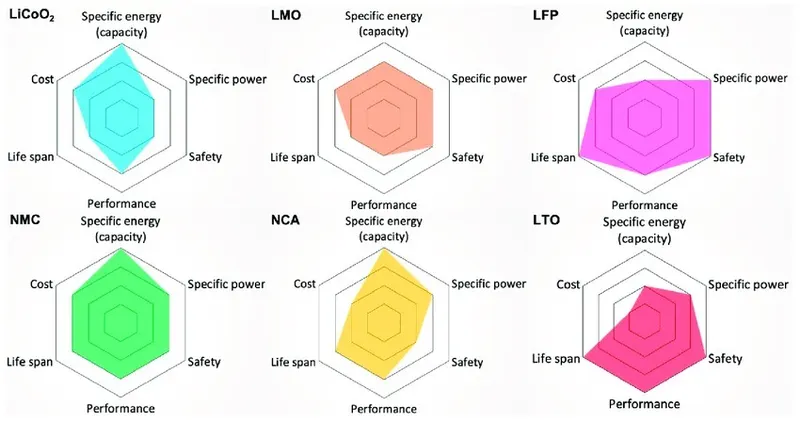
The Six lithium-ion battery types that we will be comparing are Lithium Cobalt Oxide(LCO), Lithium Manganese Oxide(LMO), Lithium Nickel Manganese Cobalt Oxide(NMC), Lithium Iron Phosphate(LFP), Lithium Nickel Cobalt Aluminum Oxide(NCA), and Lithium Titanate(LTO).
Main Characteristics of Lithium Cell types as following:
1] Specific Energy:- This defines the battery capacity in weight (Wh/kg). The capacity relates to the runtime. Products requiring long runtimes at moderate load are optimized for high specific energy. Typically expressed in Watt hours per kilogram,(Wh/kg).
2] Specific Power:- It's the ability to deliver a high current and indicates loading capability. Batteries for power tools are made for high specific power and come with a reduced specific energy.Typecally expressed in Watt per Kilogram (W/kg).
3] Cost:- Demand for electric vehicles has generally been lower than anticipated and this is mainly due to the cost of lithium-ion batteries. Hence cost is a huge factor when selecting the type of lithium-ion battery.
4] Safety:- This relates to factors such as the thermal stability of the materials used in the batteries. The materials should have the ability to sustain high temperatures before becoming unstable. Instability can lead to thermal runaway in which flaming gases are vented. Fully charging the battery and keeping it beyond the designated age reduces safety.
5] Performance:- This measures how well the battery works over a wide range of temperatures. Most batteries are sensitive to heat and cold and require climate control. Heat reduces life, and cold lowers performance temporarily.
Comparision of the differences between each type of Li+ion batteries based on their characteristics as following:
Lithium Cobalt Oxide has high specific energy as compared to the other batteries which makes it the preferred choice for laptops and mobile phones. Li-cobalt excels on high specific energy but offers only moderate performance specific power, safety and life span. It also has a low cost and a moderate performance. However, it is highly unfavorable in all the other aspects when compared to the other lithium-ion batteries. It has a low specific power, low safety, and a low lifespan.
Lithium Manganese Oxide has a moderate specific power, moderate specific energy, and a moderate level of safety when compared to the other types of lithium-ion batteries. Although moderate in overall performance, newer designs of Li-manganese offer improvements in specific power, safety and life span. It has the added advantage of a low cost. The downsides are its low performance and low lifespan. It is usually used in medical devices and power tools.
Lithium Nickel Manganese Cobalt Oxide has two major advantages as compared to the other batteries. NMC has good overall performance and excels on specific energy. This battery is the preferred candidate for the electric vehicle and has the lowest self-heating rate. The first one is its high specific energy which makes it desirable in electric powertrains, electric vehicles, and electric bikes. The other is its low cost. It is moderate in terms of specific power, safety, lifespan, and performance when compared to the other lithium-ion batteries. It can be optimized to either have high specific power or high specific energy.
Lithium Iron Phosphate only has one major disadvantage when compared to other types of lithium-ion batteries and that is its low specific energy. Li-phosphate has excellent safety and long life span but moderate specific energy and elevated self-discharge. Other than that, it has moderate to high ratings in all the other characteristics. It has a high specific power, offers a high level of safety, has a high lifespan, and comes at a low cost. The performance of this battery is also moderate. It is often employed in electric motorcycles and other applications that require a long lifespan and a high level of safety.
Lithium Nickel Cobalt Aluminum Oxide offers one strong advantage as compared to the five other batteries and that is high specific energy. High energy and power densities, as well as good life span, make NCA a candidate for EV powertrains. High cost and marginal safety are negatives. It is pretty moderate in the rest of the characteristics like performance, cost, specific power, and lifespan. The only downside to this battery type is its low level of safety. Its high specific energy and moderate lifespan make it a good candidate for electric powertrains.
Lithium Titanate offers high safety, high performance, and a high lifespan which are very important features every battery should have. Its specific energy is low compared to the five other lithium-ion batteries but it compensates for this with a moderate specific power.Li-titanate excels in safety, low-temperature performance and life span. Efforts are being made to improve the specific energy and lower cost. The only major disadvantage of lithium titanate as compared to the other lithium-ion batteries is its extremely high cost. Another important feature of this battery worthy of mention is its remarkably fast recharge time. It can be used for storing solar energy and creating smart grids.