Week 1 Understanding Different Battery Chemistry
1 .....INTRODUCTION:
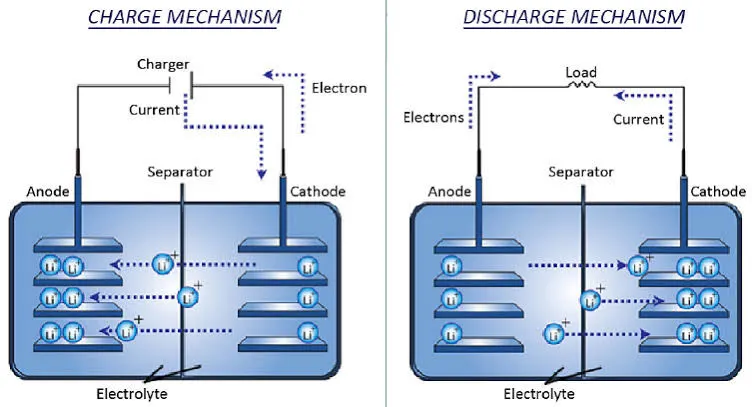
Lithium Ion batteries are divided into a wide variety of chemistries depending on the Cathodic material used. We can see Battery as a energy storage device in form of Electro-Chemical process. We can see below image indicating Electro-Chemical process in Lithium ion cell. We can see the basic chemical process happening in the Li+ Cell while Charging and Discharging cycles.
Let us see for Discharge Cycle
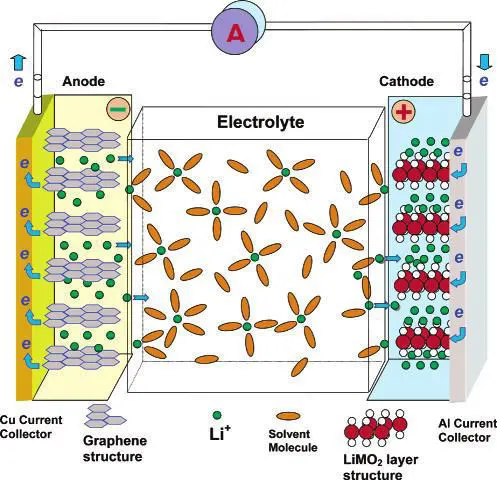
CATHODE : It is a positive electrode (generally made of oxides )where conventional current leaves(electron enters into cathode oxide structure) and flows through load to anode as seen below during discharge process.So as we see cathode accept electrons and become reduced.
ANODE : It is a negative electrode (made up of metal or alloy) where conventional current enters(electron leaves anode) into anode through load as seen below during discharge process.So as we see anode releases electrons and become oxidized.
Electrolyte : The Electrolyte is a non acqueous solution generally LiPF6(Lithium Hexaflourophosphate) salt dissolved in Ethylene Carbonate(EC) or Dimethyl Carbonate(DEC) etc.., which is used to permit ionic charge transfer between electrodes. It does not allow electrons to pass through but only ions to pass. It is non conductor of electrons.
Separator: It acts as insulating medium/material between positive and negative electrode to avoid short circuit between electrodes.
Current Collectors : They are used to reduce electronic resistance of electrodes and support ease in charge transfer in the battery. They are spread across electrode surface and allow charge to transfer without interruption. Generally Aluminium is used as Positive current collector and Copper is used as a Negative current collector. We can see all of them below.
Let us see the classification of Li Ion cell based on different chemistries. They are classified into
1. NMC (Lithium Nickel Manganese Cobalt)
2. LCO (Lithium Cobalt Oxide)
3. LMO (Lithium Manganese Oxide)
4. NCA (Nickel Cobalt Aluminium)
5. LFP (Lithium Iron Phosphate)
6. LTO (Lithium Titanium Oxide)
| TYPE OF BATTERY | CATHODE | ANODE | ELECTROLYTE | CATHODE REACTION | ANODE REACTION | OVERALL REACTION |
| NMC(Lithium Nickel Manganese Cobalt) | LiNiMnCoO2 | LiC6 | LIPF6 Salt in Ethylene Carbonate solvent |
Li1-x NiMnCoO2 +xLi+ + xe- <===>LiNiMnCoO2 |
LiC6 <==> C6+Li++e- | Li1-x NiMnCoO2 + LiC6 <===> LiNiMnCoO2 + |
| LCO (Lithium Cobalt Oxide) | LiCoO2 | LiC6 | LIPF6 Salt in Ethylene Carbonate solvent | Li1-xCoO2 + xLi+ + xe- <===> LiCoO2 |
LiC6 <==> C6+Li++e- |
Li1-xCoO2 + LiC6 <===> LiCoO2+ C6 |
| LMO (Lithium Manganese Oxide) | LiMn2O4 | LiC6 | LIPF6 Salt in Ethylene Carbonate solvent | Li1-xMn2O4 + xLi+ + xe- <===> LiMn2O4 | LiC6 <==> C6+Li++e- | Li1-xMn2O4 + LiC6 <===> LiMn2O4 + C6 |
| NCA (Nickel Cobalt Aluminium) | LiNiCoAlO2 | LiC6 | LIPF6 Salt in Ethylene Carbonate solvent | Li1-xNixCoyAlzO2 + xLi++ xe- <===> LiNixCoyAlzO2 | LiC6 <==> C6+Li++e- | Li1-xNixCoyAlzO2 + LiC6 <===> LiNixCoyAlzO2 + C6 |
| LFP (Lithium Iron Phosphate) | LiFePO4 | LiC6 | LIPF6 Salt in Ethylene Carbonate solvent |
Li1-xFePO4 + xLi+ + xe- <===> LiFePO4 |
LiC6 <==> C6+Li++e- | Li1-xFePO4 + LiC6 <===> LiFePO4 + C6 |
| LTO (Lithium Titanium Oxide) | Cathode can be LMO or NMC | Li4Ti5O12 | LIPF6 Salt in Ethylene Carbonate solvent | 4Li1-xMn2O4 + 4Li+ + 4e- <===> 4LiMn2O4 | Li7Ti5O12 <===> Li4Ti5O12 + 3Li+ + 3e- | 4Li1-xMn2O4 + Li7Ti5O12 <===> 4LiMn2O4 + Li4Ti5O12 |
Let us call Lithium Ion Battery as "LIB"
1. LIB-NMC :
In this Configuration Nickel Manganese Cobalt Oxide is used in Cathode Material and Graphite Anode. As we can see in above table the chemical (REDOX Reactions) reaction is
NiMnCoO2+ Li + + e- <===> LiNiMnCoO2 @ Cathode End
LiC6 <==> C6+Li++e- @ Anode End
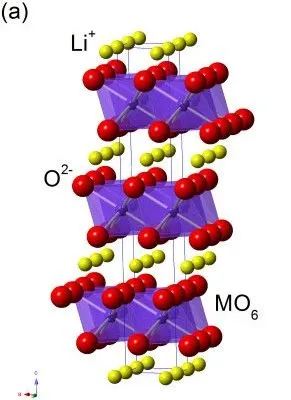
PROCESS : During Discharging the Anode gets oxidized by giving electrons to load connected. Li ions travel through electrolyte and separator and reach cathode where they are captured by the cathodic(NiMnCoO2) structure. So here Cathode gets reduced.
2. LIB-LCO :
In this Configuration Lithium Cobalt Oxide is used in Cathode Material and Graphite Anode. As we can see in above table the chemical (REDOX Reactions) reaction is
CoO2+ Li + + e- <===> LiCoO2 @ Cathode End
LiC6 <==> C6+Li++e- @ Anode End
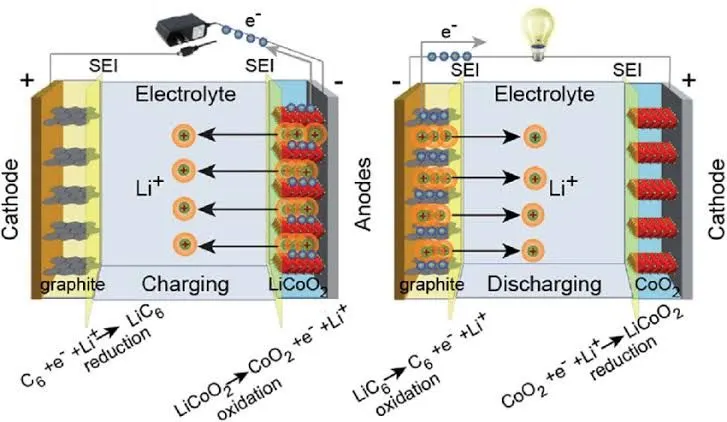
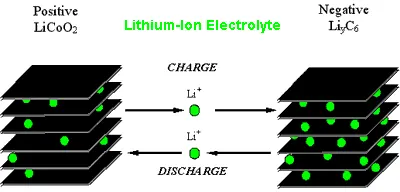
Note: We can see SEI (Solid Electrolyte Interphase)Layer which is a kind of protective layer which is formed after few charging cycles . The SEI allows Li+ transport and blocks electrons in order to prevent further electrolyte decomposition.
PROCESS : During Discharging the Anode gets oxidized by giving electrons to Load Connected. Li ions travel through electrolyte and separator and reach cathode where they are captured by the cathodic(CoO2) structure. So here Cathode gets reduced.
3. LIB-LMO :
In this Configuration Lithium Manganese Oxide is used in Cathode Material and Graphite Anode. As we can see in above table the chemical (REDOX Reactions) reaction is
Mn2O4 + Li + + e- <===> LiMn2O4 @ Cathode End
LiC6 <==> C6+Li++e- @ Anode End
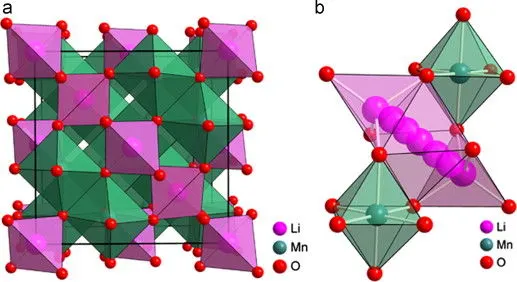
PROCESS : During Discharging the Anode gets oxidized by giving electrons to Load Connected. Li ions travel through electrolyte and separator and reach cathode where they are captured by the cathodic(Mn2O4 ) structure. So here Cathode gets reduced.
4. LIB-NCA :
In this Configuration Nickel Cobalt Aluminium is used in Cathode Material and Graphite Anode. As we can see in above table the chemical (REDOX Reactions) reaction is
Li1-xNixCoyAlzO2+ Li + + e- <===> LiNixCoyAlzO2 @ Cathode End
LiC6 <==> C6+Li++e- @ Anode End
PROCESS : During Discharging the Anode gets oxidized by giving electrons to Load Connected. Li ions travel through electrolyte and separator and reach cathode where they are captured by the cathodic(NixCoyAlzO2) structure. So here Cathode gets reduced.
5.LIB-LFP :
In this Configuration Lithium Iron Phosphate is used in Cathode Material and Graphite Anode. As we can see in above table the chemical (REDOX Reactions) reaction is
FePO4 + Li + + e- <===> LiFePO4 @ Cathode End
LiC6 <==> C6+Li++e- @ Anode End
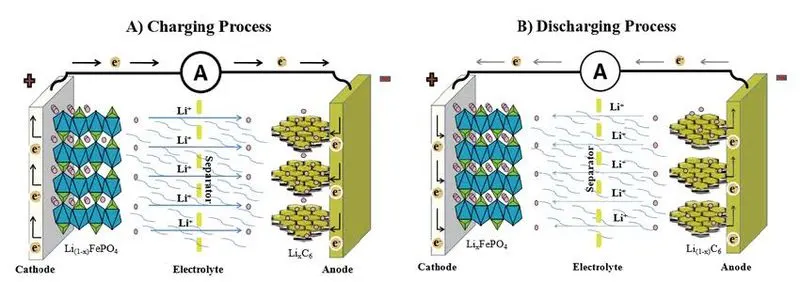
PROCESS : During Discharging the Anode gets oxidized by giving electrons to Load Connected. Li ions travel through electrolyte and separator and reach cathode where they are captured by the cathodic(FePO4) structure. So here Cathode gets reduced.
6.LIB-LTO :
In this Configuration Lithium Titanium Oxide is used in Cathode Material and LMO Anode. As we can see in above table the chemical (REDOX Reactions) reaction is
4Li1-xMn2O4 + 4Li+ + 4e- <===> 4LiMn2O4 @ Cathode End
Li7Ti5O12 <===> Li4Ti5O12 + 3Li+ + 3e- @ Anode End
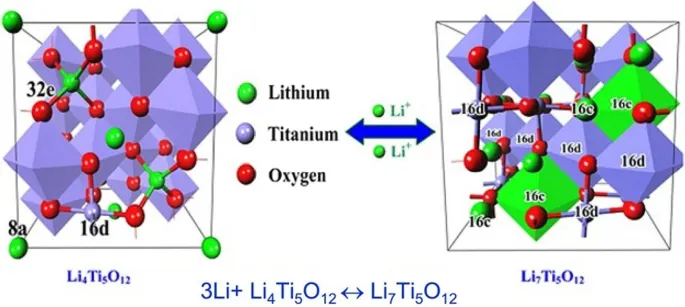
PROCESS : During Discharging the Anode gets oxidized by giving electrons to Load Connected. Li ions travel through electrolyte and separator and reach cathode where they are captured by the cathodic(4Li1-xMn2O4) structure. So here Cathode gets reduced.
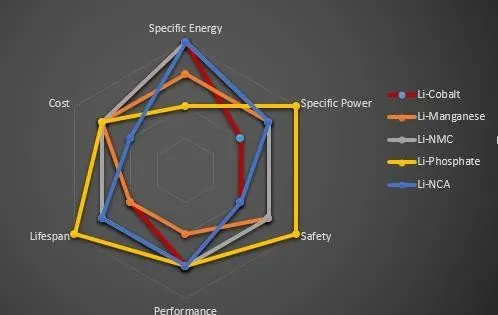
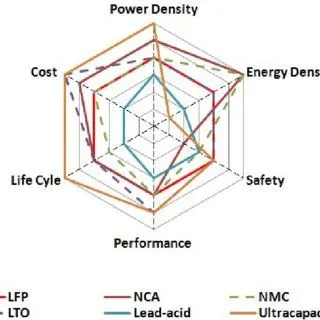
2. FOLLOWING IMAGE SHOWS THE DIFFERENT CHARACTERISTICS OF LITHIUM ION BATTERIES :
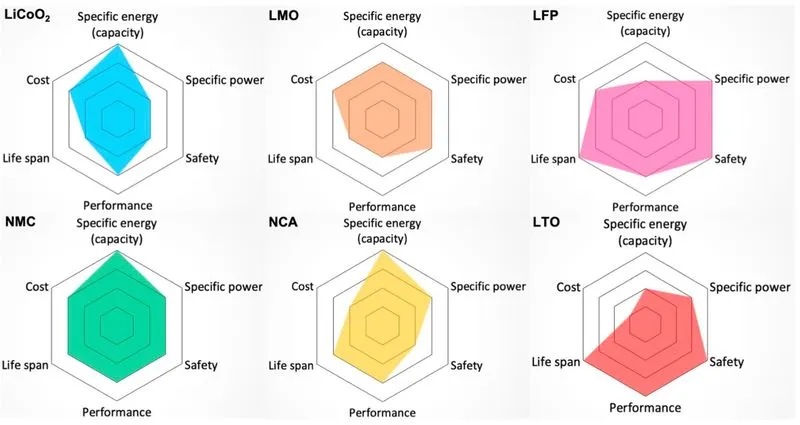
1. LCO(Lithium Cobalt Oxide): Following are the typical characteristics of LCO LIB.
| Voltages | 3.60V nominal; typical operating range is 3.0–4.2V |
| Specific energy (capacity) | 150–200Wh/kg. Specialty cells provide up to 240Wh/kg. |
| Specific Volumetric Density | 560 Wh/L |
| Charge (C-rate) | 0.7–1C, charges to 4.20V. Charge current above 1C shortens battery life. |
| Discharge (C-rate) | 1C; 2.50V cut off. Discharge current above 1C shortens battery life. |
| Cycle life | 500–1000 |
| Thermal runaway | 150°C (302°F). |
| Applications | Mobile phones, tablets, laptops, cameras |
NOTE : Cycle life is related to depth of discharge, load, temperature. At full charge it is prone to thermal runaway. The drawback of Li-cobalt is a relatively short life span, low thermal stability and limited load capabilities.
2. LMO (Lithium Manganese Oxide): Following are the typical characteristics of LMO LIB.
| Voltages | 3.70V (3.80V) nominal; typical operating range is 3.0–4.2V | |
| Specific energy (capacity) | 100–150Wh/kg | |
|
420 Wh/L | |
| Charge (C-rate) | 0.7–1C typical, 3C maximum, charges to 4.20V . | |
| Discharge (C-rate) | 1C; 10C possible with some cells, 30C pulse (5s), 2.50V cut-off | |
| Cycle life | 300–700 | |
| Thermal runaway | 250°C (482°F) typical. High charge promotes thermal runaway | |
| Applications | Power tools, medical devices, electric powertrains |
NOTE : Cycle life is related to depth of discharge, load, temperature. Due to three-dimensional spinel structure, it improves ion flow on the surface of electrode, which results in lower internal resistance and improved current handling, thermal stability, good safety. Due to low internal resistance it enables fast charging and high current discharge.
3. LFP (Lithium Iron Phosphate) : Following are the typical characteristics of LFP LIB.
| Voltages | 3.20, 3.30V nominal; typical operating range is 2.5–3.65V |
| Specific energy (capacity) | 90–120 Wh/kg |
| Specific Volumetric Density |
325 Wh/L |
| Charge (C-rate) | 1C typical, charges to 3.65V; 3h charge time typical |
| Discharge (C-rate) | 1C, 25C on some cells; 40A pulse (2s); 2.50V cut-off (lower that 2V causes damage) |
| Cycle life | 2000 and higher |
| Thermal runaway | 270°C (518°F) Very safe battery even if fully charged |
| Applications | Portable and stationary needing high load currents, Solar powered lighting systems etc.., |
Note: Cycle life is related to depth of discharge, load, temperature. It has high current rating and long cycle life, good thermal stability, enhanced safety. It is a good alternative to Li batteries with Cobalt configuration.
4.NMC(Nickel Manganese Cobalt): Following are the typical characteristics of NMC LIB.
| Voltages | 3.60V, 3.70V nominal; typical operating range is 3.0–4.2V, or higher |
| Specific energy (capacity) | 150–220Wh/kg |
| Specific Volumetric Density | 580 Wh/L |
| Charge (C-rate) | 0.7–1C, charges to 4.20V, some go to 4.30V. Charge current above 1C shortens battery life. |
| Discharge (C-rate) | 1C; 2C possible on some cells; 2.50V cut-off |
| Cycle life | 1000–2000 |
| Thermal runaway | 210°C (410°F) typical. High charge promotes thermal runaway |
| Application | E-bikes, medical devices, EVs, industrial |
Note : Cycle life is related to depth of discharge, load, temperature.Nickel is known for its high specific energy but poor stability; manganese forming a spinel structure will achieve low internal resistance but offers a low specific energy. Combining the metals enhances each other strengths. NMC batteries can have either a high specific energy density or a high specific power.
5.NCA(Nickel Cobalt Aluminium): Following are the typical characteristics of NCA LIB.
| Voltages | 3.60V nominal; typical operating range is 3.0–4.2V |
| Specific energy (capacity) | 200-260Wh/kg; 300Wh/kg predictable |
| Charge (C-rate) | 0.7C, charges to 4.20V (most cells), 3h charge typical, fast charge possible with some cells |
| Discharge (C-rate) | 1C typical; 3.00V cut-off; high discharge rate shortens battery life |
| Cycle life | 500 (related to depth of discharge, temperature) |
| Thermal runaway | 150°C (302°F) typical, High charge promotes thermal runaway |
| Applications | Medical devices, industrial, electric powertrain(Tesla Model 3 & Model X). |
Note : Cycle life is related to depth of discharge, load, temperature. It is highly thermally stable cathode material which also improves charge transfer resistance. High energy and power densities, as well as good life span, will project NCA very good for EV powertrains.
6.LTO(Lithium Titanate): Following are the typical characteristics of LTO LIB.
| Voltages | 2.40V nominal; typical operating range is 1.8–2.85V |
| Specific energy (capacity) | 50–80Wh/kg |
| Specific Volumetric Density | 177 Wh/L |
| Charge (C-rate) | 1C typical; 5C maximum, charges to 2.85V |
| Discharge (C-rate) | 10C possible, 30C 5s pulse; 1.80V cut-off on LCO/LTO |
| Cycle life | 3,000–7,000 |
| Thermal runaway | One of safest Li-ion batteries |
| Applications | UPS, fast charging station, electric powertrain , solar-powered street lighting, wind and solar energy storage. |
Note : It can be fast charged and delivers a high discharge current of 10C, or 10 times the rated capacity. No SEI film formation and no lithium plating when fast charging and charging at low temperature. Thermal stability under high temperature is also better than other Li-ion battery systems.
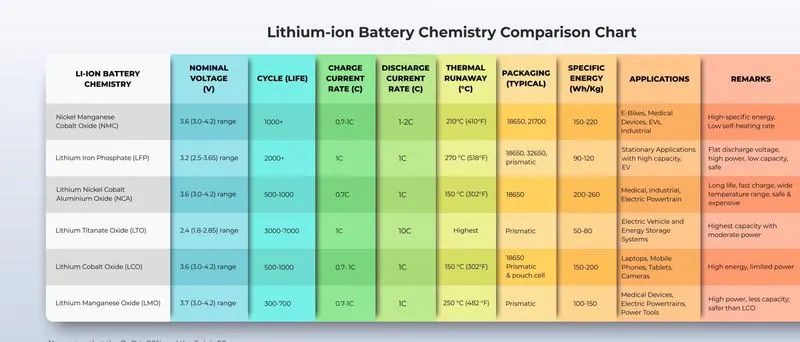
A combined view of all Li Ion Chemistries and their characteristics can be seen below :
.